Friday, 19 August 2011

Final preparations for Germany's royal wedding of the year

Very soon Germany will host a royal wedding that might be modest in comparison to the wedding of the Duke and the Duchess of Cambridge on 29th April, but when HIH Prince Georg Friedrich of Prussia and HSH Princess Sophie of Isenburg marry in Potsdam on 27th August, several hundred journalists will cover the ceremony and an interested German public will follow the events in Brandenburg very closely.

To satisfy the great interest, the public broadcasting system of Berlin and Brandenburg – RBB – Radio Berlin-Brandenburg – will broadcast live from 11 am to 2 pm. RBB will also show a 40-minutes summary at 8.15 pm on the same day. Viewers all over Germany – and in effect in great parts of Europe - can follow the event via television (either cable or satellite). However, RBB will not be offering live streaming.

For everybody outside Germany who would like to watch the „German wedding of the Year“ (Die Welt) on the internet, there is a chance from 9 pm onwards on 27th August. RBB will offer the evening summary for viewing here for a couple of days.


In July Prince Georg Georg Friedrich and his fiancée, Princess Sophie, attended the wedding in Monaco together.

Prince Georg Friedrich’s father, HRH Prince Louis Ferdinand of Prussia, married in 1975.


The grandfather of Prince Georg Friedrich, HIH Prince Louis Ferdinand of Prussia, married Grand Duchess Kira of Russia in 1938.


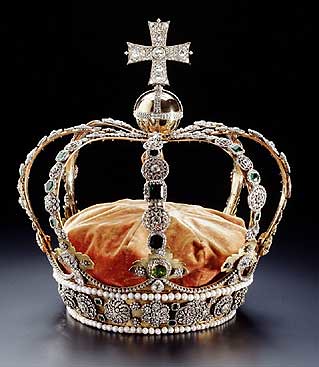
There have not been a lot of great weddings of the German Imperial Family. This underlines the importance on this year's wedding of the head of the Hohenzollern family, it's a once in a generation event. The last great Imperial wedding of the German Empire was in 1913 when Princess Viktoria Luise which was filmed using an early colour system, married Duke Ernst August of Hanover. Together they ascended to the throne of the Duchy of Brunswick.

Thanks to the internet, the RadicalRoyalist should have downloaded RBB's wedding programme by Sunday, 28th August. Anyone in Australia interested in receiving a wedding DVD?

Thursday, 18 August 2011

The Swedish Crown Princess Couple is expecting a child

Their Royal Highnesses The Crown Princess Victoria and Prince Daniel are happy to announce that The Crown Princess is expecting their first child.

The birth is expected to take place in March of 2012. No changes in the schedule of The Crown Princess´s public engagements are planned during the autumn of 2011.

Swedish tabloids immediately jumped into a frenzy over the the news.


"It is with great joy that I have been informed of the news that the Crown Princess and Prince Daniel are expecting a baby. You have a fantastic experience to look forward to and I want to send my warmest congratulations to you both," wrote Prime Minister Fredrik Reinfeldt in a statement.


Crown Princess Victoria and Prince Daniel married on 19th June 2010. Their wedding attracted 500,000 spectators to the streets of Stockholm (according to the TV station RTL: "Selon les premières estimations officieuses, quelque 500.000 curieux seraient descendus dans les rues de Stockholm pour assister aux noces de la future reine de Suède.")

Sunday, 7 August 2011

The late Prince Ali Reza's daughter was born seven months after his death

HIH Prince Ali Reza, second son of the late Shahanshah Mohammed Reza of Iran, committed suicide on 4th January 2011 (see the RadicalRoyalist's obituary).

Darius Kadivar, an exiled Iranian Monarchist blogger, reported two days ago:
It has been officially announced that the late Prince Ali Reza has a daughter named Iryana Leila born on July 26th, 2011 to his relationship with fiancee Raha Didevar.

Prince Ali Reza was formally engaged in 2001 to Sarah Tabatabai, but it seems that the relationship ended some time afterwards.

On the website of HIM Shah Reza II this message was published:
On behalf of my family, I wish to inform our compatriots & friends of the birth of Iryana Leila, daughter of our beloved Alireza, on July 26th, 2011.

We know you will join us, out of respect and love for our dearest
Alireza, and allow the baby and her mother Ms. Raha Didevar to recover & thrive in peace and privacy.

We continue to be touched and grateful for your love and heartfelt sympathies that have been extended to us, unconditionally, since our loss.

Tuesday, 2 August 2011

Is this the result of the "Egyptian Spring"?

On a Royalist forum this sentence was posted yesterday:

«Bonjour, je viens d'apprendre que l'impératrice Farah Pahlavi à l'occasion de la date d'anniversaire du décès de son époux le défunt Shah Mohammed Reza Pahlavi a été interdite de séjour en Egypte par les autorités égyptiennes.»

«I have just learned that the Empress Farah Pahlavi was forbidden by the new Egyptian authorities from visiting the country on the occasion of the anniversary of her husband's, the late Shah Mohammed Reza Pahlavi, death.»

Should this be true it indicates that the Arab spring, that led to the toppling of the longtime dictator Husni Mubarak, is heading in the wrong direction. Should such a step please the Muslim brothers who always opposed His Imperial Majesty - and all Monarchies in the region? Or should it give a signal to Iran that Egypt was trying to appease the Mullah regime?

The Shahanshah’s tomb in Cairo’s Al Rifa’i Mosque.

In any case, not allowing Her Imperial Majesty to pay homage to her late husband's tomb should be seen as an inhumane and dishonest act. And it would certainly not give a reassuring sign to the Western world.


Shah Mohammad Reza Pahlavi died on 27th July 1980. His last words: “I wait upon Fate, never ceasing to pray for Iran, and for my people. I think only of their suffering.” In Cairo, a grand funeral honoured him. Three million Egyptians followed the procession.

Sunday, 31 July 2011

Württemberg's 'secret King' 75

This 1st August Duke Carl, Württemberg’s „secret king“, celebrates his 75th birthday. He is a most respected person and keeps in close contact with the government and the elected representatives of the country and with the premiers/governors/heads of government (Ministerpräsidenten) of Baden-Württemberg, as the former Kingdom and state of Württemberg was amalgamated with Baden and Hohenzollern (the origin of Germany’s Imperial Family) in 1952.


Duke Carl is the fifth of six children of Duke Philipp (II.) Albrecht of Württemberg (né Stuttgart 14th November 1893 - + Ravensburg 15th April 1975) and his second wife, Duchess Rosa of Württemberg, née Arch Duchess of Austria-Toskana (née Parsch/Salzburg 22nd September 1906 - + Friedrichshafen 17th September 1983). After studying law in Tübingen, Duke Carl took up a leading position in the administration (Hofkammer) of the assets of the Royal House of Württemberg. After his father’s death he assumed the position as head of the family and moved to Altshausen, where the royal family has resided since 1919.

The Castle of Altshausen near Lake Constance.

Sometimes he refers to himself as the country’s “most feared donation collector”. He is patron of 27 charity organisations, among others of Herzenssache, a charity organisation to support children in need. His old alma mater of the Tübingen University (founded in 1477 by his ancestor Duke Eberhard I.) made him an honorary senator, the Catholic diocese of Rottenburg honoured him with the Max-Müller-Medal for his work as 1st Chairman of the Catholic School Association. He also received the Große Verdienstkreuz (Order of Merit of the Federal Republic of Germany). In 1991 Duke Carl founded the Ludwig-Uhland-Preis, a literature prize. The prize is awarded to those who have contributed to the understanding of the literature of Württemberg.


On 21st July 1960, he married Princess Diane of France (born in Petrópolis, Brazil, 24th March 1940), the daughter of Henri Comte de Paris (1908–1999, claimant to the French throne and Chef de la Famille de France), his wife, Princess Isabelle of Orléans-Braganza (1911–2003). They have four sons and two daughters, plus numerous grandchildren.


When in 1918 revolutionaries forced the German Monarchs to leave their thrones, King Wilhelm II of Württemberg was the last to abdicate. On 30th November 1918 he sent his Scheidegruß (Farewell Greetings) to the people of Württemberg. With his death in 1921 the protestant branch of the Royal House of Württemberg died out in the male line.


People in the state's capital Stuttgart resisting the destruction of their main railway station used images of King Wilhelm II of Württemberg to show their anger.


Duke Carl's grandfather, Duke Albrecht of Württemberg (né Wien 23rd Dec. 1865 - + Altshausen 29th Oct. 1939), was heir presumptive during the time of the Monarchy and became head of the Württemberg Royal Family and de jure King of Württemberg. He belonged to a junior branch that had converted to Catholicism.


Duke Carl of Württemberg has never made a secret of the fact that he is in favour of a Constitutional Monarchy and has said so in several interviews, like this one with the Südwestdeutscher Rundfunk (SWR) in 2006:


From the Southern hemisphere go the heartiest birthday greetings to the "secret King" of Württemberg. Long May he live!


Tuesday, 26 July 2011

His Majesty King Harald V of Norway addressing the nation in the wake of the tragic events in Oslo and on Utøya island


25th July 2011

Norway has been struck by a national tragedy. The kind of calamity that we hoped would never happen here has somehow taken place.

At Sundvolden today we met young people and their families who shared with us their gruesome stories. They have lived through a day that is beyond all comprehension. Our thoughts and deepest sympathy go out to all of those afflicted by the events in Oslo and on Utøya.

The police, rescue workers, health personnel and volunteers have worked tirelessly and heroically to save lives, in some cases at risk to their own. All of us are affected by the catastrophe that has swept over us, and we watch in disbelief as the death toll continues to rise.

In the midst of all the anguish and chaos, the Prime Minister, the Government and the ministries have responded to the situation with exceptional fortitude and resolve.

Both as individuals and as a nation it will take us a long time to digest and work our way through what we have witnessed, our grief and our feelings. We will need each other in this process. Throughout the length and breadth of our country, there are people who have lost someone they loved. Many of our children and young people are afraid today. We must make every effort to reassure them. Many will want to be together, while others will need space for quiet reflection. It is comforting that the country’s churches are open for anyone who wishes to light a candle and seeks a place to be. It is also helpful that the local authorities and volunteer organisations are providing arenas for those who feel a need to be with others.

There is still much we do not know about the background for yesterday’s atrocities, and it is essential that we let the responsible authorities continue their work to bring clarity to the situation. Some things we do know, however: the acts in Oslo and on Utøya are an attack on the Norwegian society that we hold so dear. And they represent an assault upon the very heart of Norwegian democracy.

It is when our nation is put to the test that the true strength, solidarity and courage of the Norwegian people come to the fore. We stand united behind our values.

I firmly believe that freedom is stronger than fear.

I firmly believe in an open Norwegian democracy and society.

I firmly believe that we will uphold our ability to live freely and securely in our own country.

Sunday, 10 July 2011

News of the World

Rupert Murdoch’s media empire may be stirred, but is not shaken – yet. Last week’s events in the UK has implications on three continents, where his tentacles have got hold of the media.

Peter Oborne, Chief Political Commentator of The Daily Telegraph, wrote a scathing analysis on Mr. Murdoch’s influence on Britsh politicans Phone hacking: David Cameron is not out of the sewer yet

"For more than three decades the most powerful man in Britain has not been a politician; it has been the brilliant but ruthless US-based media tycoon Rupert Murdoch, who burst on to the scene with the purchase of the News of the World in an audacious takeover bid in 1968. Within barely a decade he had built up a controlling interest in British newspapers.

"But he did not just control our media. He dominated British public life. Politicians – including prime ministers – treated him with deference and fear. Time and again the
Murdoch press – using techniques of which we have only just become aware – destroyed political careers. Murdoch also claims to determine the results of general elections.

"Rupert Murdoch’s empire has been a spider at the heart of an intricate web that has poisoned British public life.

"Murdoch used his power to immense effect, undermining and attacking our greatest public institutions – above all the monarchy and the judiciary. His employees believed they were above the law and could act with impunity".

Wednesday, 6 July 2011

Media watch
Québec, les Québecois and the Canadian Monarchy


Before the Duke and the Duchess of Cambridge arrived in the Dominion of Canada, the media hoped for trouble in the province of Québec by a republican protest wave.

They grounded their hopes on a well-known quack: Amir Khadir, a Québec Solidaire member of the province’s National Assembly had called the newlywed royal couple “parasites.” Mr. Khadir is known as an outspoken politician, whose remarks have put him in the spotlight before.

Québec’s Minister of Foreign Relations and Minister of La Francophonie, Monique Gagnon-Tremblay, welcomed their visit, which is already garnering the attention of dozens of international journalists seeking accreditation for the tour. She said the province would cover part of the cost of their tour, although she didn’t specify the exact amount. She called the visit a chance to put the belle province on display.

That incensed Mr. Khadir even more, who compared the parading of the royal couple to a “circus” meant to attract tourist.
The Globe and Mail, 31st May 2011

The visit to Montréal on 2nd July and Québec City on 3rd July went ahead and was a huge success.


The worst reported incident arising during the visit of Prince William and Kate on the weekend was a small group of Québec anti-monarchists, numbering between 30 and 100, unfurling a banner calling them royal parasites.

The protesters were overshadowed by scenes of unbridled enthusiasm for the Duke and Duchess of Cambridge. In Québec City, the heartland of Québec nationalism, William delivered a speech "tout en francais" that was deemed passable, with an improved accent. The attractive young couple went up to the barricades to shake hands and talk to star-struck Québecers who voiced their approval.
Calgary Herald, 5th July 2011

The Duke and Duchess of Cambridge kept calm and carried on as they were met by small but loud groups of Québec sovereigntists expressing their disdain for the Crown over the weekend.

Nearly 100 members of the British media are in Canada to cover the royal couple's first official international visit.

They are part of the almost 1,400 journalists accredited to cover the royal visit.
The Canadian Press, 3rd July 2011

It must be exhausting to continually fight the battle of the Plains of Abraham more than 250 years after its formal conclusion, and utterly demoralizing to keep losing it.

The relative handful of demonstrators who tried to disrupt the Montréal and Québec City segments of the royal tour only succeeded in demonstrating that their anti-monarchist sentiments are even less relevant than the monarchy.

The cost of accommodating Prince William and his wife, Kate, is a pittance compared to the international attention a royal tour commands. Travel industry marketers would kill to get that kind of bang for their buck. So the “parasites” argument doesn’t wash, especially coming from fringe characters in North America’s most notorious welfare state.

Then there’s the character of the royals themselves. I had the privilege of meeting William’s father, Prince Charles, and Charles’ wife, Camilla, during their visit to Montréal in 2009, and their easy-going nature, impeccable manners and good humour under constant scrutiny left an unforgettable impression. These are people who are drilled from early childhood in the art of social politesse, and they embrace their position and responsibilities with unfailing grace, which is more than can be said for self-centered athletes, actors, rock stars and famous-for-being-famous celebrities who behave like petulant children when they feel their ”space” is being invaded. (I’ll never forget a story from a friend of a friend who, as a teenager, was waiting outside the Forum to get a famous visiting hockey player’s autograph, and when the team bus showed up, the player brushed past his biggest fan and growled, “F*** off, kid, I haven’t even had breakfast yet.
Montréal Gazette, 5th July 2011

Anti-monarchist protesters failed to disrupt the visit of Britain's Prince William and his wife Kate to Québec, which was the most politically sensitive portion of their Canadian royal tour.

A group estimated by local reporters at about 200 people used loudspeakers on Sunday to decry the royal family and call for sovereignty for the French-speaking province, but they were kept far away from the couple in Québec City.
Reuters, 4th July 2011

Gary Sims, a staunch monarchist and amateur historian, said the protesters don’t know their history. “If it wasn’t for the British influence in North America, there would be no French at all,” he said, noting that, had the Americans and not the British triumphed in the War of 1812, French-speakers would likely have been assimilated and Quebec as we know it would not exist.
The Globe and Mail, 3rd July 2011

Sunday morning, Montréal very nationalist daily newspaper Le Journal de Montréal, posted 80% of all its pages reserved to the royal couple (the Montréal visit) in a very positive mode, with nice pictures and details. 20% was reserved for the protests, insisting these people are a minority. This morning, Montréal federalist daily newspaper La Presse report explains how Québecers appreciate the visit in Québec city, with minor references to the protests. Now look at english media outside of Québec and their pathetic focus on how these Québec separatists hate the royal couple. The focus to find and interview some Québeckers who dislike the monarchy, etc.... Let me be clear: their is no enthusiasm for the royal family in Québec, and there will never be. But the immense majority of people are polite and have nothing against Kate and William. We are simply nor indifferent or nor charmed by this couple. So now read english national media, and you will see that the coverage of the royal visit in Québec has by far focus on these bad people. English media were so happy to see some Québeckers booing them. These media needs daily doses of Québec bashing to keep alive a part of their audience.
Denis_Montreal, 4th July 2011

Monday, 4 July 2011

Otto +
* 20th November 1912 - + 4th July 2011

His Imperial and Apostolic Majesty Otto, Emperor of Austria, Apostolic King of Hungary, King of Bohemia, passed to his eternal reward this morning at his exile home, Villa Austria, in Pöcking, Germany, after a virtual reign of 89 years, three months and four days.


The mortal remains of the All Highest will rest for three days in the parish church of St. Ulrich in Pöcking. There will be requiem masses in Munich, Mariazell, and Budapest. His funeral mass will take place in St. Stephen's Cathedral in Vienna on July 16, after which his mortal remains and those of the Empress Regina will be laid to rest in the Capuchin Crypt in Vienna.

After a requiem in Budapest his heart will be buried on Sunday, 17th July in the Benedictine Abbey of Pannonhalma .

See the obituary in The Daily Telegraph.

Saturday, 25 June 2011

An unabashed Monarchist leaves the Senate

The Sydney Morning Herald paid tribute to Senator Nick Minchin Exit Minchin, unabashed monarchist to the end . One of Australia's staunchest Monarchists has drawn the curtain on an 18-year career and will leave the Australian Senate on 30th June.

Two Monarchists: Senator Nick Minchin (l.) and Senator Bernardi, both from South Australia.

Today it is The Age that gives Nick Minchin some space on his final days as a politician:
"The most notable Liberal departures are senators Nick Minchin and Judith Troeth, from opposite ideological ends of their party.

"
Minchin, a former Senate leader, has been a warrior on the right, playing a crucial role in resisting Malcolm Turnbull's embrace of Kevin Rudd's emissions trading scheme and in the elevation of Tony Abbott. Despite being a senior Howard minister, Minchin has always been his own man, sometimes promoting lost causes (non-compulsory voting), at other times telling unpleasant truths (unsuccessfully advising John Howard to retire). Minchin was Australia's longest-serving finance minister (six years) but in a gracious valedictory speech this week ceded the title of best finance minister to Labor's Peter Walsh.

"
Minchin also told Parliament that 'nothing in my long career in campaigning has given me greater pleasure than the comprehensive rejection of that republican model' in the 1999 referendum, and promised to remain active in advocating the virtues of the current system."

Retiring Senator Nick Minchin was the winner
Equally today the same newspaper reports on the re-election of Alan Stockdale as president of the Liberal Party. He had been challenged by Peter Reith, “a controversial former Howard government minister who made headlines in the maritime dispute and the 2001 ‘children overboard’ scandal” – and a republican. Senator Nick Minchin the Monarchist had his last battle to prevent a republican becoming president of the Liberal Party. And today he can claim victory, again.

Sunday, 19 June 2011

"Why I am a monarchist"

David V, an Australian Monarchist and a student with interests in history, politics and Royalty, gives a well written statement in favour of the Australian Monarchy:
Why I am a monarchist (and why monarchies will remain)

Monday, 13 June 2011

La grande tragedia d'Italia - Umberto II

The Radical Royalist commemorated King Umberto’s accession to the Italian throne on 9th May 1946 here .

Fellow blogger Matterhorn has already paid tribute to His Majesty King Umberto II of Italy who was forced to go into exile 65 years ago. Matterhorn published the King’s noble last message he addressed to the Italian people upon departing into exile. This is the last passage:
With a spirit full of sorrow, but with the serene consciousness of having made every effort to carry out my duties, I leave my country. Let those who have taken the oath and kept faith through the hardest trials, consider themselves released from their oath of allegiance to the King, but not from their oath of allegiance to the Country. I think of all those who have fallen in the name of Italy, and I salute all the Italians. Whatever destiny awaits our Country, she will always be able to count on me, as on the most devoted of her sons.

Long live Italy!

13th June 1946

On 13th June 1946 the King left the Quirinale Palace, the only official building in Rome which was still flying the royal standard. The Royal Guard saluted their King for the last time.
Il re Umberto II si appresta a lasciare per sempre il Quirinale, e qui lo vediamo nel Cortile d’Onore del palazzo con il duca Riario Sforza, comandante dei corazzieri, mentre passa in rassegna il picchetto che rende omaggio all’ultimo dei Savoia. Sono attimi di profonda commozione, per tutti e in mode particolare per Umberto chi si trova nel ruolo di protagonist del tramonto di una dinastia.

“Guardia del re, salute al re!”, dice Riario Sforza ai suoi uomini.

“Viva il re!”, gridano per l’ultima volta i corazzieri. E viene ammainata la bandiera con lo stemma sabaudo.
King Umberto did not want a throne covered with blood: Non voglio un trono macchiato di sangue."

At four o'clock in the afternoon King Umberto reached Ciampino Airport, greeted by his most fervent supporters, he is guided to the military plane, Savoia Marchetti S 95, that would take him from Rome into the Portuguese exile. He never abdicated - neither for himself nor for his descendants.
Sono le quattro del pomeriggio del 13 giugno 1946. Umberto II ha raggiunto l'aeroporto di Ciampino e, salutato dagli fedelissime, si avvia a passo spedito verso l'aereo militare, un Savoia Marchetti S 95, che lo porterà da Roma nell'esilio portoghese. ... senza tuttavia rinunciare ai suoi diritti sul trono e quelli dei suoi discendenti.
From the aeroplane's door the King greeted the Italians for the last time on Italian soil.
Dal portellone dell'aereo Umberto rivolge un ultimo saluto ai pochi che, informati all'ultimo momento della sua partenza, lo hanno accompagnato. Un ultimo, mesto, forzato sorriso. Un ultimo sguardo a quell'Italia su cui ha regnato per un solo mese e che non rivedrà più. Anche il cielo sembra intristire, in quel giorno di tarda primavera.
In 1962 King Umberto attended the wedding of Prince Juan Carlos of Spain and Princess Sophia of Greece and Denmark. On the right is the father of the bride, King Paul I of Greece.
Il re Paolo di Grecia presenta ai dignitari di Corte le re Umberto II.
His private study in his exile home, Villa Italia, near the Atlantic Ocean in Cascais, Portugal.
Il re Umberto nel suo studio privato di Villa Italia, la piccola reggia del lungo esilio a Cascais. "Cala la notte e prima di spegnere la luce e riposare ho la visione della piazza del Quirinale, di Roma, della città che non si può non amare. L'Italia è sempre nel mio cuore".
The King's library in 1970. Although he received a military education, Umberto always loved books and was interested in the arts.
Umberto nella sua grande biblioteca di Villa Italia. Dopo aver recevuto una rigida educazione militare, era stato considerato dai più come un uomo dai limitati interessi culturali. Al contrario il re Umberto era un raffinato umanista, un profondo conoscitore di storia, di letteratura e d'arte.
In 1982 Pope John Paul II visited Portugal. On 14th April 1982 the pontif and the king met in the residence of the Patriarch of Lisbon. At this stage King Umberto was already seriously sick and suffered from lung cancer.

He died on 18th March 1983 in Geneva, Switzerland. His body was not allowed to repatriated to Italy and was interred in Hautecombe Abbey in France.
Un affettuoso abbraccio, spontane e informale, tra Papa Giovanni Paolo II e il re Umberto II: è il 14 prile del 1982, il Papa si è recato in pellegrinaggio al santuario di Nostra Signora di Fatima, in Portogallo, e nella residenzia del cardinale di Lisbona ha concesso un'udienza privata alla re d'Italia. Umberto si è inginocchiato di fronte a lui, ma il Pontefice lo ha fatto subito rialzare e ha voluto abbracciarlo. Il sovrano sa di essere molto malato, che gli resta poco da vivere, e di certo in quel lungo colloquio ne parla con Papa Giovanni Paolo.

While King Umberto was totally ignored by the Italian officials, the Portuguese kept an affectionate memory of the Monarch they hosted for 37 years.

In 1987 a bust of the Italian King was unveiled in Cascais, in front of the Villa Italia, where he spent three and a half decades. The ceremony in the newly named Avenida Rei Humberto II de Itália was attended not only by King Umberto's only son, Prince Vittorio Emanuele, but also by the Portuguese President Mário Soares. Also present were Queen Marie José of Italy, King Umberto's widow, Queen Joana of the Bulgarians, the deceased King's sister, and Portugal's King-in-waiting, Dom Duarte Pio, Duke of Bragança.

Boringly republican Age


In today’s Queen’s Birthday holiday editorial The Age has written, what everybody – Monarchists or republicans alike – expected from this Melbourne daily newspaper. The author made clear that the newspaper is unwavering favouring “a” republic and despises our Monarchy. The Age did, what in an opinion piece on 27th January 2010 The Age’s associate editor, Shawn Carney, called a “hardy annual”:

The republican question is now what used to be called in the newspaper game a 'hardy annual': a predictable, intrinsically inconsequential story that can be trotted out at the same time every year to little lasting effect.

But what about a journalistic duty to report on the actual events? Would it not have been The Age’s duty as a quality newspaper, to publish something that is connected with this Queen’s Birthday holiday? What about a photo and a little article on the Royal Military College of Duntroon’s celebrating The Queen's Birthday with a traditional Trooping the Colour parade last Saturday? Or alternatively a photo from the Trooping the Colour event in London, also on Saturday? The Age may be a fiercely republican newspaper, but seems to forget that more than half of the Victorians voted in favour of retaining the Monarchy in the 1999 referendum. Would it not be a newspaper’s duty to publish something on what at least 50 percent of The Age’s readers love?

Swiss author Max Frisch once said: “You don’t have to lie – concealing is enough.” He was cynically referring to politicians, not to journalists, but a subscriber of The Age could get the impression that the newspaper’s political agenda is to conceal everything concerning the Monarchy that could be styled as "nice news". They conceal from their readers what does not fit into their conception of Zeitgeist.

Sunday, 12 June 2011

For Queen's Birthday: Australian Trooping the Colour, Canberra 2011

Cadets and officers from the Royal Military College of Duntroon celebrated The Queen's Birthday with a traditional Trooping the Colour parade.

Saturday, 11 June 2011

Another birthday on 10th June:
Prince Georg Friedrich of Prussia


While the Commonwealth countries celebrate the 90th birthday of Prince Philip, The Duke of Edinburgh, in Germany Prince Georg Friedrich of Prussia can celebrate his 35th birthday.


Prince Georg Friedrich succeeded his grandfather, Prince Louis Ferdinand of Prussia, as Head of the House of Hohenzollern on 25th September 1994. He is son of Prince Louis Ferdinand of Prussia Jr (1944–1977) and Princess Donata of Prussia, née Countess of Castell-Rüdenhausen. Prince Georg Friedrich is great-great-grandson of Kaiser Wilhelm II.

On 21st January 2011, Prince Georg Friedrich announced his engagement to Princess Sophie Johanna Maria of Isenburg (born 7th March 1978), daughter of Prince (Fürst) Franz-Alexander of Isenburg (from the Catholic branch of Isenburg-Büdingen-Birstein) by his wife, Princess (Fürstin) Christine, neé Countess of Saurma and Baroness von und zu der Jeltsch. The wedding is scheduled to take place at the Church of Peace (Sanssouci) in Potsdam on 27th August 2011.

Throughout 2011 all over Germany there will be celebrations and exhibitions on the 950th anniversary of the House of Hohenzollern.

Prince Georg Friedrich is also in the line of succession to the British throne. At present he is holding position 179 according to the William Reitwiesner's list.

Friday, 10 June 2011

90th birthday of HRH Prince Philip, The Duke of Edinburgh

On his 90th birthday His Royal Highness Prince Philip receives a lot of praise for his role as the longest-serving royal consort. Even The Age could not help publishing an article that was not full of the usual nastiness, but gave a fair summary of his life. Many other papers and blogs refer to his achievements - and his very down to earth humor, for which is is equally loved or despised.


The Radical Royalist wants to point out his Australian connection. A very useful reminder of Prince Philip's role in Australia is Philip W. Pike's book The Royal Presence in Australia 1867 - 1986 from which the following excerpt is taken:

There has always been some confusion over the Duke of Edinburgh and his title. Sometimes he is referred to as Prince Philip and sometimes as the Duke of Edinburgh. The fact is, both titles are correct, but it wasn’t until 1957 when the Duke was still only a royal duke and not a prince that the Queen gave him a new title for his services to the Commonwealth and herself – he became Prince of the United Kingdom. He had shown that he had always been “his own man” and had avoided any inference that he was a Prince Consort living in his wife’s shadow.

Australia had always seen him as an individual. When he returned on 20th February 1965 he had already visited this country four times, twice with the Queen and twice alone. Now he was here on a brief visit to New South Wales and the Australian Capital Territory.

The Duke, who had not always endeared himself to journalists over the years, held an informal meeting with the Australian press. He was, on occasions very outspoken and had several years before lashed out at the press after they had reported “rifts” between himself and the Queen. Elizabeth Longford in her book Elizabeth R records his response: “Those bloody lies that you people print to make money. These lies about how I’m never with my wife ... If photographers poke a long lens through a keyhole into my private life, then I’m bloody nasty” – it seems a perfectly normal reaction from someone living life in a goldfish bowl.

It was outbursts like this that didn’t endear him to the press.

His most important engagement in Sydney was to deliver the first Dunrossil Memorial Lecture established by the Institute of Radio and Electronics Engineers in memory of its former patron, Viscount Dunrossil. Viscount Dunrossil was Governor-General of Australia from 2nd February 1960 to 3rd February 1961. He died suddenly in Canberra on 3 February 1961. He was buried in Canberra at historic St John the Baptist Church, Reid, and remains the only Australian Governor-General to die in office

There were four hundred people assembled in the lecture theatre [of the University of New South Wales] and the presentation was telecast and broadcast throughout Australia and conveyed by Compac cable to the United Kingdom and other Commonwealth countries.
His lecture was extremely successful. Its main theme was a plea to see science and humanism linked:
We can control everything in this world except ourselves,” the Duke said.

“... it is true without this persistent investigation we wouldn’t know half the disturbing facts about our occupation of earth, but it seems to me that unless we make a very determined effort to sort out the problems created by man in his occupation of this earth it is very unlikely that further scientific exploration will be either necessary or possible.

“You may think I am getting slightly off beam, but I went off on that tack because I want to suggest that scientific and technological progress is not only valueless, it is actively harmful unless it is modified or directed by a social and humanitarian outlook.

“Scientists and engineers must give attention to really serious problems facing humanity.

“Although the scientific and technological revolution is by far the greatest influence upon the progress of modern human civilisation, scientists and technologists cannot should the whole responsibility for the direction mankind takes in the future.”
The message was quite clear and is even more relevant today. The editorial of the Sydney Morning Herald, commenting on the lecture, added that it “cannot be said too often, and it is no small gain that it should be impressed upon the Australian scientific community with such authority”.

The Duke’s performance was masterly with the matter and manner of his lecture. It was also a testimony to his lively understanding of modern problems and his effective way of communicating his thoughts about them."

The Duke left Sydney by Qantas Airways at 4 p.m. on Friday 26th February. The departure was even more informal than his arrival.

The offical portrait of Her Majesty Queen Elizabeth II, Queen of Austrailia, and His Royal Highness Prince Philip, The Duke of Edinburgh, available free of charge from every Member of Parliament. Ask your MP for your copy!

Wednesday, 8 June 2011

You have to love the revolution unconditionally, otherwise ...

Georges Clemenceau (1841-1929) was hardly a likable politician. A fierce Jacobin to his bone he denounced his opponents without mercy. After he had banned a theatre play by Victorien Sardou at the Comédie-Française in 1891, which he deemed «pro-monarchist», he defended his action by stating his conviction that the French revolution must be accepted as a block. He had accused the play’s author to be selective on the French revolution – some aspects he liked, by others he was appalled. Clemenceau proclaimed in the French Assembly:
«Messieurs, que nous le voulions ou non, que cela nous plaise ou que cela nous choque, la Révolution française est un bloc... un bloc dont on ne peut rien distraire, parce que la vérité historique ne le permet pas.

«Gentlemen, if we want it or not, if we like it or not, the French revolution is a block … a block from which nothing can be distracted, because the historical truth doesn’t allow it.
»
He explicitly included as indispensable for the revolution the time of the terror regime (La Patrie en danger et la «première» Terreur & La Grande Terreur {juin-juillet 1794}) and the genocide in the Vendée, where ethnic cleansing wiped out whole villages, because the republican troops suspected the peasants to be royalist and catholic to the core, who could not be converted to republicanism.

Once good for the revolution, always good for the revolution
For present day Jacobins the French revolution is still a sacred cow that should not be touched.

La Tour du Temple.

One recent example concerns a ten year old child that died in the infamous republican prison Le Temple. In June 2005 the council of the City of Paris expressed the wish that a place or a street should be named in the French capital after the child that died on 8th June 1795. This motion was opposed by Jean-Pierre Caffet, socialist deputy-mayor of Paris and responsible for urban development. He gave three reasons for his negative attitude – mainly because the child in matter was King Louis XVII. And obviously he was King not just for the Royalists and historians, but for the Jacobins as well. Jean-Pierre Caffet:
- «The revolution is a «block» and by retreating from this or that episode under the terror, then the whole foundation of the revolution and therefore that of the republic would be put in doubt.

- «Since two centuries the City of Paris has re-baptized places that were once named after
Louis XV and Louis XVI – and not the other way round.

- «Naming a street is an honour for a person who has rendered imminent services to the City of Paris, which is not the case with
Louis XVII.»
Critics ask, why the City was quick to name a square in the 4th arrondissement after Marie Trintignant, an actress murdered by her lover. Or what significance Mohamed Bouazizi could have for Paris, whose name will be given to a place in the 14th arrondissement to «salute the heroism of this young man».

«Enfant roi Enfant martyr» (Child King, Martered Child), Sculpture by Catherine Cairn.

This child will not be forgotten
The boy king’s death will be commemorated today in Paris. The association «Marais-Temple» has invited everyone to join them outside the town hall of the 3rd arrondissement this 8th June 2011 Les Manants du Roi:

«This young child was captured by the political events for which he bared no responsibility and remained primarily a victim. His ordeals did not leave the Parisians untouched.

«More than two hundred years after this tragic episode of the French revolution, Paris must act to commemorate this little boy who was only convicted because of his birth.»

This year Marais-Temple will remember those people who risked their life to support the Royal Family in their audacious prison. The plaque on a town hall wall dedicated to the Royal Family, was put there on the bicentenary of the revolution by the City of Paris. After the commemoration ceremony a requiem mass for Louis XVII and all abused children will be celebrated in the St. Elisabeth church.


Life is never only black or white - that is unless you are a republican revolutionary who has no option to differentiate.

Tuesday, 7 June 2011

Huis Doorn: German Monarchists commemorate the Kaiser

On the 70th anniversary of Kaiser Wilhelm II's death German Monarchists visited Huis Doorn outside Doorn, a small town near Utrecht in the Kingdom of the Netherlands. He passed away on 4th June 1941 and was buried in a mausoleum in the gardens as he had stated in his testament that he wished to be buried in Germany only when the Monarchy was restored. That has not happened in the past 70 years, therefore the Kaiser's remains still rest in the country that granted him asylum in 1918.

Tobias
, a friend of the Radical Royalist and fellow Monarchist, took these photos on 4th June 2011 and gave permission to publish them.

The entrance gate to Huis Doorn's compound.

Huis Doorn, a classic 14th century manor house.

Huis Doorn, a classic 14th century manor house.

The Kaiser's bust in front of Huis Doorn

The Kaiser's mausoleum.

The Kaiser's mausoleum.

German Monarchists at the Kaiser's mausoleum.

Sunday, 5 June 2011

From Canberra to Dublin: The Queen's favourite brooch

On her visit to Ireland the Queen wore her favourite jewellery, a brooch, which the Australian people gave her as a gift on her first visit to Australia in 1954.

Queen Elizabeth II during a visit to Croke Park on 18th May 2011 in Dublin, Ireland. An unprecedented security operation is taking place with much of the centre of Dublin turning into a car free zone. Republican dissident groups have made it clear they are intent on disrupting proceedings. (Photo by Irish Government)

On a couple of occasions The Official Commemorative Volume of the Royal Visit to the Commonwealth of Australia, 1954, published by Angus and Robertson Ltd., Sydney, printed in Australia, refers to the brooch:

"Before the banquet [in Canberra on 16th February 1954] ended, Mr. Menzies presented Her Majesty with a gift from Australia - a diamond brooch in the shape of a spray of wattle and tea-tree."

"A tribute to their Queen from the people of Australia was this diamond brooch outlining sprays of wattle and tea-tree, blooms symbolic of Australia. (Photo actual size.)"

The Queen wore the brooch on Saturday, 27th February for the Melbourne Cup at Flemington racecourse. "Her Majesty and the Duke made a 'Royal Ascot' entrance to the course, driving up the famous 'Straight Six'. They were escorted to the Royal box by the chairman of the Victoria Racing Club, Sir Chester Manifold."

It is remarkable that 57 years later the Queen keeps the gift of the Australian people in such high esteem that she wore it in Ireland on a visit that was of such immense historic importance and that was so hotly disputed by a tiny number of Irish republicans.

Saturday, 4 June 2011

70 years today since Kaiser Wilhelm II passed away

This 4th June German Monarchists will gather in Huis Doorn (Doorn Manor, photos see here), a classic 14th century manor house outside Doorn, a small town near Utrecht in the Kingdom of the Netherlands, to commemorate Kaiser Wilhelm II. He died at Huis Doorn on 4th June 1941 and was buried in a small mausoleum in the gardens, awaiting his return to Germany upon the restoration of the German monarchy, according to the terms of his will; his wish that no swastikas be displayed at his funeral was not heeded. He did however refuse to have a grand funeral in Berlin which considerably frustrated Hitler who had wanted to walk behind Kaiser Wilhelm's coffin as a propaganda show.

Kaiser Wilhelm and his eldest grandsons, Prince Wilhelm (1905-1940) and Prince Louis Ferdinand (1907-1994), grandfather of the present head of the Hohenzollern Family.

Baroness Ella van Heemstra (1900 1984), the mother of actress Audrey Hepburn, spent most of her childhood living in the house. The house was purchased in 1919 by Kaiser Wilhelm II as his residence-in-exile. The Emperor had the house adapted and fitted with all modern conveniences. He also makes some changes to the park (35 hectares), laid out in the English landscape garden style.

Kaiser Wilhelm and the Dutch Crown Princess Juliana, mother of the present Queen Beatrix of the Netherlands.

The Dutch government confiscated the manor house and its household effects in 1945 as German property and transformed it into a museum that is visited by approximately 50,000 people a year.

Kaiser Wilhelm II and sons

The life of Kaiser Wilhelm II is well-documented and shall not be repeated in this posting. For further information on Germany's last ruling Emperor see The Altar and Throne Monarchy Site and The Mad Monarchist in English or Paukenschlag in German.

When German Monarchists gather in Doorn on His Majesty’s 70th death anniversary, they might do so with nostalgia, but they are also looking forward to this year’s big event: On 27th August the head of the House of Hohenzollern, Prince Georg Friedrich of Prussia, will get married to Princess Sophie of Isenburg und Büdingen. Prince Georg Friedrich’s father married in 1976 and was killed one year later in a training accident whilst serving in the Bundeswehr.


Germany’s Imperial Family suffered many setbacks and tragedies, but they are still there – a living reminder of the possibilities of having a crowned democracy.


Prince Georg Friedrich: great-great-grandson of Kaiser Wilhelm II.