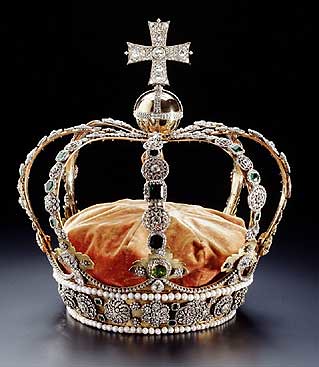
Showing posts with label coronation. Show all posts

Sunday, 2 June 2013

The Queen's 60th Coronation anniversary


The 1953 Coronation provided the Queen with a formal initiation rite and an investiture with her official regalia.

Australia's magnifiscent Queen's Birthday stamp 2013
Queen Elizabeth was the 39th sovereign to be crowned at Westminster Abbey; the first was William the Conqueror, whose coronation took place on Christmas Day, 1066.

The 27-year-old Queen swore her oath and was anointed (concealed under a canopy) on her hands, her breast and her head with holy oil of orange flowers, roses, cinnamon, jasmine and sesame with benzoin, musk, civet and ambergris, in imitation of the anointing of the kings of ancient Israel. She put on the Armills (bracelets), the Robe Royal and the Stole Royal. She held the orb and sceptre. Then the crown was placed upon her head.

Everyone shouted “God Save Queen Elizabeth. Long Live Queen Elizabeth. May the Queen live for ever.”

Tuesday, 9 April 2013

Australia Post releases Diamond Jubilee Coronation stamps


Australia Post is celebrating the 60th anniversary of Her Majesty Queen Elizabeth II’s coronation with the release of one domestic base-rate (60c) stamp and one international-rate ($2.60) stamp.

"Australia Post is delighted to recognise the Diamond Jubilee of Her Majesty's coronation with the release of this stamp issue," said Australia Post Philatelic Manager, Michael Zsolt. "We're pleased that this special stamp issue will be a great memento of this wonderful event for collectors and the public."

The coronation of Queen Elizabeth II took place on 2nd June 1953 over twelve months after her accession. The Queen rode from Buckingham Palace to Westminster Abbey in the ornate Gold State Coach.

Prime Ministers and leading citizens of the Commonwealth countries, representatives of foreign states, hundreds of thousands of Britons and over 200,000 tourists from other countries arrived in London for the coronation. (Actually there were approximately three million spectators lining the procession and more than twenty million viewers around the world watched the coverage on television.)

During the coronation ceremony, Queen Elizabeth swore the coronation oath, undertaking to rule according to law, to exercise justice with mercy and to maintain the Church of England. She was then anointed, blessed and consecrated and crowned by the archbishop before trumpets sounded, the Abbey bells pealed, and guns at the Tower of London saluted.

The large-sized 60-cent stamp features the Gold State Coach which has been used for every coronation since that of King George IV in 1821. The photograph is by Tim Graham from Getty Images.

The $2.60 stamp features a photographic portrait of the newly-crowned monarch in 1953 and is a detail from a full formal portrait of the Queen and Prince Philip. The photograph was taken in Buckingham Palace by renowned photographer Cecil Beaton and is featured on the miniature sheet. The image comes from the Victoria and Albert Museum in London.

A special pack is available which features an embellished sheetlet of 10 x 60c double-definitive stamps housed in an attractive folder.

Other associated products include a first day cover, stamp pack, maxicard set of two, sheetlet of five x $2.60 self-adhesive stamps and a stamp and medallion cover.

The stamps and associated products were designed by Jo Mure of the Australia Post Design Studio. Jo's previous stamp issues include the Royal Wedding (2011) and the Queen's Diamond Jubilee (2012).

The Diamond Jubilee Coronation stamp issue is available from 9th April 2013 at participating Australia Post retail outlets, via mail order on 1800 331 794 and online at auspost.com.au/stamps while stocks last.

Wednesday, 16 May 2012

21 Australian cinemas will present ‘A Queen is Crowned’ as part of HM’s Diamond Jubilee Celebrations


A Queen is Crowned’ is the only colour film of Her Majesty, Queen Elizabeth II’s 1953 coronation ceremony, narrated by Sir Laurence Olivier. Upon its original release, the film won a BAFTA, a Golden Globe Award and was nominated for an Oscar at the 26th Annual Academy Awards.

This will be the first time this lavish documentary has been seen in cinemas since its initial release 60 years ago. Rights owners ITV Studios Global Entertainment have carefully restored the film in time for this historic occasion.

CinemaLive’s CEO, Peter Skillman, said of the release: ‘I’m delighted to begin our relationship with Park Circus by bringing this remarkable piece of history to the Australian public, for one very special day leading up to the excitement of the Diamond Jubilee Celebrations."

Nicholas Varley, Park Circus’ Managing Director says: ‘We are pleased to have teamed up with CinemaLive on this project. Park Circus has been at the forefront in making classic films available to worldwide audiences in the digital format. We have always looked for new and innovative ways to get classic films back in theatres and what a wonderful way to celebrate the Diamond Jubilee of Her Majesty The Queen”.

These are the cinemas, where "A Queen is Crowned" will be shown:

New South Wales


Odeon Cinema, Orange

Forum 6 Cinema, Tamworth

Forum 6 Cinema, Wagga Wagga

Hayden Orpheum Picture Palace, Cremorne


Victoria

Palace Cinema, Balwyn

Palace Dendy, Brighton

Wangaratta Cinema, Centre

Deakin Cinema Complex, Mildura


Tasmania

Cmax Cinema, Devonport


Western Australia

Grand Cinemas, Warwick

Grand Cinemas, Bunbury


South Australia

Wallis Cinemas, Mt Barker

Wallis Cinemas, Noarlunga

Wallis Cinemas, Picadilly

Wallis Cinemas, Mitcham

Semaphore Odeon Star, Cinema

Oatmill Cinema, Mt Gambier

Gawler Village Twin Cinema

The Age spoke to Jason Ronald, Victorian president of monarchist group the Royal Over-Seas League, who said the cinema release was a ''great idea'' that reflected increasing interest in the Diamond Jubilee.

''Going to the cinema was the only way to see it in Australia 59 years ago, so they're trying to recreate the atmosphere and I think it's marvellous.''

He is certainly right. See you at the movies!!

Thursday, 9 July 2009

Australian World War II Victoria Cross recipient dies

While the Sydney Morning Herald reported: "
Mr Kenna went to London for the Queen's coronation in 1953 and was presented to her when she visited the newly-restored Hall of Memory at the Australian War Memorial in Canberra in 2000. He appeared on a postage stamp in that year."

... The Age left the Monarchist part of Mr Kenna's biography unmentioned:
"Mr Kenna was born in Hamilton, in Victoria's west, in 1919 and returned there when discharged from service in December 1946.
He worked at the local council and played for the local footy team, was active in army reunions and has led Melbourne's annual Anzac Day march.
Before enlisting in the army in August 1940, he had worked as a plumber in his hometown."

Of course, both Fairfax media failed to mention that he received the Victoria Cross from HRH Prince Henry, The Duke of Gloucester, during his service as Governor-General of Australia in 1947.

This failure of leaving out what was obviously a big part of his life, makes me wonder, once more, just how much we can trust the Australian media to provide the whole story on any topic let alone the state of our Monarchy.

Tuesday, 21 April 2009

Would you believe ...
... that The Age published 19 lines on Her Majesty's birthday today? 19 lines without open nastiness, but in the usual substandard quality when it comes to referring to our Monarchy. It must have cost the editor some effort to give facts - or information (s)he considered to be facts - and not open bias. Well, and of course not quite without its usual sting against the Australian Monarchy, just by not mentioning it in the headline.

ELIZABETH II (1926-)
QUEEN OF THE UNITED KINGDOM
[and Australia, as The Age deliberately failed to mention]
BORN on April 21, 1926, in Mayfair, London, Elizabeth Alexandra Mary was the first child of the Duke and Duchess of York, later King George VI and Queen Elizabeth. The young princess became first in line for the throne in 1936 when her father ascended to become king, following the abdication of King Edward VIII. Elizabeth and Lieutenant Philip Mountbatten announced their engagement early in 1947, and were married in December that year. [It was actually 20th November 1947, but we don't want to be fussy]. Their first child, Charles, was born in 1948, and Elizabeth and Philip had three more children - Anne, Andrew and Edward.

After the death of George VI, Elizabeth was crowned on February 6, 1952.
[The Age did not check the archives, Princess Elizabeth became Queen on her father's death on February 6, but she was crowned 16 months later, on 2nd June 1953.] Elizabeth was crowned Queen of 32 countries, but 16 have subsequently become republics. [The reality was, when she was crowned the Archbishop of Canterbury asked the Queen: "Will you solemnly promise and swear to govern the Peoples of the United Kingdom of Great Britain and Northern Ireland, Canada, Australia , New Zealand, the Union of South Africa, Pakistan and Ceylon, and of your Possessions and other Territories to any of them belonging or pertaining, according to their respective laws and customs?" That makes SEVEN countries of which three became republics. The Age is as ill informed as usual.]

She was named Time Person of the Year in 1952. Elizabeth described 1992 as an "annus horribilis", following the divorce of Prince Charles and Lady Diana [Princess Diana at the time of her divorce], and a fire at Windsor Castle. She is now the longest living English monarch.

Isn't it amazing, how many mistakes a 19 lines news item can contain when it is published in The Age?

Queen Elizabeth II on her Coronation day, 2nd June 1953 and not, as The Age stated, on 6th February 1952. To her left Prince Charles, Princess Anne and Prince Philip.

Tuesday, 13 January 2009

Inauguration = Coronation, only more frequent

While Washington DC is buzzing with rehearsal stress, the rest of the world awaits Barack Obama’s coronation, oops, inauguration. But is there really any difference?

The pomp, with which Obama will be crowned president is nothing short of that of any 19th century Monarch. The "Potus" - President of the United States – will swear a holy oath on a 150 year old bible, watch a military parade and be honoured by a 21 gun salute. A US Marines Band will intone "Hail to the Chief". As the Queen is head of the armed forces of Australia (and Her other realms), Obama will become commander in chief of the US forces.

The Joint Committee on Inaugural Ceremonies handed out 240,000 colour-coded tickets that give entry to areas right in front of the Capitol in Washington, where the swearing-in will take place. When the coronation of Queen Elizabeth II took place on 2 June 1953, more than twelve months after her accession, hundred of thousands of Britons and over 200,000 tourists from other countries descended upon London for the coronation.

Has anybody criticised the cost of the four-yearly US show? The Coronation of Queen Elizabeth II cost £ 3m (the equivalent of £ 60m today, based on retail price index). A government paper of that period gave an insight into the government's struggle to afford a £3 million coronation in the aftermath of the Second World War. At one point, ministers considered charging guests at Westminster Abbey 16 shillings a head for the food. Churchill later dismissed the idea as "shabby".

Records reveal Queen's 'cut-price' Coronation
The Queen’s Coronation was in danger of becoming a cut-price affair in which the government even briefly considered charging VIP guests for their coronation lunch, according to records just released.

But seats in spectator stands were put up for sale, at a cost of £4-6 each, in order to cover the costs of erecting them. The cost-cutting plans were discussed as the Conservatives, who took over austere Britain at the end of October 1951, immediately faced a financial crisis, struggling to keep even a basic programme going to pay for food imports, housing and defence, the notebooks reveal.

The crowning of the monarch on June 2nd, 1953 attracted an estimated viewing audience of 20 million and gave the new TV networks a most welcome boost, wrote the SundayHerald.

Unlike in political campaigns, there are no legal restrictions in the USA on the amount that one can contribute to an inaugural celebration. The 2005 inauguration saw numerous corporations contribute $250,000 to George W. Bush's second inauguration, which cost more than an estimated $40 million, while Obama's inauguration is expected to cost $40 million from Obama's Presidential Inaugural Committee and "near $50 million" from the city. Barack Obama's inauguration committee set a $50,000 contribution limit to underscore their "commitment to change business as usual in Washington." As of January 6th, 2009, the committee had raised over $27 million and at least 378 gave the maximum $50,000. Although the committee is not accepting donations from PACs (political action committees), federally registered lobbyists, or corporations, they are accepting donations from individuals with active lobbying interest such as Google and Microsoft executives such as Eric Schmidt and Steve Ballmer.

People, who complain about the cost in a Monarchy, never take into consideration that the Monarchy of the United Kingdom had one coronation in 56 years, while the USA have their inauguration every four years. Multiply this year's cost by 14 and you see how much cheaper the Monarchy effectively is.

Saturday, 2 August 2008

Coronation of His Majesty King Siaosi (George) Tupou V of Tonga
The Anglican Archbishop of Polynesia, Jabez Bryce, crowning the King of Tonga

The coronation of the King of Tonga, His Majesty Siaosi (George) Tupou V that took place on 1st August 2008 in the capital Nuku’alofa, cost the astonishingly low sum of five million Tongan US dollars ($A2.6 million). Nevertheless critics will say that the Polynesian Kingdom could not afford this expenditure.

Help me, when was the last coronation of a Tongan King? Yes, in 1967 the father of the present King was crowned. After 41 years the country could not afford a ceremony that would last in the memories of all those who participated or watched it on TV? In these 41 years ten US presidential inaugurations took place. France had seven inaugurations, and even if the latter one is not as ritualized as the USA’s presidential coronation, how much did it cost?

How much money is spent on any president’s taking office? Try to answer this simple question, then multiply the sum with the occasions that had taken place since 1967. And only if you can name a single republic, where the money spent on these ceremonies in 41 years is lower in proportion to the Tongan population, only then you are allowed to criticise the Tongans for having a colourful and memorable ceremony to honour their King.

Monday, 2 June 2008


55 Years ago:
Coronation of Queen Elizabeth II, Queen of Australia

For the Queen's 50th Coronation Jubilee the Australian Post issued the stamps shown above. Like all stamps giving reference to our sovereign, they were quickly sold out and are now precious collectors' items. This year's 55th coronation anniversary did not get as much attention as the Golden Jubilee one - very much as the Queen herself wanted it. Only in March this year, she cancelled a diamond wedding anniversary party, because of Britain's economic downturn. The party, for 60 close friends and relatives to celebrate her 60 years of marriage to Prince Philip, was due to take place at the Ritz in London. The Queen felt it would be "inappropriate", as the United Kingdom faced a recession. Although the party was planned and paid for by friends of the royal couple, she was thought it would have appeared insensitive at a time when people are tightening their belts.

The Queen was crowned on 2nd June 1953. This event was the focus for major pageantry and celebrations in Britain and throughout the Commonwealth. The files listed here illustrate some of the arrangements made by the Australian government in association with the event. Australia was invited to have representatives present at the ceremony itself and many celebrations in honour of the coronation occurred concurrently throughout Australia.

Amidst the official celebrations and ceremonies in London, 7 000 seats with a view of the coronation procession were allocated to Australians who would be in London for the event. Within Westminster Abbey itself, 250 seats were reserved for official Australian representatives. Within its official contingent, the Australian Government sent 250 representatives of the armed forces and seven parliamentary delegates to the coronation festivities.

Personal account of the Coronation by Harold Holt
Harold Holt [Australian Prime Minister from January 1966 to December 1967] and his wife Zara were in London for the duration of all the festivities arranged in conjunction with the coronation. On Wednesday, 27 May 1953, at one of the official pre coronation functions, Holt, the President of the Commonwealth Parliamentary Association made a speech addressed to the Queen. At the function itself, Holt sat to the right of the Queen, with the Duke of Edinburgh to her left. Despite his anxieties about his speech (‘I had to say [everything]… all in five minutes. An agony of the spirit for a politician accustomed to our own windy speech making.’) Holt called it ‘an unforgettable experience for me’.

These are celebration medals that were presented to Australians, awarded for attending, as an invited guest a Royal Occasion.

More on the medals on the digger history and on the coronation of Her Majesty Queen Elizabeth II.

Friday, 28 December 2007

What is rational and fair?
Here’s a good one: “I am a natural & philosophical supporter of the Presidential Republic as the best, more rational and fair government structure.”
(http://noggia.
blogspot.com/
2007/12/another-
good-reason-to-
abolish-this.html)

For nearly 200 years this “rational government structure” has been the major form of state in Latin America. And look at the mess all the presidents, caudillos and military dictators have produced. If a republic is such a modern way of how to run a country, why is it that among the ten countries with the highest standard of living seven are Monarchies, in fact the first six countries with the highest record in human development have without exception a crowned head of state:
1. Norway * 0.956
2. Sweden * 0.946
3. Australia * 0.946
4. Canada * 0.943
5. Netherlands * 0.942
6. Belgium * 0.942
7. Iceland 0.941
8. United States 0.939
9. Japan * 0.938
10. Ireland 0.936
Five more monarchies rank among eleven and twenty.
This latest index, the index for 2004, lists 177 countries in order of achievement. Nations ranked from one to 55 are deemed to have ‘High Human Development’, those from 56 to 141 are deemed to have ‘Medium Human Development’ and those from 142 to 177 are deemed to have ‘Low Human Development’.1)

Let’s look how fair republics are. The year 2000 is still on everybody’s memory, when the US citizens elected a new head of state and head of government. Very rational to have both in one hand. And very useful to have one’s brother as governor in one of the key states that finally pushes you into the White House. And it is equally fair if you belong to an influential family that's daddy once had been in the White House and grand dad as a senator paved the ways for his siblings. And of course it is only fair that you start the presidential race not as someone who lives under bridges, but as a boy (!) who was born with a silver spoon in his mouth. How else would one be able to raise money to take part in the primaries. The Age, 28 Dec. 2008: “For the first time, the cost of the 2008 presidential race is likely to exceed $US1 billion, ($A1.14 billion) with Democrat frontrunners Hillary Clinton and Barack Obama each expected to spend $US80 million to $US100 million on the primary phase alone.”

Monarchies are branded “expensive”, but how many coronations could you finance with the money spent in this primaries’ circus every four years? Queen Elizabeth's coronation was 54 years ago. The British Monarchy’s budget is a fraction of the money spent in the presidential race. Of course the candidates get donations, but without a sound money basis of their own they would not be able to rent an office in, let’s say, Harlem or Witchita Falls, not to mention Washington DC.

If Hillary Clinton does win the presidency of the United States, next year, and serves four years, the USA will have had 24 years of two family rule in this country. The modern president has immense new power, after leaving office - millions of dollars in book deals, a library, and the ability to attract a hundreds of thousands of dollars from one speech to a special interest.

“Rational & fair” that’s what I call a Monarchy. It is rational to keep politicians away from at least one job in the state. It is a great advantage that the position as the Australian head of state is not up for grabs. Should Rupert Murdoch decide who’d be Australian president? He’s the one who hates our Royal Family – only to put his children into different positions in his media empire. We can’t stop him expanding his acquisitions, but his power hungry attitude shows that we need the Monarchy to keep him out of the presidential race – at least in Australia.


1) Fortunately, there is a reasonably objective way to answer these questions, courtesy of the UN Human Development Programme. We can use its Human Development Index (HDI), which was originally developed by the late Pakistani economist, Mahbub ul Haq. This index uses three dimensions to measure a country’s average human development, as follows:
1. A long and healthy life, as measured by life expectancy at birth;
2. knowledge, as measured by the adult literacy rate (with two-thirds weight) and the combined primary, secondary and tertiary gross enrolment ratio (with one-third weight); and
3. a decent standard of living, as measured by Gross Domestic Product per capita expressed in US dollars on a purchasing power parity basis.