Showing posts with label Queen Sofía. Show all posts

Saturday, 13 December 2014

« C'est phénoménal »


The sky over Brussels was in mourning. The funeral of Queen Fabiola of Belgium was a sad event for the country, but the rainy, windy and over-all wintry weather added to the « tristesse  » as the French would call it. Only a few thousand Belgians lined the streets and gathered in front of the churches Saints Michel et Gudule and Notre-Dame de Laeken to farewell the Spanish-born noblewoman Doña Fabiola Fernanda Maria de las Victorias Antonia Adelaïda de Mora y Aragón who had been their Queen for 33 years. With her husband, the late King Baudouin of the Belgians, whom she had married on 15th December 1960 in one of the first internationally live broadcast royal weddings, she became a symbol of the Belgian unity. When King Baudouin died of a heart attack on 31st July 1993, she insisted on not wearing black, but white. She stuck out at the funeral procession through the streets of Brussels.

This Friday not only Belgian nationals, Spaniards or other Europeans paid their respect. From all over the world members of royal families flew to Brussels to assist in the religious service. Japan's Empress Michiko, Queen Margrethe II of Denmark, Prince Moulay Rachid El Alaoui of Morocco, King Mohammed VI's brother, and Sweden's Carl XVI Gustaf and Queen Silvia, where among the guests. King Harald V and his sister Princess Astrid came from Norway. Princess Sirindhorn flew in from Thailand and sat next to Princess Beatrix, the former Queen Beatrix of the Netherlands. King Juan Carlos and Queen Sofia from Spain joined the congregation singing a Spanish hymn. Prince Vittorio Emmanuele, Prince of Naples, whose mother was a sister of King Leopold III of the Belgians, sat next to Dom Duarte of Portugal, Duke of Bragança. France was represented by Prince Eudes of Orléans, the youngest son of the Count of Paris. The Habsburg family were represented by the head of the Imperial House, Archduke Karl, and other members who found refuge in Belgium, first and foremost Archduke Lorenz who is married to Princess Astrid of Belgium, sister of King Philippe I. Luxemburg's Grand Ducal family came from the neighbouring country, including 90 year old Grand Duke Jean in a wheel chair. At some stage Duke Michael of Württemberg was visible, but this wasn't confirmed by the commentator, the well-known French journalist Stéphane Bern who was at RTL-Belgium giving very useful explanations. He knew the members of Kuwait's and Qatar's royal family and could name the members of the important noble families of Belgium, like the Prince de Ligne.


In this list of royal guests one house is missing: Windsor. Her Majesty did not send a member of the British Royal Family, but had asked her ambassador in Brussels, H.E. Alison Rose, to represent her at the funeral service. The Belgians were not amused about being snubbed: L'absence de la famille royale britannique énerve les réseaux sociaux.

None of the members of the Belgian Royal Family were missing. King Philippe and Queen Mathilde led the mourners and were visibly grief stricken. And so were their children, the hereditary Princess Elisabeth, her brother Prince Gabriel and the two youngest, Prince Emmanuel and Princess Eléonore. King Albert II, who had abdicated last year, and his wife Queen Paola looked shaken. And so was Prince Laurent, their youngest son, who had been in hospital for a couple of weeks this year. But even he had to smile, when a Spanish choir, La chorale hispanique de Vilvorde (a suburb of Brussels), sang "Salve Rociera”. Even King Juan Carlos joined in and the members of Queen Fabiola's Spanish family sang this traditional funeral song.


The body of the late Queen Fabiola was interred in the royal crypt at the church Notre-Dame de Laeken. Before she was finally laid to rest, two members of her household paid their respect to their old "patronne" (boss). It was a lovely and moving good-bye from two of her closest collaborators. The congregation had to smile, when the marshal of her household repeated her favourite gesture (raising to joined hands) and her favourite phrase for praise: C'est phénoménal!


This is how Her Majesty always will be remembered: A lovely smiling lady. May she rest in peace!


Sunday, 9 March 2014

Honouring King Pavlos I of the Hellenes

In the centre: H.M. King Constantine II of the Hellenes and his wife, H.M. Queen Anna-Maria of the Hellenes. On the extreme right, H.R.H. Princess Irene of Greece and Denmark and next to her, H.M. Queen Sofía of Spain.

Their Royal Highnesses Crown Prince Alexander and Crown Princess Katherine attended the two day commemoration for the 50 years of the passing of His Majesty King Paul I of the Hellenes and published the following short report on the website of The Royal Family of Serbia.
A documentary “Pavlos No Ordinary King” about the life of His Majesty King Paul of the Hellenes was shown last night at the Gennadius Library, Kolonaki in Athens. HM Queen Sophia of Spain hosted a dinner for relatives after the documentary.

This morning a memorial service took place at the graveside located at Tatoi for His Majesty King Paul.

The Greek Royal Family was represented by Their Majesties King Constantine and Queen Anne Marie, Their Royal Highnesses The Crown Prince and Crown Princess Marie Chantal and their children and Her Royal Highness Princess Irene. Also present were Her Majesty Queen Sophia of Spain, Their Royal Highnesses the Prince and Princess of Asturias, Infanta Elena and Infanta Cristina, as well as His Majesty King Simeon of the Bulgarians.

King Paul was born in Athens 14 December 1901 and was the third son of King Constantine I of Greece and his wife, Princess Sophia of Prussia. King Paul married Princess Frederica of Hanover. King Paul’s brother was His Majesty King Alexander of the Hellenes grandfather of Crown Prince Alexander of Serbia. King Paul died in Athens 6 March 1964.

His Majesty King Alexander of the Hellenes and Her Royal Highness Princess Aspasia (grandparents of Crown Prince Alexander) are buried in the Royal Cemetery at Tatoi. Her Majesty Queen Alexandra of Yugoslavia was buried in the cemetery and was transferred last year to the Royal Family Crypt in the Mausoleum at Oplenac, Serbia.
HRH Crown Prince Alexander II lays wreath on the tomb of HM King Paul of the Hellenes, commemorating the 50 years of his passing, Tatoi cemetery, Athens, March 6, 2014.

Thursday, 6 March 2014

Greek Royal Family commemorates King Paul I of the Hellenes


Crown Prince Pavlos and his family in Athens.


Athens hasn't seen such a big royal event in decades. On the occasion of the 50th anniversary of King Paul's death  his children, King Constantine II of the Hellenes, Queen Anna-Maria, Queen Sofía of Spain and Princess Irene, and many other family members gathered in the Greek capital to hold a memorial service for their parents . Yesterday a new documentary on the life of King Paul I had a world premiere. The film perfomance was attended not only by Greek royals, but also by many members of other royal families, among them  Crown Prince Alexander of Serbia, Margrave Max and Margrevine Valery of Baden.


Today 50 years ago King Paul I of the Hellenes passed away. In late February 1964, he had undergone an operation for stomach cancer, and a couple of days afterwards in Athens he passed away. On 19th February 1964 his eldest son, Crown Prince Constantine, had been appointed as Regent.


The royal decree that appointed 23-year-old Crown Prince Constantine as Regent, was drafted by the Government and sent to the King for signature. King Paul signed it, and it was promulgated in the official gazette. Before he was admitted to the hospital, King Paul had sworn in the new cabinet of Prime Minister Georgios Papandreou, which was formed after the recent elections. Due to the king's fragile health the ceremony had taken place at the royal residence of Tatoi and not at the Royal Palace in Athens. On 6th March 1964 the death of King Paul I was announced. He was succeeded by his only son, King Constantine II of the Hellenes.
King Paul (Greek: Παῦλος, Βασιλεὺς τῶν Ἑλλήνων, Pávlos, Vasiléfs ton Ellínon; 14th December 1901 – 6th March 1964) was born in Athens, the third son of King Constantine I of the Hellenes and his wife, Queen Sophia, née Princess of Prussia. He was trained as a naval officer and joined the British Royal Navy as a cadet at the Naval Academy in Dartmouth, later in Osborne. During World War I he accompanied his parents into exile, which they spent in Switzerland and Germany, while his elder brother ruled as King Alexander I. After his brother's premature death, the Greek parliament had proclaimed Prince Paul to be his successor, but he refused and insisted on his father's return on the throne. On 19th December 1920 the royal family returned and Prince Paul joined the Greek Royal Naval Academy in Piraeus to complete his formation. In 1922 he graduated and was promoted to sub lieutenant.

After the Greek troops were defeated by Turkey, King Constantine I was picked as scapegoat and forced into exile again. He left his beloved Greece on 22nd September 1922 and was succeeded by his eldest son, King George II. This made Prince Paul the new Crown Prince of Greece. King Constantine I died in Italy on 23 January 1923, but the government refused to grant the dead monarch a state funeral at home. The second republic was proclaimed on 25th March 1924 and the Royal Family was forced to leave the country of their birth and were stripped of their nationality and their property.

Short of money, Crown Prince Paul first went to Romania, where his sister had married Crown Prince Carol, then to the UK and found a job in the new aeroplane industry. At the British company Armstrong Siddeley in Coventry he became a mechanic apprentice under the name of "Paul Beck" and assembled planes.

Instablility in the Greek republic
Between 1924, when the republic was proclaimed and 1935, when it was finally abolished again Greece was shaken by instability and financial ruin. In little less than ten years, the country had 23 governments, one dictatorship and 13 coups d'État. In the end, the Monarchy was universally seen as the solution. On 10th October 1935 a military putsch deposed the prime minister and the president and the national assembly proclaimed the re-instalment of the Monarchy under the regency of Georgios Kondýlis. King George II insisted on a popular vote and Kondýlis organised a referendum on 3rd November 1935. On 5th November King George agreed to return to Greece. King and Crown Prince arrived in Athens on 25th November.

Wedding of Crown Prince Paul of Greece and Princess Frederika of Hanover.
To secure the dynasty's future Crown Prince Paul married the Princess Frederika of Hanover. He first met his bride in 1927, when she was only ten years old. They met again in 1934 when both attended the wedding of Greek Princess Marina and the Duke of Kent. The young couple married on 9th January 1938. The first child was born on 2nd November 1938: Princess Sophia, today Queen Sofía of Spain, followed on 2nd June 1940 by Prince Constantine, today King Constantine II of the Hellenes, and 11th May 1942 Princess Irene. The latter princess was born in South Africa, where Crown Princess Frederika had found refuge. Between the two births was the Italian attack on Greece and after the Greek troops had defeated the invader, the Germans came to the aid of their allies and occupied the Kingdom of Greece in 1941.

While King George II, Crown Prince Paul and the royal government went to Britain to continue the fight against the invaders, Crown Princess Frederika and her children were invited by South African Prime Minister Jan Smuts to come to his country. They stayed there until March 1944 and then left South African for Egypt. After the German troops were defeated another referendum was held on the Monarchy. On 1st September 1946 69 % of the Greeks said yes to the return of their royal family. On 27th September King George II came back to Greece for a third time only to die suddenly on 1st April 1947.

The reign of King Paul I
The new King and Queen faced a country that was torn apart by civil war. In 1947 they was unable to attend the wedding of his first cousin, Prince Philip, the Duke of Edinburgh to Princess Elizabeth as King Paul was suffering from typhoid fever.

By 1949 the Civil War was effectively over, with the Communist insurgents ceasing the majority of their operations, and the task of rebuilding the shattered north of the country began. Between 1948 and 1952 Greece received 376 millions US $ US aid from the Marshall Plan. The country began to stabilise under King Paul in eleven years the country had only two prime ministers, one of them was Konstantin Karamanlis  who after 1974 played such an unfortunate role. But in the 50s the agricultural and mining sectors boomed and the tourism industry flourished. Greece recovered not only economically, but diplomatic and trade links were strengthened as well by the royal couple's state visits abroad. King Paul became the first Greek Monarch to visit Istanbul and Ankara in June 1952. However, links with Britain became strained over Cyprus, where the majority Greek population favoured union with Greece, which Britain, as the colonial power, would not endorse. Eventually, Cyprus became an independent state in 1960.

The monarch's health deteriorated at the end of the 50s. He died during surgery on 6th March 1964 and was buried in a state funeral on 11th March 1964.
Funeral of King Paul on 11th March 1964. At the centre his widow, Queen Frederika, to her right the new king: Constantine II, next to him, Princess Sofía of Spain. From right to left: Prince Juan Carlos, Prince Michael of Greece and Denmark, Princess Irene of Greece and Denmark, Prince Peter of Greece and Denmark.


Saturday, 2 November 2013

Queen Sofía turns 75


Her Majesty Queen Sofia of Spain celebrates her 75th birthday today. She was born Princess Sophia Margarita Victoria Friederika of Greece and Denmark nearly exactly three years to the day that Greece had voted in a referendum to restore the Monarchy (3rd November 1935). King George II of the Hellenes had returned after 12 years of exile, but he and his Romanian born wife Queen Elisabeta had no children, therefore Princess Sophia’s father Pavlos was Crown Prince of Greece. In 1947 the Crown Prince ascended to the Greek throne as King Pavlos I. When she was born Princess Sophia was second in line to the Greek throne until her brother Konstantinos was born on 2nd June 1940. He succeeded his father in March 1964 as King Constantine II of the Hellenes.

Princess Sophia with her father, King Pavlos, and sister Princess Irene 1948.

The Greek Royal Family was again forced into exile in 1941, when German and Italian troops invaded the Kingdom. In an adventurous escape Crown Princess Friederika and her two children fled first to the island of Crete, then to Egypt and finally to South Africa, where the family stayed until in 1946 another referendum affirmed the Monarchy in Greece.

During the Greek civil war and the years of reconstruction in the 1950s Princess Sophia fulfilled her duties as a member of the Greek Royal Family.

Royal wedding in Athens in May 1962.
On 14th May 1962 she married Prince Juan Carlos of Borbón y Borbón in a colourful ceremony in Athens. The Greek parliament has approved a $300,000 tax-free dowry for Princess Sophie. The bill was passed by a show of hands. Two parties, the Union of the Centre and the Pro-Communist United Democratic left, abstained from the voting. Opposition leaders "denounced the practice of granting dowries and anachronistic and barbarous."

Between 1963 and 1968 the couple had three children: Infanta Elena (* 20th December 1963), Infanta Cristina (* 13th June 1965) and Infant Felipe (* 30th January 1968).

Queen Sofia cuddles a panda bear in the Madrid zoo.
After General Franco’s death Prince Juan Carlos was proclaimed King of Spain and the return of the Monarchy, which had been approved in a referendum in 1947 was completed in November 1975. A new democratic constitution was drawn and accepted by the Spanish people in a referendum. In the difficult years of the renewed the Monarchy as well as democracy and various attempted coups that were tried by adherents of the old regime Queen Sofia was at her husband’s side to encourage and inspire him. On the occasion of his 30th anniversary as King, Don Juan Carlos thanked Queen Sofia "for her constant support, sensitivity and commitment”.

Queen Sofia behind the wheel of the Peugeot iON, a zero-emission electric vehicle with a battery life of 80 miles.


Sunday, 22 September 2013

King Juan Carlos has to undergo another hip surgery


It was the top news of the Spanish evening news on Friday: King Juan Carlos has to undergo a hip operation on a suspected infection that is hampering his ability to walk.

Miguel Cabanela, a specialist surgeon who flew in from Mayo Clinic in Rochester, Minnesota, will lead the operation on Tuesday at Madrid's Quiron hospital, a palace statement said.

Cabanela said surgery on the left hip is needed to clear up a problem that is causing the monarch considerable discomfort. It will be the 75-year-old's third hip operation in less than two years.

The King was last seen in public on 18th September, when he and Queen Sofía welcomed the new Dutch King Willem-Alexander and Queen Máxima at the Zarzuela Palace outside Madrid.

King Willem-Alexander of the Netherslands and Queen Máxima paid a first visit as monarchs to Spain.

Friday, 21 June 2013

Commemorative Mass for King Juan III


With a solemn commemorative mass in the royal chapel of the Royal Palace in Madrid the Spanish Royal Family and the Spanish Government honoured the centenary of the birth of Don Juan de Borbón y Battenberg. The father of King Juan Carlos was born on 20th June 1913 as the third son of King Alfonso XIII and Queen Victoria Eugenia, née Princess of Battenberg (the family changed its name to Mountbatten in 1917). He died on 1st April 1993 from laryngeal cancer.

The Royal Family during the commemorative mass.

Besides King Juan Carlos I and Queen Sofía many members of the Royal Family were present: Prince Felipe and Princess Letizia, the Prince and Princess of Asturias, the Infantas Elena and Cristina. Prime Minister Mariano Rajoy, former Prime Minister José Luis Rodrîguez Zapatero, and the son of the former Prime Minister Adolfo Suarez, who is suffering from dementia and is no longer participates in public engagements, were among the audience of more than 200 people.

The Prince and Princess of Asturias - the King and Queen of Spain.


Other royal dignitaries also joined the Spanish Royal Family: King Simeon and Queen Margarita of the Bulgarians, Dom Duarte Pio and Duchess Dona Isabel of Bragança and the head of the South-Italian Royal Family Infante Don Carlos and Doña Ana of Bourbon-Two Sicilies.


The mass was celebrated by the military Archbishop of Spain, Juan del Rio, who in his homily recalled the historical and human history of Don Juan.

On 15th January 1941 King Alfonso XIII abdicated in favour of his son, the Infante Don Juan, Count of Barcelona. In 1947 a referendum restored the Monarchy in Spain. When Don Juan met the Spanish dictator Francisco Franco in August 1948, they agreed that the future heir, Don Juan Carlos, should be educated in Spain. It was clear that Franco had no desire to give up his position as head of the Spanish state. He was also aware that his supporters included the anti-royalist Falange movement, and Carlists who backed a rival branch of the Bourbon dynasty. Franco's compromise was to restore the monarchy in name in 1949, appoint himself head of state for life, and reserve the right to name his successor 'as King or Regent'.

Don Juan moved Portugal in 1946 in order to be closer to the Spanish people. He was faced with a dilemma which he never managed to resolve. Should he conclude that Franco intended to cling to power for as long as possible, and side with the liberal opponents of the regime? The issue between Don Juan and Franco was who should succeed the dictator as king in a restored monarchy: Don Juan or his son Don Juan Carlos. Don Juan knew that to sever ties with Franco would destroy his own chances of restoration. Equally, by putting Don Juan Carlos under Franco's tutelage, he knew that he was increasing the chance that Franco would name the younger Bourbon as his successor. That’s what happened in July 1969, and Don Juan was bitterly disappointed by his rejection.

From his exile in Estoril, he issued a statement pointing out that he had not been consulted and the freely expressed opinion of the Spanish people had not been sought. In Franco's final years he increased his contacts with the democratic opposition, and in June 1975, just before the dictator died, he was banned from Spain after attacking the regime at a dinner in Barcelona. After Franco’s death Don Juan realised that his son’s introduction of democratic reforms in Spain was the same as he had always intended to do and on 14th May 1977 Don Juan formally renounced his rights to the throne.

Don Juan de Borbón y Battenberg, Count of Barcelona, heir to the Spanish throne, his wife, María de las Mercedes de Borbón y Orléans, Countess of Barcelona, after they were married in Rome, Italy, 12th October 1935.
Don Juan always claimed that he took up the monarchist cause out of a sense of obligation. Before the war he had served as a naval officer, first with the Spanish navy, and after 1931 at the Royal Naval College in England.

On 1st April 1993 Don Juan died and was interred at the Pantheon of Kings in the Monastery of El Escorial under his rightful title Juan III. On 2nd January 2000, barely seven years later, his wife Doña María de las Mercedes de Borbón, Countess of Barcelona, whom he had married in 1935 in Rome, died and was buried at his side at the Pantheon of Kings in the Monastery of El Escorial.

Wednesday, 18 April 2012


95th birthday of HM Queen Frederica of the Hellenes

The Greek Queen Frederica was born on 18th April 1917 as daughter of Duke Ernest Augustus III of Brunswick and his wife, Duchess Victoria Luise, née Princess of Prussia, the only daughter of German Emperor Wilhelm II and Empress Augusta Viktoria. As daughter of the head of the House of Hanover, she was Princess Frederica of Hanover, Great Britain and Ireland, and also Duchess Frederica of Brunswick-Lüneburg. As a descendant of King George III of the United Kingdom, she was, at birth, 34th in the line of succession to the British throne.


HRH Crown Prince Paul of Greece proposed to her during the summer of 1936, while he was in Berlin attending the 1936 Summer Olympics. Prince Paul was the son of King Constantine I of Greece and Queen Sophie, sister of Kaiser Wilhelm II. Their engagement was announced officially on 28th September 1937. They married in Athens on 9th January 1938. With her marriage Frederica used the title Hereditary Princess (Greek: Πριγκήπισσα Διαδόχου, Prinkēpissa Diadókhou, literally "Princess of the Heir") of Greece, her husband being heir presumptive to his elder brother, King George II of the Hellenes.


During the early part of their marriage, they resided at Villa Psychiko in the suburbs of Athens. Ten months after their marriage, their first child, Princess Sophia (the future Queen Sofia of Spain), was born on 2nd November 1938. On 2nd June 1940, their son and heir, Prince Constantine (the future King Constantine II), was born.

On 28th October 1940 Mussolini's troops attacked Greece, but were defeated by the Royal Greek Army. In April 1941 Hitler came to Mussolini’s rescue and invaded Greece. Crown Princess Frederica and her infant children were evacuated on a British warplane to Crete, where they were repeatedly strafed by the Luftwaffe. Several weeks later, Crete fell, and the Royal Family escaped to Cairo. From there, Crown Prince Paul accompanied King George to London, where a government-in-exile was formed. Crown Princess Frederica and the children spent the next two and a half years in South Africa, where a third child, Princess Irene, was born in 1942.


After the war, the Allies oversaw a plebiscite, and in September 1946, the Royal Family returned to Athens. On 1st September 1946 the Greek people decided by referendum on the Monarchy, which won 69 percent of the vote. King George II returned to the throne for a third time.


On 1st April 1947, King George II died suddenly and Frederica's husband ascended the Greek throne as King Paul I. Civil war was raging with the Communist guerrillas in the North, and that spring the Truman Doctrine had been launched to prevent Greece and Turkey from coming under Communist control. The King and Queen toured Northern Greece under severe security to try to appeal for loyalty in the summer of 1947.


During the civil war, Queen Frederica set the Queen's Camps or Child-cities (translation of: Παιδο(υ)πόλεις / Paidopoleis or Paidupoleis) a network of 53 camps around Greece where she would gather mostly orphans and children of poor families. These camps provided much needed shelter, food, and education to these children.


The Greek Civil War ended in August, 1949. The Sovereigns took this opportunity to strengthen the monarchy. But Queen Frederica has been described as "inherently undemocratic". The reason why the Queen became an often hated figure was because she was involved in Greek politics. However this involvement was often undertaken out of necessity. A closer analysis of Queen Frederica’s actions indicate that she was motivated by a desire to promote democracy and ultimately ensure that the Greek Monarchy became an institution that was above politics.


On 6th March 1964, King Paul died of cancer, and her son ascended the throne as King Constantine II. Queen Frederica assumed the title of queen dowager but continued to serve in the role of Queen. When King Constantine married Princess Anne-Marie of Denmark later that year on 18th September, Queen Frederica stepped back from the majority of her public royal duties in favor of the new Queen. She remained a target for vicious attacks. In response she renounced her apanage and retired to the countryside where she lived an almost reclusive life. However, she continued to attend Royal events that were family-oriented, such as the baptisms of her grandchildren in both Spain and Greece.


After King Constantine’s counter-coup to restore democracy failed on 13th December 1967, Queen Frederica left the country with the King, Queen Anne-Marie, the King’s two year old daughter Princess Alexia, Crown Prince Pavlos, the King’s sister, Princess Irene and Prime Minister Kollias.


Queen Frederica died during a surgery in Madrid on 6th February 1981. Her funeral on 12th February 1981 in the garden of the Royal Estate Tatoi was attended by a multitude of reigning and deposed royalty. This was testament to the high esteem that the late Queen was still held in royal circles. Unfortunately Queen Frederica’s status as an important twentieth century historical figure progressively diminished following her son’s exile and the repudiation of the monarchy in 1974. When King Constantine II and his family were allowed to return to briefly attend Queen Frederica’s funeral at Tatoi, the King’s return was brief and His Majesty was not even allowed to stay overnight. At Athens Airport the King and his family were greeted by cheers from Monarchists behind a wire fence. Poignantly, many of the assembled Monarchists were vexed to the point of crying that their King was not allowed to go over and meet with them.
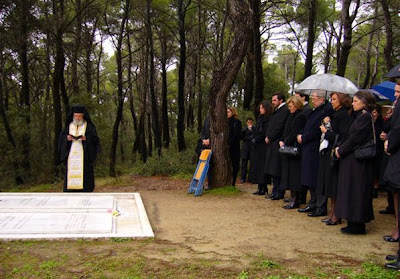
In February 2006 the Royal Family commemorated the late Queen Frederica at Tatoi.

Monday, 13 June 2011

La grande tragedia d'Italia - Umberto II

The Radical Royalist commemorated King Umberto’s accession to the Italian throne on 9th May 1946 here .

Fellow blogger Matterhorn has already paid tribute to His Majesty King Umberto II of Italy who was forced to go into exile 65 years ago. Matterhorn published the King’s noble last message he addressed to the Italian people upon departing into exile. This is the last passage:
With a spirit full of sorrow, but with the serene consciousness of having made every effort to carry out my duties, I leave my country. Let those who have taken the oath and kept faith through the hardest trials, consider themselves released from their oath of allegiance to the King, but not from their oath of allegiance to the Country. I think of all those who have fallen in the name of Italy, and I salute all the Italians. Whatever destiny awaits our Country, she will always be able to count on me, as on the most devoted of her sons.

Long live Italy!

13th June 1946

On 13th June 1946 the King left the Quirinale Palace, the only official building in Rome which was still flying the royal standard. The Royal Guard saluted their King for the last time.
Il re Umberto II si appresta a lasciare per sempre il Quirinale, e qui lo vediamo nel Cortile d’Onore del palazzo con il duca Riario Sforza, comandante dei corazzieri, mentre passa in rassegna il picchetto che rende omaggio all’ultimo dei Savoia. Sono attimi di profonda commozione, per tutti e in mode particolare per Umberto chi si trova nel ruolo di protagonist del tramonto di una dinastia.

“Guardia del re, salute al re!”, dice Riario Sforza ai suoi uomini.

“Viva il re!”, gridano per l’ultima volta i corazzieri. E viene ammainata la bandiera con lo stemma sabaudo.
King Umberto did not want a throne covered with blood: Non voglio un trono macchiato di sangue."

At four o'clock in the afternoon King Umberto reached Ciampino Airport, greeted by his most fervent supporters, he is guided to the military plane, Savoia Marchetti S 95, that would take him from Rome into the Portuguese exile. He never abdicated - neither for himself nor for his descendants.
Sono le quattro del pomeriggio del 13 giugno 1946. Umberto II ha raggiunto l'aeroporto di Ciampino e, salutato dagli fedelissime, si avvia a passo spedito verso l'aereo militare, un Savoia Marchetti S 95, che lo porterà da Roma nell'esilio portoghese. ... senza tuttavia rinunciare ai suoi diritti sul trono e quelli dei suoi discendenti.
From the aeroplane's door the King greeted the Italians for the last time on Italian soil.
Dal portellone dell'aereo Umberto rivolge un ultimo saluto ai pochi che, informati all'ultimo momento della sua partenza, lo hanno accompagnato. Un ultimo, mesto, forzato sorriso. Un ultimo sguardo a quell'Italia su cui ha regnato per un solo mese e che non rivedrà più. Anche il cielo sembra intristire, in quel giorno di tarda primavera.
In 1962 King Umberto attended the wedding of Prince Juan Carlos of Spain and Princess Sophia of Greece and Denmark. On the right is the father of the bride, King Paul I of Greece.
Il re Paolo di Grecia presenta ai dignitari di Corte le re Umberto II.
His private study in his exile home, Villa Italia, near the Atlantic Ocean in Cascais, Portugal.
Il re Umberto nel suo studio privato di Villa Italia, la piccola reggia del lungo esilio a Cascais. "Cala la notte e prima di spegnere la luce e riposare ho la visione della piazza del Quirinale, di Roma, della città che non si può non amare. L'Italia è sempre nel mio cuore".
The King's library in 1970. Although he received a military education, Umberto always loved books and was interested in the arts.
Umberto nella sua grande biblioteca di Villa Italia. Dopo aver recevuto una rigida educazione militare, era stato considerato dai più come un uomo dai limitati interessi culturali. Al contrario il re Umberto era un raffinato umanista, un profondo conoscitore di storia, di letteratura e d'arte.
In 1982 Pope John Paul II visited Portugal. On 14th April 1982 the pontif and the king met in the residence of the Patriarch of Lisbon. At this stage King Umberto was already seriously sick and suffered from lung cancer.

He died on 18th March 1983 in Geneva, Switzerland. His body was not allowed to repatriated to Italy and was interred in Hautecombe Abbey in France.
Un affettuoso abbraccio, spontane e informale, tra Papa Giovanni Paolo II e il re Umberto II: è il 14 prile del 1982, il Papa si è recato in pellegrinaggio al santuario di Nostra Signora di Fatima, in Portogallo, e nella residenzia del cardinale di Lisbona ha concesso un'udienza privata alla re d'Italia. Umberto si è inginocchiato di fronte a lui, ma il Pontefice lo ha fatto subito rialzare e ha voluto abbracciarlo. Il sovrano sa di essere molto malato, che gli resta poco da vivere, e di certo in quel lungo colloquio ne parla con Papa Giovanni Paolo.

While King Umberto was totally ignored by the Italian officials, the Portuguese kept an affectionate memory of the Monarch they hosted for 37 years.

In 1987 a bust of the Italian King was unveiled in Cascais, in front of the Villa Italia, where he spent three and a half decades. The ceremony in the newly named Avenida Rei Humberto II de Itália was attended not only by King Umberto's only son, Prince Vittorio Emanuele, but also by the Portuguese President Mário Soares. Also present were Queen Marie José of Italy, King Umberto's widow, Queen Joana of the Bulgarians, the deceased King's sister, and Portugal's King-in-waiting, Dom Duarte Pio, Duke of Bragança.

Saturday, 6 November 2010

Rare Species
Panda bears are a rare species, but equally rare are real Monarchs.


Here Queen Sofia of Spain meets a baby Panda bear in Madrid's zoo. At the Madrid Zoo & Aquarium a pair of twin pandas were born on 7th September 2010, conceived through artificial insemination in a joint effort by Spain's National Research council other scientiests. The cubs are the first of their species to be born in Spain since 1982 and only the third litter to be born in Europe.

Tuesday, 10 August 2010

Envious republicans

Everybody is entitled to a holiday. A Royal or a president, a few weeks away from daily routine are necessary for everyone. Well paid critics in the media or in politics are less generous, they try to sew dispute.

This holiday season in the Northern hemisphere saw two cases of envious reporting.

US president Barack Obama’s wife Michelle and daughter Sasha were were on a four-day visit and stayed at the five-star Villa Padierna, rated as one of the world's top 30 hotels, with 40 friends. The party has reserved 60 rooms. The First Lady went to the city of Granada and enjoyed the spectacular Alhambra Palace. Mrs Obama and her daughter also paid a visit to Spain's King Juan Carlos and Queen Sofia at their summer palace on the island of Majorca, a short flight from Marbella.
From the website of the Casa de Su Majestad el Rey: Sus Majestades los Reyes y Su Alteza Real la Princesa de Asturias, acompañados de la primera dama de los Estados Unidos de America, Michelle Obama y su hija, Sasha

Mrs. Obama left no doubt that this was a private tour at her own expenses. Fair enough and the Kingdom of Spain is worth more than one visit. She will certainly be welcome whenever she wants to return to the Iberian Kingdom.

Some 250 Spanish officers and military personnel protected the Obamas during their stay. They include police divers, bomb disposal experts and dog handlers. About 70 US Secret Service agents are also in Marbella, some of them dressed undercover as tourists.

US Republicans have criticised Mrs. Obama for taking a holiday in the Kingdom of Spain instead of visiting the Gulf of Mexico. While the US security staff was paid by the US taxpayers, the cost of the 250 Spanish security personnel was shouldered by the Spaniards, and despite the country’s dire financial situation there was not criticism about the unknown bill.

Had this happened in Australia, would the republicans be up in arms against the expenditure for a foreign tourist? Certainly not, if it was a family member of a foreign republican head of state. What would they have made of the second example.

This July the Australian Royal Family had a cruise around the Western Highlands and islands of Scotland on the Hebridean Princess, a converted ferry. The Queen has paid £300,000 out of her own pocket, but that did not cover the security surrounding her, including the protective shadowing of her vessel by a Royal Navy frigate and divers.

In August 1979 Lord Mountbatten, Prince Philip’s uncle, was killed when the Irish Republican Army blew up his boat.(Sinn Féin vice-president Gerry Adams said of Lord Mountbatten's death: “The IRA gave clear reasons for the execution.”) The Royal Family is still on many terror groups’ death list. In civilised countries security measures are paid by the public for ex-prime ministers like Tony Blair as well as for authors like Sir Salman Rushdie. Only the Royal Family is always under criticism, because of the cost to protect their lives.

Gerald Warner:
„ ... By an extraordinary coincidence that [amount of money] is precisely what the frigate would have cost if it had carried out the same exercises purely in theory, without the presence of the Queen to make them more focused and realistic. The only way to avoid costs would have been to put the ship in mothballs which, with our services currently so overstretched, would hardly be practical. Don’t forget the divers! snivel the critics. Right, so, Royal Navy divers should never venture into the water, on grounds of expense – is that the idea? Should our divers keep their flippers dry while any terrorist who can use a snorkel attaches limpet mines to the vessel carrying half of the royal family?
Or if al-Qaeda were to raid the ship and hold the royal family hostage, would that be less expensive?
”
Imagine, the Royal Family had decided to take a holiday in Australia, just like Michelle Obama wanted her time off in the Kingdom of Spain. The republicans would be running amok, crying foul and murder over the cost for a couple of security officers who would have to be paid anyway, since in analogy to Gerald Warner, they would have cost the same amount sitting at stand-by.

Republicans – in the US and in Australia or in the UK for that matter – just play political games, and very cheap and obvious ones as well.

Tuesday, 13 July 2010

Royal embrace

Spain is celebrating its first-ever football World Cup victory.
The match in Johannesburg between the Spanish and the Dutch teams was watched by H.M. Queen Sofía of Spain, H.R.H. Don Felipe, the Prince of Asturias, and H.R.H Doña Letizia, Princess of Asturias, and H.R.H Crown Prince Willem Alexander, Prince of Orange, H.R.H. Princess Maxima of the Netherlands.
After Spain's victorious World Cup squad had returned to Madrid the players went to meet Spain's Royal Family.

H.M. King Juan Carlos was accompanied by his wife, H.M. Queen Sofía, his eldest daughter, H.R.R. Infanta Elena, and his son, H.R.H. Crown Prince Felipe and his wife, H.H.R. Crown Princess Letizia as well as their children, H.R.R. Infanta Leonor and H.R.H. Infanta Sofía.

"Thank you champions, in the name of all of Spain and all Spaniards," the King said after personally greeting each of the players.


"This is a well deserved victory for an exceptional team which thrilled the hearts of all Spaniards. You brought together all Spaniards, made our dreams a reality and projected the name of Spain around the world."


Palabras de Su Majestad el Rey a la Selección Española de Fútbol, Campeona de la Copa Mundial de la FIFA "Sudáfrica 2010"

Palacio Real de Madrid, 12 de julio de 2010

Este no es un día de discursos. Es un día de enorme emoción e inmenso orgullo.

Emoción por un triunfo bien merecido y por una selección excepcional que ha hecho vibrar el corazón de todos los españoles.

Mi orgullo por ver a España campeón, por aglutinar a todos los españoles, por hacer realidad nuestros mejores sueños, y por proyectar, sobre todo, el nombre de España en todo el mundo.

Estos son los sentimientos que como Rey quiero trasladaros con el mayor de los abrazos, con toda mi gratitud y con toda mi más afectuosa enhorabuena.

Sois un ejemplo de deportividad, de nobleza, de buen juego, de trabajo en equipo. Y ahí tengo que dar la enhorabuena a Vicente del Bosque, aunque sé que no le gusta aparecer por ahí, pero siempre tendrá mi reconocimiento. Un ejemplo de esfuerzo y espíritu de superación para las nuevas generaciones. Y una capacidad, sobre todo, de demostrar la capacidad que tiene España para lograr juntos los éxitos que nos propongamos.

¡Gracias Campeones en nombre de toda España y de todos los españoles!

¡Gracias por vuestro ejemplo y por vuestro espíritu!

¡Viva nuestra selección y viva España!