Showing posts with label King Constantine. Show all posts

Saturday, 2 November 2013

Queen Sofía turns 75


Her Majesty Queen Sofia of Spain celebrates her 75th birthday today. She was born Princess Sophia Margarita Victoria Friederika of Greece and Denmark nearly exactly three years to the day that Greece had voted in a referendum to restore the Monarchy (3rd November 1935). King George II of the Hellenes had returned after 12 years of exile, but he and his Romanian born wife Queen Elisabeta had no children, therefore Princess Sophia’s father Pavlos was Crown Prince of Greece. In 1947 the Crown Prince ascended to the Greek throne as King Pavlos I. When she was born Princess Sophia was second in line to the Greek throne until her brother Konstantinos was born on 2nd June 1940. He succeeded his father in March 1964 as King Constantine II of the Hellenes.

Princess Sophia with her father, King Pavlos, and sister Princess Irene 1948.

The Greek Royal Family was again forced into exile in 1941, when German and Italian troops invaded the Kingdom. In an adventurous escape Crown Princess Friederika and her two children fled first to the island of Crete, then to Egypt and finally to South Africa, where the family stayed until in 1946 another referendum affirmed the Monarchy in Greece.

During the Greek civil war and the years of reconstruction in the 1950s Princess Sophia fulfilled her duties as a member of the Greek Royal Family.

Royal wedding in Athens in May 1962.
On 14th May 1962 she married Prince Juan Carlos of Borbón y Borbón in a colourful ceremony in Athens. The Greek parliament has approved a $300,000 tax-free dowry for Princess Sophie. The bill was passed by a show of hands. Two parties, the Union of the Centre and the Pro-Communist United Democratic left, abstained from the voting. Opposition leaders "denounced the practice of granting dowries and anachronistic and barbarous."

Between 1963 and 1968 the couple had three children: Infanta Elena (* 20th December 1963), Infanta Cristina (* 13th June 1965) and Infant Felipe (* 30th January 1968).

Queen Sofia cuddles a panda bear in the Madrid zoo.
After General Franco’s death Prince Juan Carlos was proclaimed King of Spain and the return of the Monarchy, which had been approved in a referendum in 1947 was completed in November 1975. A new democratic constitution was drawn and accepted by the Spanish people in a referendum. In the difficult years of the renewed the Monarchy as well as democracy and various attempted coups that were tried by adherents of the old regime Queen Sofia was at her husband’s side to encourage and inspire him. On the occasion of his 30th anniversary as King, Don Juan Carlos thanked Queen Sofia "for her constant support, sensitivity and commitment”.

Queen Sofia behind the wheel of the Peugeot iON, a zero-emission electric vehicle with a battery life of 80 miles.


Sunday, 25 August 2013

"King Constantine was the first to move against the colonels, but was shown the door"


Good old Taki Theodoracopulos sums the Greek problem up in a few words What History Does to Heroes:
"We Greeks are down and out right now, but there are still a few seconds left before the referee counts to ten. When in trouble, think and dream about the past. Back then we were number one in everything. There were no gruesome, soulless, untalented hustlers like Jay-Z, no punk rockers, no TV vulgarians like Jonathan Ross. Sure, we were a bit tough on people who were born on the wrong side of the tracks, but no one’s perfect, as Socrates should have told us. My great hero was a real person, not a mythological one—Kimon, son of Miltiades, victor of the battle of Marathon. Kimon had his cake and also ate it. He was a real stud who serviced everyone and was madly loved by his wife. He, too, ended up in exile like his old man.
Official photo of H.M. King Constantine II of the Hellenes.
"Greeks have a tendency to do that sort of thing—get rid of what’s good and keep what’s rotten and corrupt. Themistocles won the battle of Salamis and was shown the door.
"Since 1974 the same two parties have shared power and have stolen the country blind. The king, who was the first to move against the colonels, was also shown the door and his property stolen from him by the state. Go figure, as Homer never said."

Monday, 10 June 2013

Swedish Wedding


On Saturday 8th June, Princess Madeleine of Sweden and Mr Christopher O'Neill were married in the Royal Chapel at the Royal Palace of Stockholm.

The Princess Couple with the bridal attendants.

The wedding began at 16.00, and the service was conducted by Chaplain to The King and Bishop Emeritus Lars-Göran Lönnermark. Princess Madeleine's wedding dress was created by the Italian designer Valentino Garavani. The Princess's tiara is privately owned, and was decorated with sprigs of orange blossom.

Representing the British royal family: Prince Edward, the Earl of Wessex and Sophie, the Countess of Wessex, leaving the Royal Chapel.

Crown Prince Frederik and Crown Princess Mary of Denmark.

The Greek Royal Family was represented by four children of Their Majesties King Constantine II and Queen Anne-Marie of the Hellenes.

Crown Prince Pavlos of Greece and his wife Marie-Chantal.

Prince Nikolaos of Greece and his wife Tatiana.

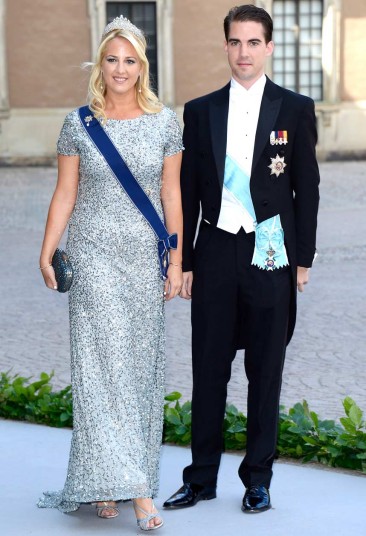
Princess Theodora and her brother Prince Philippos of Greece.


Wednesday, 20 March 2013

Greek King still on a mission for Greece


HM King Constantine II of the Hellenes has no official function in Greece anymore, however, he is still actively working for his home country.

This became obvious in a new documentary Our Queen that was broadcast last Sunday on ITV. The excellent two-hour documentary about the Queen in her Jubilee year received praise from the critics and can be watched on YouTube or in the embedded video below.


Twelve minutes ten seconds into the programme Prime Minister David Cameron appears for his weekly meeting with the Queen. The comment goes on like this:

Every Wednesday at 6 pm the sovereign receives her prime minister.

Prime Minister : There’s a lot going on this week. There’s the Euro zone crisis, the Greek elections, French elections ...

Queen Elizabeth: We were talking about the Euro zone problem. The King did ring me. He is very worried about it.
Greek republicans may not like it, but via the British Monarch the Greek King raised the issue with one of the important leaders in the EU.

On The Greek Royal Familiy's website is another indicator for the King's concern:

His Majesty King Constantine’s message on the occasion of the centennial anniversary of the Liberation of the city of Ioannina 4 March 2013

Asked by journalists about Greece's social and economic crisis, HM King Constantine, stressed, that the politicians and our society can lead our country to better days, only when they act in accord, in unity.

We cannot afford further friction amongst politicians nor our society to be divided.

Citizens and the State must be in concord.

"When the people suffer, we all suffer", HM King Constantine concluded.

Tuesday, 19 March 2013

100 years ago: Greek King George I assassinated


King George I (Γεώργιος Αʹ, Βασιλεύς των Ελλήνων, Geórgios Αʹ, Vasiléfs ton Ellínon; *24th December 1845) was elected King of the Hellenes by the Greek National Assembly on 30th March 1863.


Just as he did in Athens, the King went about Thessaloniki without any protection. While out on an afternoon walk near the White Tower on 18th March 1913, he was shot at close range in the back by Alexandros Schinas, who was said to belong to a Socialist organization and declared when arrested that he had killed the King because he refused to give him money. The King died instantly, the bullet having penetrated his heart.


The King's body was taken to Athens on the Amphitrite, escorted by a flotilla of naval vessels. The first King of the Schleswig-Holstein-Sonderburg-Glücksburg dynasty was buried at Tatoi, a royal resort at the foot of Mount Parnitha outside Athens, which King George had bought with his own private money.

The tombs of the Greek Royal Family, lying in a pine wood by a disused chapel, have been vandalised. They include the graves of the Duke of Edinburgh's parents. In 1994 a decree by the viciously anti-royal Socialist Government of the time stripped King Constantine II of Tatoi, its contents, and his Greek citizenship. In November 2002 the European Court of Human Rights at Strasbourg ruled that the confiscation of the Greek Royal Family's property in their homecountry was an illegal act.

Wednesday, 18 April 2012


95th birthday of HM Queen Frederica of the Hellenes

The Greek Queen Frederica was born on 18th April 1917 as daughter of Duke Ernest Augustus III of Brunswick and his wife, Duchess Victoria Luise, née Princess of Prussia, the only daughter of German Emperor Wilhelm II and Empress Augusta Viktoria. As daughter of the head of the House of Hanover, she was Princess Frederica of Hanover, Great Britain and Ireland, and also Duchess Frederica of Brunswick-Lüneburg. As a descendant of King George III of the United Kingdom, she was, at birth, 34th in the line of succession to the British throne.


HRH Crown Prince Paul of Greece proposed to her during the summer of 1936, while he was in Berlin attending the 1936 Summer Olympics. Prince Paul was the son of King Constantine I of Greece and Queen Sophie, sister of Kaiser Wilhelm II. Their engagement was announced officially on 28th September 1937. They married in Athens on 9th January 1938. With her marriage Frederica used the title Hereditary Princess (Greek: Πριγκήπισσα Διαδόχου, Prinkēpissa Diadókhou, literally "Princess of the Heir") of Greece, her husband being heir presumptive to his elder brother, King George II of the Hellenes.


During the early part of their marriage, they resided at Villa Psychiko in the suburbs of Athens. Ten months after their marriage, their first child, Princess Sophia (the future Queen Sofia of Spain), was born on 2nd November 1938. On 2nd June 1940, their son and heir, Prince Constantine (the future King Constantine II), was born.

On 28th October 1940 Mussolini's troops attacked Greece, but were defeated by the Royal Greek Army. In April 1941 Hitler came to Mussolini’s rescue and invaded Greece. Crown Princess Frederica and her infant children were evacuated on a British warplane to Crete, where they were repeatedly strafed by the Luftwaffe. Several weeks later, Crete fell, and the Royal Family escaped to Cairo. From there, Crown Prince Paul accompanied King George to London, where a government-in-exile was formed. Crown Princess Frederica and the children spent the next two and a half years in South Africa, where a third child, Princess Irene, was born in 1942.


After the war, the Allies oversaw a plebiscite, and in September 1946, the Royal Family returned to Athens. On 1st September 1946 the Greek people decided by referendum on the Monarchy, which won 69 percent of the vote. King George II returned to the throne for a third time.


On 1st April 1947, King George II died suddenly and Frederica's husband ascended the Greek throne as King Paul I. Civil war was raging with the Communist guerrillas in the North, and that spring the Truman Doctrine had been launched to prevent Greece and Turkey from coming under Communist control. The King and Queen toured Northern Greece under severe security to try to appeal for loyalty in the summer of 1947.


During the civil war, Queen Frederica set the Queen's Camps or Child-cities (translation of: Παιδο(υ)πόλεις / Paidopoleis or Paidupoleis) a network of 53 camps around Greece where she would gather mostly orphans and children of poor families. These camps provided much needed shelter, food, and education to these children.


The Greek Civil War ended in August, 1949. The Sovereigns took this opportunity to strengthen the monarchy. But Queen Frederica has been described as "inherently undemocratic". The reason why the Queen became an often hated figure was because she was involved in Greek politics. However this involvement was often undertaken out of necessity. A closer analysis of Queen Frederica’s actions indicate that she was motivated by a desire to promote democracy and ultimately ensure that the Greek Monarchy became an institution that was above politics.


On 6th March 1964, King Paul died of cancer, and her son ascended the throne as King Constantine II. Queen Frederica assumed the title of queen dowager but continued to serve in the role of Queen. When King Constantine married Princess Anne-Marie of Denmark later that year on 18th September, Queen Frederica stepped back from the majority of her public royal duties in favor of the new Queen. She remained a target for vicious attacks. In response she renounced her apanage and retired to the countryside where she lived an almost reclusive life. However, she continued to attend Royal events that were family-oriented, such as the baptisms of her grandchildren in both Spain and Greece.


After King Constantine’s counter-coup to restore democracy failed on 13th December 1967, Queen Frederica left the country with the King, Queen Anne-Marie, the King’s two year old daughter Princess Alexia, Crown Prince Pavlos, the King’s sister, Princess Irene and Prime Minister Kollias.


Queen Frederica died during a surgery in Madrid on 6th February 1981. Her funeral on 12th February 1981 in the garden of the Royal Estate Tatoi was attended by a multitude of reigning and deposed royalty. This was testament to the high esteem that the late Queen was still held in royal circles. Unfortunately Queen Frederica’s status as an important twentieth century historical figure progressively diminished following her son’s exile and the repudiation of the monarchy in 1974. When King Constantine II and his family were allowed to return to briefly attend Queen Frederica’s funeral at Tatoi, the King’s return was brief and His Majesty was not even allowed to stay overnight. At Athens Airport the King and his family were greeted by cheers from Monarchists behind a wire fence. Poignantly, many of the assembled Monarchists were vexed to the point of crying that their King was not allowed to go over and meet with them.
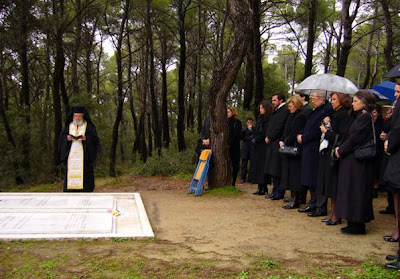
In February 2006 the Royal Family commemorated the late Queen Frederica at Tatoi.

Saturday, 18 February 2012

Good news from Greece

There was a time, not so long ago, when news from Greece were joyful:


Arrival of HRHPrincess Anne-Marie of Denmark in her new homecountry.


Their Majesties' wedding on 18th September 1964 was the first televised royal wedding in Greece. This wedding was watched by millions of people around the world and was international headline news. All of Athens seemed to celebrate the wedding. Prime Minister Georgios Papandreou attended the wedding in good spirits. King Constantine II publicly heralded the prime minister as a replacement father figure in the wake of his father’s death. King Pavlos I had died on 6th March 1964.

The US magazine Time knew this about the Royal Wedding:
"Weddings are, so to speak, expensive propositions. In Athens, Finance Minister Constantine Mitsotakis announced that the marriage of Greece's King Constantine, 24, to Denmark's Princess Anne-Marie, 18, cost the treasury $303,000, including $183,300 spent on wedding gifts.

However, an issue of 2,000,000 commemorative 30-drachma pieces will net a profit of $1,063,000, leaving the wily Greeks with $760,000 to play around with, or possibly use as a dowry for
Crown Princess Irene."

A very apt comment by a French Royalist
Ces vues nous rappellent que la dynastie et le peuple grec faisaient qu'un à l'époque et que la Grèce pouvait montrer au monde sa puissance et sa prospérité. Quel dommage que le jeune couple royal n'est pas pu gouverner plus longtemps leur royaume. Peut-être aujourd'hui il n'y aurait pas la crise et le chaos qui se passe actuellement en Grèce. Si les Grecs voient ces photos, ils doivent se rappeler du bon vieux temps. Espérons que dans quelques années, le roi Constantin ou un de ses descendants pourra remonter sur le trône grec.

And of course this is still true: The Hellenic Republic is losing its sovereignty

Friday, 3 September 2010


"What a beautiful three days and nights"

Good old Taki Theodoracopulos was invited to attend last week's wedding of HRH Prince Nikolaos of Greece and Denmark and Ms Tatiana Blatnik on the Greek island of Spetses.
"... King Constantine’s speech which was unsurpassed in expressing his love for his son and his country and its people without being awkward in the least. So much so I got up and told him so and he thanked me and put his arm around me.
Many of us were very moved. When I saw the king speaking to a prominent Cretan, I remembered that 69 years before,
Constantine and his sister Sophia, the Queen of Spain, were in Crete both suffering from the onslaught of Cretan bedbugs. They were two and one years of age. The royal family was retreating from the German invasion, which came days later."

Saturday, 28 August 2010

Royal wedding in Greece

Finally, there is good news coming from Greece. On 25th August the seventh in line to the Greek throne, King Constantine II of the Hellenes second son, HRH Prince Nikolaos of Greece and Denmark married Tatiana Blatnik at the church of Aghios Nikolaos, on the island of Spetses. The last Greek royal wedding took place in September 1964, when the ruling King Constantine married 18 year-old Danish Princess Anne-Marie in a lavish ceremony in the nations' capital Athens.


His Majesty's website describes the Spetses wedding as following:

We are delighted to announce that the wedding of HRH Prince Nikolaos to Tatiana Blatnik took place at the church of Aghios Nikolaos, Spetses.

The ceremony was officiated by His Eminence the Bishop of Hydra, Spetses, Aigina, Ermionida and Trizinia, Efraim.


During the dinner that followed, His Majesty King Constantine delivered the following speech:

Your Majesties, Your Royal Highnesses, Your Eminence, Your Excellencies and dear friends….as the King of Siam put it in the musical The King and I….etcetera, etcetera, etcetera...

Nikolaos…..at last! As Shakespeare wrote in Romeo and Juliet..”Wisely and slow; they stumble that run fast”…and Tatiana….“One fairer than my love? The all-seeing sun ne’er saw her match since first the world begun”…..

A little morality tale for my son on the occasion of his wedding:
A married couple in their early 60s was celebrating their 40th Wedding Anniversary in a quiet, romantic, little restaurant. Suddenly, a tiny and beautiful fairy appeared on their table. She said, 'For being such an exemplary married couple and for being loving to each other for all this time, I will grant you each a wish.


The wife answered, 'Oh, I want to travel around the world with my darling husband.' The fairy waved her magic wand and - suddenly! – two tickets for the Queen Mary II appeared in her hands

The husband thought for a moment: 'Well, this is all very romantic, but an opportunity like this will never come again. I'm sorry my love, but my wish is to have a wife 30 years younger than me.'

The wife, and the fairy, were deeply disappointed, but a wish is a wish. So the fairy waved her magic wand and suddenly!...the husband became 92 years old.


The moral of this story? Always remember this, my son: however magical they may be, fairies are always female!


So…. Pavlo brought into the family a shining diamond, Alexia brought a bright star, and you a beautiful pearl. I remember when you were born, I was in the delivery room and the doctor said in a loud voice “2” meaning the medical team should be alert as the umbilical cord had gone twice round your neck! In my ignorance, I thought my lovely wife was about to produce twins! Thinking back, I am not convinced that the world is quite ready to cope with two Nikolaos’!

Your negotiating skills were apparent to me from the moment you went to Brown University. Whenever the occasion presented itself, and you had to submit your work or an essay which, more often than not, wasn’t ready, you always managed to persuade The Dean to give you an extension.

You impressed me a great deal that you wanted to follow your elder brother, Pavlo, into the Army. Having left the regiment, Pavlo volunteered to re-join at the beginning of the Gulf War and you approached the Brigadier commanding 7th Brigade requesting to join the front line alongside your fellow officers. It was quite a difficult period for your mother and me when it became apparent that you might have to go to war.

I know I don't need to remind you of our country's history, but from the day your great great grandfather, George I, was elected by the Greek national assembly unanimously to become King of the Hellenes until today, when our lives have changed and Greece has become a republic. Service to our country and the Greek people has always been our tradition, and always will be.


As you know, Nikolae, our country and all of us Greeks are going through and will continue to endure difficult times. I have great confidence in the resilience of the Greek People. I can only wish that there is a sign of hope soon so that the crisis is terminated and that Greece finds its way to redevelopment.


This is the first wedding of our family in Greece since we left and we are delighted that it is taking place on this beautiful island, Spetses, with it’s wonderful people. It is a place we have come to love and, don’t forget, very close to here is where your mother and I spent our honeymoon and just across the sea on the mainland, we have started to make our home.

With deep gratitude to the people of Spetses and to the people from different parts of Greece who have come here today – our love and sincere thanks. We would also like to thank the Municipality of Spetses for welcoming this wedding on their island and for their understanding, the Police Authorities represented, the Port Authority and the Fire Brigade for the long hours they have all put in and for their discretion.

Anne-Marie has asked me to mention, as happy as we are to have you here today, we would be really thrilled if you would return and spend some time getting to know this beautiful island.

The advice I gave to your brother in law, Carlos, when he married Alexia, I give to you now….

“To keep your marriage brimming
with love in the loving cup,
whenever you are wrong, admit it,
whenever you are right, shut up”.

There is a song written by Rogers and Hammerstein which you will all be happy to know I am not going to sing… which goes…

"It's a lovely day for a wedding
Every heart is bursting with pride
It's a lovely day for a wedding
But not for the parents of the bride."

Why? Because today they lose their daughter to my son Nikolaos. To my brand new daughter in law… I say from my heart - welcome to our family.


Tatiana, I heard you ask your mother in the midst of all the planning for this great day, how far have you got…..what have you accomplished….the answer, without doubt…..her greatest accomplishment is you….

My friends, it is a lovely day for a wedding and my heart is indeed bursting with pride.

Tatiana, look after your husband. He's not a bad fellow.

And Nikolaos, look after your wife. She's a treasure.

God bless you both.


By the way, the state controlled TV-station ERT reported nothing on the wedding. And there is no hint on the website on what happened on Spetses. That's called freedom of information. Well done, you republicans!

Tuesday, 15 June 2010

Taki Theodoracopulos praises King Constantine II of the Hellenes

On the occasion of the Greek Monarch's 70th birthday, Taki's Magazine found the most charming words on the King of the Hellenes.
The Greek royal family had to endure endless vilifications while political hacks led the nation to the ruin of today. Greek politicians fear the King and they fear monarchy even more. Presidents can be appointed and expected to pay back, Kings are not and do not. ...

And it gets worse. Vilification aside, the Greek royal family’s lands were confiscated—lands that had been bought by the family in the early 19th century and not handed to them by a grateful nation - and after judicial review in the highest court of Europe, appraised at one hundredth of their value. The Greek King gave the funds to a Greek charity and has never complained. The fact that the Greek King and his family have always acted impeccably when the nation has been in danger does not seem to matter. Envy is a Greek trait, and the envious among them cheered at the unfairness of it all. Basically, the Greek left never forgave the present King’s father and mother for fighting against the communist guerrillas who tried to take power through force of arms back in the Forties. Greek journalists are, like everywhere, men and women of the left. Punto basta, as they say in the land of pasta.

Which brings me to the present. The King is now planning to move to Greece and last week he celebrated his 70th birthday. His son, Prince Pavlos and his wife, Princess Marie-Chantal, threw a wonderful dinner to celebrate it. ...

Who else was there? I’ve already done all the name dropping I will ever do, but it’s not every day that a King turns 70 and does it in such style. Bob and Chantal Miller, the Carringtons, the Bismarcks, the Frosts, the Hoares, many Greeks, and little ole me. Afterwards I had a drink with Prince Nikolaos of Greece and as I walked back home I thought what a sign of affection for the Greek King Queen Elizabeth and the rest of the royals showed towards a very nice man who has always deserved better. Oh yes, I almost forgot. I did not see who dropped coffee on the Queen’s dress, but I sure have my suspicions.

Their Majesties attended the Danish Queen's 70th birthday on 13th April 2010 at Christiansborg Palace.

Saturday, 5 June 2010

The Queen attended the Greek King's birthday reception


On 2nd June 2010 The Queen of the United Kingdom of Great Britain and Northern Ireland and Her other realms attended the 70th birthday reception of King Constantine II of the Hellenes at Crown Prince Pavlos of Greece's residence in London - unfortunately not in His Majesty's Greek residence.

Photos of other royal guests and a short report (in French) were published here plus here.

Wednesday, 2 June 2010

Happy Birthday, Your Majesty!

This is how Italian Monarchists congratulated the King of the Hellenes.


70th Birthday of the King of the Hellenes

Today His Majesty King Constantine II of the Hellenes Κωνσταντίνος, Βασιλεύς των Ελλήνων celebrates his 70th birthday. That this important landmark in his life cannot be celebrated with joy and festivities at home has nothing to do with the Greek financial crisis that cripples the country. The King has been living in exile since the counter-coup to re-establish democracy in Greece, failed that fatal night of 13th December 1967.

The Mad Monarchist stated quite bluntly that “the ruling regime is so hostile to the former royal family and the royals so increasingly removed from the country that it can seem like a lost cause more along the lines of the plight of the Dalai Lama than even the King of Romania in terms of the likelihood of the success of a restoration. However, the Greek monarchists deserve a great deal of credit for fighting the good fight far more frequently and for greater durations than most other monarchists, especially in modern times. It is also important to note that when modern Greece won its independence from the Turks in 1829 it originally went back to the classical period which is so idealized and founded a republic. Monarchists should be quick to point out that this republic did not last long because it proved totally incapable and so a monarchy was established.”

When Prince Constantine of Greece and Denmark was born on 2nd June 1940 to Crown Prince Paul and Crown Princess Frederika (née Prinzessin Friederike von Hannover, Herzogin zu Braunschweig und Lüneburg) Europe was at war. On 28th October the same year the Duce decided to attack the Kingdom of Greece, but the defiant Greeks were able to claim the first great victory that the Allied forces had won against the Axis powers since the beginning of the war. It increased the prestige of King George II of Greece, Crown Prince Paul's brother, who was very active in monitoring the progress of the military campaign against Italy. The Italian troops were driven out of Greece, and the Royal Greek army entered Albania, that had also fallen victim to Italian expansion plans. German dictator Adolf Hitler came to his allies rescue and on 6th April 1941 German troops attacked the Royal Greek Army.

After several weeks of intense fighting, the Greek armed forces were defeated and German troops occupied Athens on 27th April. At that time the King was determined to continue the resistance. He formed a government under Emmanouel Tsouderos (a former opponent of the King’s), who also happened to be from the island of Crete - the place of the latest epic battle between the Greeks and the Germans. On 23rd April King George , Crown Prince Paul, Queen Frederika and their children, Princess Sophia and Prince Constantine and the royal government were evacuate to Crete.

The German invasion of Crete began on 20th May 1941 and by 1st June the last Allied troops had surrendered. King George II, Crown Prince Paul and the Royal Greek government were first evacuated to Egypt, and later went to the United Kingdom to continue their fight for the liberation of Greece. Crown Princess Frederika and her children went to South Africa, where in 1942 the couple's third child, Princess Irene, was born.

After the German defeat the Monarchy was re-affirmed in a referendum in 1946. In the midst of a bloody civil war, King George II died and was succeeded by his brother, who ascended the Greek throne as King Pavlos I. Now Crown Prince Constantine went to the Anavryta School in Athens; graduated of three military academies; was inscribed in the Faculty of Law at the University of Athens; and underwent postgraduate studies in modern European History at Cambridge University. At the Games of the XVII Olympiad in Rome Crown Prince Constantine won an Olympic Gold Medal in 1960 for yachting, becoming the first Greek to do so since 1912.

On 6th March 1964 King Paul died, and his son ascended to the throne as King Constantine II. The US magazine Time illustrated his proclamation:

Last week, as high government officials, the hierarchy of the Greek church, leading judges and Members of Parliament gathered solemnly for a candlelight ceremony at the royal palace, new King Constantine kissed a silver-bound Bible, then took the royal oath. "I succeed my father to the throne with the firm determination to follow his lofty example," Constantine declared. "I pledge to serve my country with wholehearted devotion, and all my powers as a vigilant guardian of the free institutions of the democratic regime. My only thoughts and cares will always be the true and supreme interest of our fatherland." When the vows had been spoken, Premier George Papandreou shouted "Long live the King!" and the assemblage echoed the words. At 23 the world's youngest monarch, Constantine will be tutored in statecraft by the foxy Papandreou,* 76, whose Center Union coalition won a landslide victory over Karamanlis' Conservatives last month. A tall, athletic youth who won an Olympic gold medal in 1960, Constantine can rely for some time on sympathy for his father and the good feeling engendered by his impending marriage next January to Denmark's Princess Anne-Marie to facilitate his task. But ultimately Constantine can calm Greece's latent antimonarchist feelings only by calling, like his father, on the motto of his royal house: "My power is the love of my people."

* Whose own son Andreas, 45, gave up U.S. citizenship and a University of California post as an economics professor to run for election and join his father's Cabinet as chief aide to the Premier.

The following years were full of unrest and unstable governments. For a good account of this period see Wikipedia.

King Constantine’ Counter-Coup:

From the outset, the relationship between King Constantine II and the colonels was an uneasy one. The colonels were not willing to share power with anyone whereas the 25-year old King, like his father before him, was used to playing an active role in politics and would never consent to being a mere figurehead, especially in a military administration.

The King finally decided to launch his counter-coup on 13th December 1967. Since Athens was effectively in the hands of the junta militarily,
Constantine decided to fly to the small northern city of Kavala, East of Thessaloniki. There he hoped to be among troops loyal only to him.

The vague plan he and his advisers had conceived was to form a unit that would advance to Thessaloniki (Greece's second biggest city and unofficial capital of northern Greece) and take it.
Constantine planned to install an alternative administration there. International recognition, which he believed would be given, as well as internal pressure from the fact that Greece would have been split in two governments would, as the King hoped, force the junta to resign, leaving the field clear for him to return triumphant to Athens.

In the early morning hours of 13th December the King boarded the royal plane together with
Queen Anne-Marie of Greece, their two baby children, Princess Alexia of Greece and Denmark and Pavlos, Crown Prince of Greece, his mother [Queen] Friederike and his sister, Princess Irene of Greece and Denmark. Constantine also took Premier Kollias with him. At first things seemed to be going according to plan. Constantine was well received in Kavala which, militarily, was under the command of a general loyal to him. The air force and navy, both strongly royalist and almost not involved in the 1967 coup, immediately mobilized. Another of Constantine's generals effectively cut all communication between Athens and the north.

Two referenda, the first under the military junta’s rule in 1973 and another one in 1974 did not bring back the Monarchy. The Greek Royal Family left Rome in 1973 and took residence in the United Kingdom.

King Constantine suffered another blow in 1994, when the Greek parliament, the very same parliament that is directly responsible for Greece's current debt crisis, passed a law to expropriate his property and revoke his citizenship. To this day, he refuses to accept being told that he is not Greek.

The Prime Minister in 1994 was Andreas Papandreou, son of the former Prime Minister Giorgios Papandreou, and father of the current Prime Minister... so much for democracy in a republic!
One of the most recent photos: On 16th April 2010 the King and Queen of the Hellenes attended H.M. Queen Margrethe of Denmark's 70 birthday anniversary at the Palace of Fredensborg.

Sunday, 16 May 2010

King Constantine's statement on the Greek crisis

His Majesty King Constantine II of the Hellenes has published the following statement on his website:

'I am aware of the collective feeling of sorrow and grief; that which transcends blame. When anger erupts, when hope is hard to perceive, this feeling is expressed through reaction and violence.

However, now is not the time for Greece and her people to succumb to rage, valid as it may be. Now, is the time to stand up for our faith in Democracy. It is time to remember that we have prevailed in hardship, drawing on the unfailing force that we amass in unity.

For Greece to achieve the first, painful steps out of recession, the nation needs to overcome the political and social crisis by separating it from the economic crisis. As with any breakthrough, this will require both strength and patience.

Democracy offers freedom, expression, ways to address injustice and the vigour to keep Greece standing tall.

Five weeks ago, in Pilio (Greece), I had proposed that ‘we may even have reached the point for a coordinated, peaceful protest to take place, resembling what inspired the people of Northern Ireland a few years ago, when in a unified, silent march they expressed the spirit of a nation against those who wounded their country, the Democracy and its citizens’. That was the stance of a nation against terrorism; this, I believe, should be the outcry to those who threaten Democracy in Greece.

If the people succumb they will become victims, if the people react they will become predators. If, through the wisdom of peace and the power of solidarity they rise above the pain of injustice, the nation will prevail and lighten the path for the next generation, and for the rest of the world.'

Constantine R.

Thursday, 29 April 2010

HM King Constantine on the Greek economy and current events

The following statement was published on His Majesty's website:

During his short visit in the region of Pilio with HM Queen Anne-Marie, HM King Constantine addressed journalists’ questions on current events.

Asked to evaluate the fiscal measures imposed recently by the Greek Government, King Constantine stated that it would better be left to the experts. He emphasized, however, that the people do acknowledge the significant efforts on the part of the Greek Government and that everybody take part in the effort to overcome the crisis. His only wish is that despite all adversities, a feeling of collaboration and hope will be cultivated and that in the near future this great undertaking and the sacrifices made by the Greek people will bear fruit.

His Majesty was then asked about the recent terrorist activities*, to which he replied, that he does not differentiate a common thief, who harasses a family or a shop owner and puts their life in danger from a terrorist who harasses and endangers an entire community. The solution to both cases is a unified front comprised of the People, the police authorities and the Justice system. It is our common responsibility to protect Democracy and to demonstrate that public opinion is against terrorism in any form, he continued. We may even have reached the point for a coordinated, peaceful protest to take place, resembling what inspired the people of Northern Ireland a few years ago, when in a unified, silent march they expressed the spirit of a nation against those who wounded their country, the Democracy and its citizens.

In response to questions on the subject of the Mediterranean Games, which will be held in Volos in 2013, King Constantine replied that although he is not fully informed on the progress of the works, he is certain that Greece will pull through, as with the Olympic Games, even if at the very last minute. The success of the Games will depend on the good presentation of the Greek athletes and the effective presence of the volunteers. Asked whether he is willing to offer his assistance, King Constantine responded that he would of course help, if asked to do so, as he did during the bidding process which led to the 2004 Athens Olympics.

*NOTE: The interviews took place before the latest breakthrough and the arrests of alleged members of the terrorist group ‘the Revolutionary Struggle’.

Sunday, 25 April 2010

Hellenic Republic is losing its sovereignty
The Economist: "GREECE’S prime minister, George Papandreou, faced the television cameras on Friday 23rd April to announce that his government would draw on emergency aid to tide it over for the rest of the year. Mr Papandreou described the rather embarrassing request to to other euro zone members and the IMF as 'an extreme necessity.' This followed a week in which yields on Greek bonds reached an alarming 8.9%. That in part reflected an announcement by Eurostat, the European statistics agency, that Greece’s budget deficit reached 13.6% of GDP in 2009, even worse than it had previously thought. The agency added that the number might be revised up again, owing to the poor quality of the available data.

"An earlier analysis by
The Economist suggested that Greece would need at least €75 billion of official aid. ... Greece will run up an extra €67 billion of debt by 2014, by which time its debt will stabilise at a scary 149% of GDP."

The Daily Telegraph: "... the Greek crisis represents a deeper test of the entire EMU structure. Germany, which will have to pay the largest chunk of the €45bn (£40bn) Greek loan, also faces its own constitutional struggles connected with the emergency rescue package, raising the prospect that it, rather than the Greeks, may also find cause to abandon the project."

The Hellenic Republic cries out for help. The politicians do not count on the Monarchy's stabilising effects.

Symbol of Greece's sovereignty: King Constantine II of the Hellenes in Thessaloniki. Even the most vicious republicans can't blame neither the Greek Monarchy nor His Majesty for the mess, the Hellenic Republic is in. The modern Greek republic is bankrupt.