Showing posts with label Sikkim. Show all posts

Monday, 1 April 2013

The Chogyal's 60th birthday


Chogyal Palden Thondup Namgyal with his family. Chogyal Wangchuk Namgyal is on the extreme left.


Sikkim and the injustice this tiny Kingdom in the Himalayas has had to experience has always been close to the Radical Royalist's heart.

Today the 13th Chogyal celebrates his 60th birthday.

On the Sikkim Bhutia Lepcha Apex Committee (SIBLAC) is an accurate portrait of the present head of Sikkim's Royal Family.

Long live the 13th Sikkim! Long live the free Kingdom of Sikkim!Chogyal Palden Thondup Namgyal with his family

Monday, 19 September 2011

Sikkim hit by powerful earthquake


This Sunday Sikkim, a state that is dear to the RadicalRoyalist's heart was hit by an earthquake. A powerful earthquake hit the Sikkim-Nepal border with a magnitude of 6.8 at 6.10 p.m. local time, leaving at least 17 persons dead and more than 100 injured, besides causing extensive damage to buildings and roads.

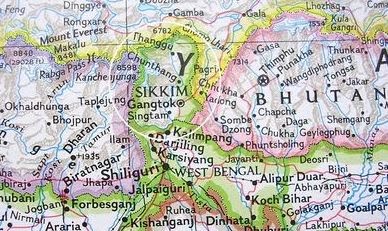
The epicentre was about 69 km northwest of Sikkim's capital Gangtok, 119 km north-northwest of Siliguri (India) and 272 km east of Kathmandu (Nepal).

Of the deaths, seven occurred in Sikkim, five in Nepal, three in the Darjeeling hills of West Bengal and two in Bihar, according to reports received here.

Among the victims in Sikkim, two died at Singtham in East district, two in Rishi in West district and one at Mangan in North district, Chief Secretary Karma Gyatso said in Gangtok. Two Indian army jawans were killed in north Sikkim, and three army vehicles including one with Indian army personnel were reported missing.

In Sikkim, there were also reports of landslips as it was raining, and power supply was seriously disrupted. Mobile phone services were not functioning and only BSNL lines were working.

In Nepal, three of five deaths occurred outside the British Embassy in Kathmandu when a high brick wall collapsed.

After the earthquake, the Siliguri-Gangtok road has been blocked and 10 Army Engineering columns have been deployed to open it for moving rescue and relief and other engineering equipment to the region.

Wednesday, 29 December 2010

For goodness sake, he’s the King

The Indian occupation of Sikkim is an ongoing violation of international rights.
In reaction to a previous posting the RadicalRoyalist received a testimonial from a former fellow student of Prince Wangchuk Tenzing Namgyal (*1st April 1953), second son of the 12th Chogyal of Sikkim, Palden Thondup Namgyal (+ 29th January 1982). He was crowned as Sikkim's 13th king after his elder brother, Crown Prince Tenzing Namgyal was killed in a road "accident" on 11th March 1978.

David from London wrote: "I have read much about the political situation in Sikkim, especially at the time the 11th Chogyal was dealing with the Nepalese, the Indians and the Chinese. It certainly is a tragic story, after so many centuries of the monarchy. It would be very interesting to get the perspective of the 13th Chogyal on the situation – although I don’t suppose much will change now.

A small story about Wangchuk that may amuse you:
"

He [Prince Wangchuk] used to accompany a small group of us to the pub at lunchtimes. He was never a big drinker, but used to participate in the banter, and enjoy the company.

One day I asked him where he came from - he replied:

“Sikkim – it’s a small country in the Himalayas, between Bhutan and Nepal”.

I then asked, “So why are you here in London, Wangchuk?”

“Oh, my father thought it would be a good idea for me to get a British education”.

My next question was: “So what does your father do in Sikkim, Wangchuk?”

“Oh, he’s in the government.”

“So what does he do in the government, Wangchuk?”

“Oh, he’s quite senior actually...”

“Well, how senior, Wangchuk?”

“Well, really quite senior.”

“Come on, Wangchuk – what does he do??”

“Oh for goodness sake, he’s the King, OK?!”

Stunned silence ensued, followed by an animated conversation about the political situation, and how unhappy his father was...

Wangchuk was always the most charming chap, although quite self effacing. I enjoyed his company immensely.

Sikkim's Royal Family, Prince Wangchuk is second from the right(with spectacles).

Thursday, 11 December 2008

The sister of the Chogyal of Sikkim has died
In an obituary published by The Daily Telegraph on 11th December 2008, I learned of the death of Her Highness, Princess Pema Tsedeun Yapshi Pheunkhang Lacham Kusho of Sikkim. The sister of Chogyal Palden Thondup Namgyal, Twelfth Consecrated Ruler of Sikkim, has died on 2nd December 2008. Her brother has predeceased her in 1982:

Princess Coocoola of Sikkim, who has died aged 84, was the beautiful widow of a Tibetan governor and a champion of the distinct culture of the northern Indian state of Sikkim.

Embodying a combination of oriental charm and western sophistication, she relayed messages to the outside world as the Chinese invasion of Tibet began in 1950, then devoted ten years to running a rehabilitation centre for Tibetan refugees in Sikkim. Twenty-five years later, when Sikkim was annexed by India, she played an active role in trying to retain its separate political status and unique character, giving a press conference in Hong Kong to protest at its loss of independence.

Acting as the hostess for her brother, the Chogyal (King) of Sikkim, at State functions until he married his American wife, she travelled widely to lobby politicians in New Delhi. She mixed with John Kenneth Galbraith, Senator Edward Kennedy and presidential aides in Washington and presented an 18-in high Buddha to a Tibetan children's village at Sedlescome, Sussex.

When the Indian prime minister Pandit Nehru offered her a pension, the Princess turned it down, and asked instead for trading rights. Working from a single room in Calcutta, she and her younger sister Princess Kula started a business importing turquoise from Iran. Later she joined the boards of a company which produced jewels for watches and of the State Bank of Sikkim.

Princess Pema Tsedeun Yapshi Pheunkhang Lacham Kusho (known as Coocoola) was the daughter of Sir Tashi Namgyal, KCSI, KCIE, the 11th Chogyal, and the granddaughter of a Tibetan general. She was born at Darjeeling on September 6 1924, when the Himalayan kingdom, which had been established in the 1640s, was a protectorate of the British Empire.

Young Coocoola was educated by the nuns of St Joseph's convent at Kalimpong, a hill station near Darjeeling. The Tibetan Pheunkhang family then wrote to the palace, saying that they wanted a Sikkimese Princess to marry their 23-year-old eldest son. Her father did not force her to accept, and she asked a secretary to reply that she wanted to go to university first. On being pressed, she accepted Sey Kusho Gompo Tsering Yapshi Pheunkhang, the governor of the Tibetan city of Gyantse and a son of one of the four ministers of Tibet. But she broke precedent by declining to marry both the bridegroom and his brother, as was the custom. "I replied that I would only marry the eldest," she recalled in later life.

In 1941 the Princess duly set off on the three-week journey to Lhasa with two maids, one bearer and two horses. She rode while going through the countryside, but retreated to her palanquin when passing through towns. When she arrived she found the two sons sitting next to her at the wedding ceremony, but repeated to her intended that she would marry only him. She and her husband settled down to enjoy the leisured life of the Tibetan gentry, with parties, picnics and festivals. The few visitors who arrived in Tibet – known as "the roof of the world" – were mesmerised by her.

In his book Seven Years in Tibet Heinrich Harrer hailed her as the most beautiful woman he had ever seen, and more interesting than her husband: "She possessed the indescribable charm of Asian women and the stamp of age-old oriental culture. At the same time she was clever, well-educated, and thoroughly modern. In conversation she was the equal of the most intelligent woman you would be likely to meet in a European salon. She was interested in politics, culture and all that was happening in the world. She often talked about equal rights for women… but Tibet has a long way to go before reaching that point."

Another visitor compared her to an exotic butterfly, saying her qualities showed in the quizzical way she looked up through her long lashes, and in the slow manner in which she exhaled her cigarette smoke or murmured a few words in her low, clear, musical voice. She entertained far more regally than her homely brother, the Chogyal, offering sparkling conversation as the best French wines were poured from heavy decanters. Her place at table was set with golden coasters and cutlery to remind even the most honoured guests of their inferior rank.

When travelling the dangerous trade route between Tibet and Gangtok, the largest town in Sikkim, with her small children bundled up in windowed boxes on horses or mules, she insisted on riding a horse with a rifle slung across her shoulder and a revolver in her pocket to repel bandits.

Princess Coocoola and her husband were founding members of the Namgyal Institute of Tibetology, to which they donated manuscripts and a large silver-plated stupa to hold the relics of two Ashokan monks, which were a gift from the Indian government. She allowed the institute to scan her photographic collection.

In her last years she lived in a modest cottage on the outskirts of Gangtok, keeping up with events in Sikkim and world politics and continuing to enjoy discussions with scholars who came knocking at her door. When one completed a book on Sikkimese village religion she insisted they celebrate with a bottle of champagne.

Princess Coocoola was widowed in 1973, and is survived by three of her children. When she died on December 2 four tremors were felt in Sikkim, which, according to local belief, signals the passing of a great soul.

Friday, 23 May 2008

85th Birthday Anniversary of the Chogyal of Sikkim

This spring the world’s attention was drawn to Tibet, where on 10th March this year the people commemorated the 49th anniversary of the Tibetan upheaval against the Chinese occupation. The protests spread from Tibet across the whole world and along the route of the torch relay for this year’s Olympic games people demanded: “Free Tibet!”.

In the Southern part of the Himalaya another occupied territory did not attract any attention at all: Sikkim. The Kingdom which had defended its independence for 300 years against powerful neighbours was annexed by India in April 1975 and became the 22nd state of the Indian Union. The 85th birthday of the 12th Chogyal of Sikkim gives me the opportunity to focus on the fate of the tiny Himalaya Kingdom.

Chogyal Palden Thondup Namgyal, Twelfth Consecrated Ruler of Sikkim, was born in Sikkim’s capital Gangtok on 22nd May 1923. The Denzong Chogyal was the second son of the late illustrious Chogyal Sir Tashi Namgyal, who will always be remembered as Sikkim’s gracious, enlightened and benevolent ruler.
In 1935 he continued his studies at St. Joseph’s College, Darjeeling, and completed his studies at Bishop Cotton School, Simla, in 1941.

As the Heir Apparent, Gyalsay Palden Thondup Namgyal undertook the Indian Civil Service Training Course at Dehra Dun in 1942 and thereafter returned to Sikkim to look after the administration so that the needs of the people could be taken care of.

Chogyal Palden Thondup Namgyal was keenly alive to the needs of the people and as Heir Apparent had exercised direct personal supervision over various departments of the government of Sikkim. He was his father’s adviser on external affairs and led the Sikkim team, which negotiated the Treaty with India in 1949-1950. By contract Sikkim became India’s “protectorate” on 5th December 1950, not unlike Nepal and Bhutan that were forced to sign similar treaties after the British had left the subcontinent. So far the other two Kingdoms could maintain their independence. If Nepal will be able to keep the two greedy neighbours outside the borders should the country be declared a republic, is in doubts.

The Chogyal was connected with a number of cultural and academic bodies in Sikkim, India and abroad. He had been the President of the Mahabodhi Society of India since 1953 and he led the Sikkim delegation to the Sixth Buddhist Council that was held in Burma in 1954. He participated in the 2500 Buddha Jayanti Celebrations in India in 1956, and was the only member of the Working Committee from Sikkim. In March 1959 he attended the 2500 Buddha Jayanti Conference in Japan and represented Sikkim at the Sixth World Fellowship of Buddhists conference in Cambodia in 1961. In 1958, under the patronage of Maharaja Sir Tashi Namgyal, he set up a centre for Mahayana and Tibetan studies at Gangtok , and this world famous centre bears the name of “Namgyal Institute of Tibetology.”

In August 1950, he married Sangey Deki, daughter of Yapshi Samdu Phodrang of Tibet. Sangey died in June 1957. In March 1963 he married Hope Cooke, grand daughter and ward of Mr. and Mrs. Winchester Noyes of the United States of America, which drew a huge media attention to the tiny Kingdom. The Chogyal had three children from his first wife, namely Tenzing, Wangchuk and Yangchen. His second wife bore him Palden and Hope. After his father’s death, Palden was crowned as the Twelfth Chogyal of Sikkim on 4th April 1965. (Please note the photo, where his US-born wife Hope Cooke is sitting at his right on a lower throne.)

Among the honours and distinction the Chogyal held were: The Order of the British Empire (1947), Padma Vibushan, India (1954) and Commander de l’Ordre de l’Étoile Noire, France (1956).

The Indian invasion
Small numbers of Nepalese had been migrating to Sikkim from about the 15th century, but it was only under the British that the Nepalese began entering Sikkim in great numbers, entirely upsetting the traditional ethnic balance of Sikkim. This social engineering was done by the British to weaken the traditional Lepchas – Bhutia strength. The Eleventh Chogyal and representatives of two of Sikkim’s largest parties, the Sikkim State Congress and the Sikkim National Party, agreed in May 1951to a parity formula . According to this formula, the seats in the state council were to be divided equally between the Bhutia-Lepcha group, and the Nepalese. The Sikkim State Council was then institute in 1953.

In April 1973, after making allegations that elections had been rigged, ethnic Nepali protested in front of the King's palace, demanding civil rights and the sidelining or even removal of what they called the "feudal" monarchy. Palden Thondup Namgyal, the King of Sikkim, ultimately gave in and signed an agreement on 8th May 1973.

The document called on India to provide a chief executive, and to hold elections for an assembly. The agreement was the first step in the disappearance of the Kingdom of Sikkim. The inhabitants of the Kingdom are in no doubt that the Indian Prime Minister Indira Gandhi and her local agents fomented the unrest. Indira Gandhi’s dictatorial and imperialist attitudes were are a major concern in the 70s. Asked in 1998 by the German daily Frankfurter Allgemeine Zeitung, why the Sikkimese army did not resist the Indian invasion, a former captain of Sikkim's army replied: "The Indians soldiers had joined the army because they were hungry and received a warm meal; to shoot at them would not have been in accordance with our Buddhist faith. We knew four days in advance about the invasion, but the King had ordered not to fight."

In 1975, Sikkim’s Prime Minister “appealed” to the Indian Parliament for representation and change of Sikkim's status to a state of India. In April 1975 the Indian army moved into Sikkim, seizing the capital city of Gangtok, disarming the Palace Guards and putting the Chogyal under house arrest.
A “referendum” was held in which 97.5% [!] of the votes cast (or counted!) agreed to join the Indian Union. China did not recognize India’s occupation of Sikkim until 2003, which led to an improvement in the Sino-Indian relations. In return, India announced its official recognition of Tibet as an integrated part of China.

The Chogyal never renounced his throne and hoped till the end that justice would win.

On 29th January 1982 Chogyal Palden Thondup Namgyal died a heartbroken man from cancer in New York. His second son Wangchuk inherited the rights to the throne after the Chogyal's eldest son Crown Prince Tenzin had died in a car accident on 11th March 1978.