Showing posts with label India. Show all posts

Friday, 29 March 2013

Indian Raja dies at the age of 100


Prince Charles, may be the oldest Prince of Wales on record, however, he cannot beat the record of another heir apparant. In what is today the Indian state of Kerala Puthiya Kovilakathu Sree Manavedan Raja, the Zamorin of Calicut, was 90 years old, when he ascended the throne in 2003. On the occassion of his passing way the Indian daily newspaper The Hindu reported, "Kunhianiyan, as he was lovingly referred to, died on Wednesday in a hospital here, barely a week after completing 100 years on March 22". India may have a republican constition, but the numerous royal families in India still play an important role in the cultural, religious and political life of the country.

The Zamorin of Calicut with Minister of State for Human Resource Development Shashi Tharoor (Congress Party), former UN Under-Secretary-General for Communications and Public Information.

"The Zamorins once ruled this port city, which had a prosperous harbour on the medieval Spice Route. Kunhali Marakkars, the admirals of the Zamorin, thwarted attempts by the Portuguese to dominate the region. But during the British period, the Zamorins were reduced to the position of landlords. But they retained their patronage of temples and mosques — and popular esteem.

"A fan of [cricket player] Sachin Tendulkar and a  Kathakali [Malayalam theatre] connossieur, an Ancient British History buff, author and an avid reader of The Hindu, Manavedan Raja was a simple man who took time to listen to all, and promoted communal harmony."

Zamorin of Calicut, P.K.S.Raja

Dr. E.K. Govinda Varma Raja wrote a biography of the Zamorin, titled The King Without A Crown, who as an officer of the Post and Telegraph Department, travelled widely, and had extended postings in the eastern parts of India, Pakistan and Bangladesh, when it was still the British Raj. After retirement as a Deputy General Manager with BSNL (Bharat Sanchar Nigam Limited, an Indian state-owned telecommunications company), he spent his years travelling the world till he ascended the throne in 2003.

As Zamorin he had few powers, but he was trustee to 40 temples from Chemanchery to Palakkad. He had a permanent seat on the Guruvayur Sree Krishna Temple’s managing committee. His family managed the Zamorin’s Guruvayurappan College, where the P.K.S Raja Centenary Research Centre, built at a cost of Rs. 1.5 crore (AU$ 265,000), was scheduled to be inaugurated this month.

Kerala's royal families have a very special succession law: The new rulers are always the sons of the deceased ruler's sister, never his own sons. This matrilinear line of succession is still in use to determine the Maharaja's of Travancore and Kochi. Were this succession law in place in Britain (and therefore in Australia) it would mean that Prince Charles' successor would be Princess Anne's son, Peter Philips.

Tuesday, 11 September 2012

Queen Paola of the Belgians celebrates her 75th birthday


She may be Europe's least known Queen and she celebrates her 75th birthday today "dans l’intimité" - "in private" as the court announced - without public celebrations. But her Italo-Belgian charm can easily match that of the more famous European Queens.

Queen Paola was born Princess Ruffo di Calabria, on 11th September 1937, at Forte del Marmi in Italy. She is the youngest of seven children of Prince Fulco Ruffo di Calabria, a First World War flying ace, and Countess Luisa Gazelli. Her grandmother on her father's side, Laure Mosselman du Chenoy, was Belgian.

The Queen spent her entire youth in Rome, where she completed her classical secondary education in Latin and Greek.


She married Prince Albert of Belgium on 2 July 1959, whom she met at the coronation of HH Pope John XXIII in October 1958. The couple have three children: Prince Philippe, Duke of Brabant (born on 15th April 1960), Princess Astrid (born on 5th June 1962) and Prince Laurent (born on 19th October 1963).

The Constitution did not provide for any particular official role for the Queen. Nevertheless, Belgian queens have always played a role in the public life of the country. So the Queen assists the King in carrying out his functions as Head of State: many visits to institutions, contacts with the population, ceremonies in Belgium and abroad, state visits, audiences with representatives of various groups in society and many cultural and social activities. Towards this end, the Queen pays special attention to her role as hostess.

Apart from her activities in the company of the King, the Queen also devotes time to topics that are close to her heart, mainly in the social and cultural sphere.

Social activities
The Queen deploys the Queen's Charities to offer help to citizens who are struggling to cope with financial hardship in their daily lives and often turn to her as a last resort.

On her own initiative or by invitation, she regularly visits social institutions or medical centres throughout the country. These contacts enable her to keep her finger on the pulse of the people and their needs and requirements and of the many initiatives taken every year in Belgium to help others.

Set up in 1992 the Queen Paola Foundation provides the Queen with an opportunity to focus on the issue of integration and training for young people. The Queen Paola Foundation's activities are primarily based on three themes:
  • Meaningful support offered to agencies providing help to young people struggling to be included in the main social networks.
  • The Queen Paola Prize for Education (launched in 1997) seeks to highlight and reward innovative schemes undertaken by educationalists from all academic levels and networks. 
  • The School of Hope (set up in 1999): this initiative lends support to schools operating in a disadvantaged social and economic environment.
In April 2002, the Queen was made Honorary President of Child Focus, the charity which searches for children who have disappeared, combats sexual abuse and helps the parents concerned. Thanks in particular to her international contacts, the Queen is trying to facilitate the creation of similar operational centres in other countries.

Cultural activities
Having lived a long time in Rome, the Queen soon developed an appreciation of beauty and good taste in all areas:

Heritage
The Queen takes a keen interest in the protection and preservation of Belgium's heritage as a result of the very many visits she pays to gain "on the ground" experience. These include visits to Beguine convents and industrial facilities from the early 19th century. In this connection, the Queens devotes a lot of her time to facilitating the restoration and maintenance of the Royal estates and residencies.

Crafts
The Queen is interested in both new and traditional crafts. She takes every opportunity to encourage the exercise and teaching of craft professions.
  
Contemporary art
The Queen is in constant contact with artistic circles and regularly supports major exhibitions or artistic performances both in Belgium and abroad by her presence or via High Patronage. On the initiative of the Queen, contemporary artists have had the opportunity to design and make original works within the Palace of Brussels.
  
Music
As a result of organising activities in the Palace, attending concerts, particularly those held against the background of the Queen Elisabeth International Music Competition, and visits to innovative initiatives, the Queen above all aspires to lend support to training and to emerging young professional musicians.

The Royal Family plays a key role in the Queen's life. In common with all grandmothers, the Queen is delighted to spend time in the company of her grandchildren. She is also keen on going on long walks in the forest with the King, as this offers her the opportunity to enjoy the rich variety of natural resources there and the changing seasons.

The Queen is also passionately fond of books, music and travel, particularly in Europe and Africa.

While in India, she visited the "Holy Family Hansenarium", a leprosy hospital in Tiruchirapalli, Tamil Nadu, founded in 1955 and supported by the Belgian Action Damien.


Wednesday, 29 December 2010

For goodness sake, he’s the King

The Indian occupation of Sikkim is an ongoing violation of international rights.
In reaction to a previous posting the RadicalRoyalist received a testimonial from a former fellow student of Prince Wangchuk Tenzing Namgyal (*1st April 1953), second son of the 12th Chogyal of Sikkim, Palden Thondup Namgyal (+ 29th January 1982). He was crowned as Sikkim's 13th king after his elder brother, Crown Prince Tenzing Namgyal was killed in a road "accident" on 11th March 1978.

David from London wrote: "I have read much about the political situation in Sikkim, especially at the time the 11th Chogyal was dealing with the Nepalese, the Indians and the Chinese. It certainly is a tragic story, after so many centuries of the monarchy. It would be very interesting to get the perspective of the 13th Chogyal on the situation – although I don’t suppose much will change now.

A small story about Wangchuk that may amuse you:
"

He [Prince Wangchuk] used to accompany a small group of us to the pub at lunchtimes. He was never a big drinker, but used to participate in the banter, and enjoy the company.

One day I asked him where he came from - he replied:

“Sikkim – it’s a small country in the Himalayas, between Bhutan and Nepal”.

I then asked, “So why are you here in London, Wangchuk?”

“Oh, my father thought it would be a good idea for me to get a British education”.

My next question was: “So what does your father do in Sikkim, Wangchuk?”

“Oh, he’s in the government.”

“So what does he do in the government, Wangchuk?”

“Oh, he’s quite senior actually...”

“Well, how senior, Wangchuk?”

“Well, really quite senior.”

“Come on, Wangchuk – what does he do??”

“Oh for goodness sake, he’s the King, OK?!”

Stunned silence ensued, followed by an animated conversation about the political situation, and how unhappy his father was...

Wangchuk was always the most charming chap, although quite self effacing. I enjoyed his company immensely.

Sikkim's Royal Family, Prince Wangchuk is second from the right(with spectacles).

Monday, 4 October 2010


Prince Charles declared Commonwealth Games open

There was no mucking about: The Indian daily The Hindu put it in its headline: Prince Charles declares Games open. In a colourful ceremony the Indian capital Delhi the heir to the throne and to the title as Head of the Commonwealth received the Queen’s baton, which has traversed 190,000 kilometres through all 71 participating countries and territories. The Prince of Wales read out Her Majesty’s message and under the applause of some 60,000 spectators declared the Commonwealth Games open.


After Prince Charles, Ms. Pratabha Patil, or “Madame President”, as the Prince of Wales addressed her, read out her welcome message and added: “Let the Games begin.”

Considering the row ahead of the Commonwealth Games, this was a compromise everybody could live with.

The South African team entered the arena with the meanwhile infamous vuvuzelas. A new national symbol of South Africa?

Drummers from various Indian states dominated the opening ceremony.

Thursday, 30 September 2010

Prince Charles to open the Commonwealth Games – not another politician

At the beginning of this week, Prince Charles’ office sought to play down the reported row over whether the heir to the throne or Indian president Pratibha Patil would open the Commonwealth Games saying at both would have “a prominent role” in the opening ceremonies.

“The Prince of Wales will read out the Queen’s baton message, ending by declaring the Games open," it said in a statement. The reference to “declaring the Games open” left it open to interpretation, according to observers.

There is no row. Both the Prince of Wales and the president of India will have a prominent role in the opening ceremony in Delhi. The Queen has asked the Prince of Wales to represent Her at the opening of the Commonwealth Games.

Earlier The Daily Mail quoted an anonymous Indian “official source” as saying: “Although there has not been an official announcement, we have decided the president will open the Games.”

Why is it that politicians always try to set themselves in the first fiddle, when they obviously have no right to do so? There is no doubt that The Queen is Head of the Commonwealth and therefore the one and only person to open the Commonwealth Games. Her heir and successor is Prince Charles – also as Head of the Commonwealth - and he will be sent to represent Her Majesty. She did not ask the Indian president or any other politician to be her representative. India may try to override the shortcomings in the preparations to this year’s Commonwealth Games by setting new rules. But being the second biggest nation on earth does not give India the right to embarrass the heir to the throne and all other Commonwealth nations who are loyal to the principle of this free association of nations.

The only acceptable compromise could be that His Royal Highness and Ms. Patel will both proclaim the Games open simultaneously.

Wednesday, 21 July 2010

Prince Charles at the Indian Memorial at Neuve-Chapelle in France

Most Australian media reported from Fromelles, where the last of the 250 British and Australian soldiers were laid to rest with full military honours on 19th July. They could not avoid noticing that HRH Prince Charles and HRH The Duchess of Cornwall attended the commemorative ceremony at the new Military Cemetery, however, nobody had found it newsworthy that the heir to the throne and his wife also attended a ceremony to honour the fallen Indian soldiers the very same day.


The French newspaper La Voix du Nord published a very fine article on this event, that is in stark contrast to the abysmal journalism practiced by The Age, and the daily's photographs give an excellent insight into the ceremonies with the Indian soldiers and their relatives.


TRH The Prince of Wales and The Duchess of Cornwall paid tribute to the contribution of Muslim and Sikh and Hindu soldiers in the First World War during a visit to the Neuve-Chapelle Indian Memorial.

The Battle of Neuve-Chapelle saw a huge contribution by the British Indian Army, and the memorial represents the 4,742 Indian soldiers with no known grave who died in the First World War.


Their Royal Highnesses attended a memorial service, which was attended by children from a number of schools in Britain learning about the contributions of the many different ethnic communities that fought and died in the First World War for the Allied cause.

On entering the memorial, The Duchess was presented with flowers, before The Prince was invited to lay a wreath given to him by a pupil from Allerton Grange School in Leeds.


Pupils from the school talked to The Prince and told him what they have been learning about the link between shared national values and national cohesion, in relation to Neuve-Chappelle and the sacrifices made there by the many different ethnic communities.

Poems were recited by 10-year-old Rasnam Singh, who travelled with a Sikh delegation. Their Royal Highnesses listened as he read the poem which had been written by a Sikh soldier who served at Neuve-Chapelle.


Rasnam was followed by a specially written poem by a pupil from Allerton Grange School.


The Prince and The Duchess toured the memorial grounds meeting with veterans, Gurkhas, and representatives from Britain’s Hindu, Sikh and Muslim communities who had made the journey to Neuve-Chapelle especially for the service.


Prince Charles asks: Why are all our war heroes white?

In its edition of 21st July 2010 The Daily Express quoted “a senior royal aid” having said “the Prince was so concerned about the way that black and Asian troops had been marginalised from our history he had decided to try to highlight the issue”.

The Prince of Wales and The Duchess of Cornwall paid tribute to 4,742 Indians whose deaths in two battles in October 1914 and March 1915 are commemorated at the First World War memorial at Neuve Chapelle. They were among 140,000 Indians who saw active service on the Western Front in the First World War.

The Daily Express continues:

"At the memorial Charles and Camilla learned about the exploits of Rifleman Gobar Singh Negi, who won a posthumous Victoria Cross for his bravery fighting in the trenches with the 2nd Battalion, 39th Garhwal Rifles at Neuve Chapelle on March 10, 1915.

Charles and Camilla also met Jaimal Singh Johal, 74, a retired sub-postmaster from Maidenhead, Berkshire, whose grandfather Manta Singh, a junior officer in the 2nd Sikh Royal Infantry, was fatally wounded at Neuve Chapelle, dying in hospital in Brighton aged only 27.

"It means a lot that they have come to see this memorial and that my grandfather is being recognised in a foreign country," said Mr Johal.

Sir Christopher Bayly, professor of imperial and naval history at Cambridge University, agreed that many people knew little about the role of non-whites who had fought for Britain, apart from the Gurkhas."

Thursday, 11 December 2008

The sister of the Chogyal of Sikkim has died
In an obituary published by The Daily Telegraph on 11th December 2008, I learned of the death of Her Highness, Princess Pema Tsedeun Yapshi Pheunkhang Lacham Kusho of Sikkim. The sister of Chogyal Palden Thondup Namgyal, Twelfth Consecrated Ruler of Sikkim, has died on 2nd December 2008. Her brother has predeceased her in 1982:

Princess Coocoola of Sikkim, who has died aged 84, was the beautiful widow of a Tibetan governor and a champion of the distinct culture of the northern Indian state of Sikkim.

Embodying a combination of oriental charm and western sophistication, she relayed messages to the outside world as the Chinese invasion of Tibet began in 1950, then devoted ten years to running a rehabilitation centre for Tibetan refugees in Sikkim. Twenty-five years later, when Sikkim was annexed by India, she played an active role in trying to retain its separate political status and unique character, giving a press conference in Hong Kong to protest at its loss of independence.

Acting as the hostess for her brother, the Chogyal (King) of Sikkim, at State functions until he married his American wife, she travelled widely to lobby politicians in New Delhi. She mixed with John Kenneth Galbraith, Senator Edward Kennedy and presidential aides in Washington and presented an 18-in high Buddha to a Tibetan children's village at Sedlescome, Sussex.

When the Indian prime minister Pandit Nehru offered her a pension, the Princess turned it down, and asked instead for trading rights. Working from a single room in Calcutta, she and her younger sister Princess Kula started a business importing turquoise from Iran. Later she joined the boards of a company which produced jewels for watches and of the State Bank of Sikkim.

Princess Pema Tsedeun Yapshi Pheunkhang Lacham Kusho (known as Coocoola) was the daughter of Sir Tashi Namgyal, KCSI, KCIE, the 11th Chogyal, and the granddaughter of a Tibetan general. She was born at Darjeeling on September 6 1924, when the Himalayan kingdom, which had been established in the 1640s, was a protectorate of the British Empire.

Young Coocoola was educated by the nuns of St Joseph's convent at Kalimpong, a hill station near Darjeeling. The Tibetan Pheunkhang family then wrote to the palace, saying that they wanted a Sikkimese Princess to marry their 23-year-old eldest son. Her father did not force her to accept, and she asked a secretary to reply that she wanted to go to university first. On being pressed, she accepted Sey Kusho Gompo Tsering Yapshi Pheunkhang, the governor of the Tibetan city of Gyantse and a son of one of the four ministers of Tibet. But she broke precedent by declining to marry both the bridegroom and his brother, as was the custom. "I replied that I would only marry the eldest," she recalled in later life.

In 1941 the Princess duly set off on the three-week journey to Lhasa with two maids, one bearer and two horses. She rode while going through the countryside, but retreated to her palanquin when passing through towns. When she arrived she found the two sons sitting next to her at the wedding ceremony, but repeated to her intended that she would marry only him. She and her husband settled down to enjoy the leisured life of the Tibetan gentry, with parties, picnics and festivals. The few visitors who arrived in Tibet – known as "the roof of the world" – were mesmerised by her.

In his book Seven Years in Tibet Heinrich Harrer hailed her as the most beautiful woman he had ever seen, and more interesting than her husband: "She possessed the indescribable charm of Asian women and the stamp of age-old oriental culture. At the same time she was clever, well-educated, and thoroughly modern. In conversation she was the equal of the most intelligent woman you would be likely to meet in a European salon. She was interested in politics, culture and all that was happening in the world. She often talked about equal rights for women… but Tibet has a long way to go before reaching that point."

Another visitor compared her to an exotic butterfly, saying her qualities showed in the quizzical way she looked up through her long lashes, and in the slow manner in which she exhaled her cigarette smoke or murmured a few words in her low, clear, musical voice. She entertained far more regally than her homely brother, the Chogyal, offering sparkling conversation as the best French wines were poured from heavy decanters. Her place at table was set with golden coasters and cutlery to remind even the most honoured guests of their inferior rank.

When travelling the dangerous trade route between Tibet and Gangtok, the largest town in Sikkim, with her small children bundled up in windowed boxes on horses or mules, she insisted on riding a horse with a rifle slung across her shoulder and a revolver in her pocket to repel bandits.

Princess Coocoola and her husband were founding members of the Namgyal Institute of Tibetology, to which they donated manuscripts and a large silver-plated stupa to hold the relics of two Ashokan monks, which were a gift from the Indian government. She allowed the institute to scan her photographic collection.

In her last years she lived in a modest cottage on the outskirts of Gangtok, keeping up with events in Sikkim and world politics and continuing to enjoy discussions with scholars who came knocking at her door. When one completed a book on Sikkimese village religion she insisted they celebrate with a bottle of champagne.

Princess Coocoola was widowed in 1973, and is survived by three of her children. When she died on December 2 four tremors were felt in Sikkim, which, according to local belief, signals the passing of a great soul.

Sunday, 30 November 2008

V. P. Singh passes away
Vishwanath Pratap Singh (Hindi: विश्वनाथ प्रताप सिंह), India’s tenth prime minister, had been fighting against leukemia since 1991. On 27th November 2008 he lost the fight and passed away at the Indraprastha Apollo Hospital in Delhi, India. His close associate Wasim Ahmad said: "The end came at 2.45 PM.” Singh leaves behind his wife Sita Kumari and two sons Ajeya Singh and Abhay Singh. Though his term in office was short (5th Dec. 1989 to 10th Nov. 1990) he was regarded as one of the most honest and socially oriented politicians the Indian union ever has had as leader.

You may ask, why does this blog, which is dedicated to Monarchy and royal families, commemorate an Indian politician? Answer: Because he was an Indian Royal!


Born on June 25th, 1931 at Allahabad, Shri V. P. Singh was the son of Raja Bahadur Ram Gopal Singh. In 1936 he was adopted by the then Raja of Manda, Bhagwati Prasad Singh of Daiya, a Gaharwar Rajput and head of a princely estate near Allahabad.
He ascended to the throne as 40th Raja of Manda in 1941 on the death of his adoptive father and according to Indian Royalists, he remained Raja of Manda until his death in November (see scan):


He was educated at Allahabad and Poona Universities. He was married to Smt. Sita Kumari on June 25, 1955 and they had two sons. A scholarly man, he was the proud founder of Gopal Vidyalaya, Intermediate College, Koraon, Allahabad. He was the President of the Students Union at Udai Pratap College, Varanasi in 1947-48 and was the Vice-President, Allahabad University Students Union. He actively participated in Bhoodan movement in 1957 and donated a well-established farm in village Pasna, District Allahabad.

A politician with a mission to help the Indian poor
In an obituary published in The Age on 29th November 2008, there was no mention of his royal descend, that would not have fitted into the republican policy of The Age. What value does an obituary have that suppresses important parts of the deceased's life? However Melbourne’s daily newspaper gave praise to the former Indian prime minister's policy: “… He won kudos for championing the rights of the caste-conscious country’s poor, as well as the minority Muslim population.” Popularly known as the 'Mandal messiah', he pulled out the long forgotton B.P. Mandal Commission's report from a dusty government almirah and went on to implement its recommendations, giving 27 percent job reservation for Other Backward Classes (OBCs). The middle class, whose support first catapulted V. P. Singh to power as he campaigned against corruption in the Bofors gun deal, loved to hate him, and did not forgive him till the end. The Raja of Manda’s coalition government came to an end, when the support of the BJP-Hindu nationalists was withdrawn in 1990 and he no longer had a majority in the Lok Sabha (Indian House of Commons).

After his downfall he turned towards painting and writing poetry. On his own website he explained his turn towards the arts:

“The visual always fascinated me. As I grew up, I slowly realized that we not only see through our eyes, but also from the heart. Feeling is living. Beauty is Understanding. I was overwhelmed by the harmony of creation. My youth was one rapturous communion with nature. The ecstasy is gone but fragments of its memory, still, at times, shimmer, to give a sudden insight. My paintings are such fragments. Yes, they are fragments because my life is so.”

Indian Royalty play an important part in the country's politics

V. P. Singh was only one of many members of Indian Royal Families who entered politics. In 2004, my favourite Indian newspaper, The Hindu, published an article by Vinay Kumar on this phenomenon.

"More than three decades after [Indian Royalty] were stripped of their royal privileges by Indira Gandhi, they still continue to dominate public life, in some way or the other.

"With elections round the corner, former Rajas, Mahants and Nawabs are all set to enliven the poll arena in the Hindi heartland of Uttar Pradesh. They are jumping into the electoral fray for various reasons: some of them see this as a way of protecting whatever remains of their royal legacies; others see it as a way to further their political careers. But the fact is that they are here to stay.

"It was from this belt that V.P. Singh, the Raja of Manda, emerged to occupy the office of the Prime Minister. He is not the only one to have made it big in politics — there have been others such as the former Raja of Kalakanker, the late Dinesh Singh, elected from the adjoining Pratapgarh parliamentary constituency, who served as a Union Minister during the Congress regime. His daughter, Rajkumari Ratna Singh, represented the same constituency in the Lok Sabha in 1996 and in 1999. In 1991, Abhai Pratap Singh, better known as Bade Raja of Pratapgarh, won the seat on a Janata Dal ticket. His father, Ajit Pratap Singh, won from here in 1962 and 1980. Truth to tell, royals have always dominated the electoral scene in Pratapgarh. Yet another scion of Pratapgarh's ruling family, Vijay Bhushan Singh alias Babbu Raja, has also unsuccessfully contested the Assembly polls.

"'There was a time when royals built schools and shelters for the people and opened their granaries to them in times of crisis. In due course, several of them entered politics and won elections purely because they were so respected. But that is no longer the case; politics is no longer a noble profession. It is only a means to advance one's own interests,' says Raja Bhaiyya, who hails from the royal family of Bhadri and became an MLA from Kunda in 1993."

Friday, 23 May 2008

85th Birthday Anniversary of the Chogyal of Sikkim

This spring the world’s attention was drawn to Tibet, where on 10th March this year the people commemorated the 49th anniversary of the Tibetan upheaval against the Chinese occupation. The protests spread from Tibet across the whole world and along the route of the torch relay for this year’s Olympic games people demanded: “Free Tibet!”.

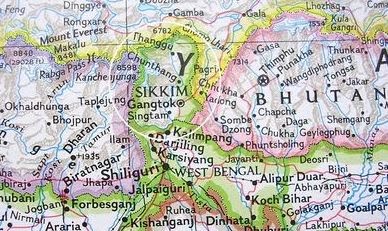
In the Southern part of the Himalaya another occupied territory did not attract any attention at all: Sikkim. The Kingdom which had defended its independence for 300 years against powerful neighbours was annexed by India in April 1975 and became the 22nd state of the Indian Union. The 85th birthday of the 12th Chogyal of Sikkim gives me the opportunity to focus on the fate of the tiny Himalaya Kingdom.

Chogyal Palden Thondup Namgyal, Twelfth Consecrated Ruler of Sikkim, was born in Sikkim’s capital Gangtok on 22nd May 1923. The Denzong Chogyal was the second son of the late illustrious Chogyal Sir Tashi Namgyal, who will always be remembered as Sikkim’s gracious, enlightened and benevolent ruler.
In 1935 he continued his studies at St. Joseph’s College, Darjeeling, and completed his studies at Bishop Cotton School, Simla, in 1941.

As the Heir Apparent, Gyalsay Palden Thondup Namgyal undertook the Indian Civil Service Training Course at Dehra Dun in 1942 and thereafter returned to Sikkim to look after the administration so that the needs of the people could be taken care of.

Chogyal Palden Thondup Namgyal was keenly alive to the needs of the people and as Heir Apparent had exercised direct personal supervision over various departments of the government of Sikkim. He was his father’s adviser on external affairs and led the Sikkim team, which negotiated the Treaty with India in 1949-1950. By contract Sikkim became India’s “protectorate” on 5th December 1950, not unlike Nepal and Bhutan that were forced to sign similar treaties after the British had left the subcontinent. So far the other two Kingdoms could maintain their independence. If Nepal will be able to keep the two greedy neighbours outside the borders should the country be declared a republic, is in doubts.

The Chogyal was connected with a number of cultural and academic bodies in Sikkim, India and abroad. He had been the President of the Mahabodhi Society of India since 1953 and he led the Sikkim delegation to the Sixth Buddhist Council that was held in Burma in 1954. He participated in the 2500 Buddha Jayanti Celebrations in India in 1956, and was the only member of the Working Committee from Sikkim. In March 1959 he attended the 2500 Buddha Jayanti Conference in Japan and represented Sikkim at the Sixth World Fellowship of Buddhists conference in Cambodia in 1961. In 1958, under the patronage of Maharaja Sir Tashi Namgyal, he set up a centre for Mahayana and Tibetan studies at Gangtok , and this world famous centre bears the name of “Namgyal Institute of Tibetology.”

In August 1950, he married Sangey Deki, daughter of Yapshi Samdu Phodrang of Tibet. Sangey died in June 1957. In March 1963 he married Hope Cooke, grand daughter and ward of Mr. and Mrs. Winchester Noyes of the United States of America, which drew a huge media attention to the tiny Kingdom. The Chogyal had three children from his first wife, namely Tenzing, Wangchuk and Yangchen. His second wife bore him Palden and Hope. After his father’s death, Palden was crowned as the Twelfth Chogyal of Sikkim on 4th April 1965. (Please note the photo, where his US-born wife Hope Cooke is sitting at his right on a lower throne.)

Among the honours and distinction the Chogyal held were: The Order of the British Empire (1947), Padma Vibushan, India (1954) and Commander de l’Ordre de l’Étoile Noire, France (1956).

The Indian invasion
Small numbers of Nepalese had been migrating to Sikkim from about the 15th century, but it was only under the British that the Nepalese began entering Sikkim in great numbers, entirely upsetting the traditional ethnic balance of Sikkim. This social engineering was done by the British to weaken the traditional Lepchas – Bhutia strength. The Eleventh Chogyal and representatives of two of Sikkim’s largest parties, the Sikkim State Congress and the Sikkim National Party, agreed in May 1951to a parity formula . According to this formula, the seats in the state council were to be divided equally between the Bhutia-Lepcha group, and the Nepalese. The Sikkim State Council was then institute in 1953.

In April 1973, after making allegations that elections had been rigged, ethnic Nepali protested in front of the King's palace, demanding civil rights and the sidelining or even removal of what they called the "feudal" monarchy. Palden Thondup Namgyal, the King of Sikkim, ultimately gave in and signed an agreement on 8th May 1973.

The document called on India to provide a chief executive, and to hold elections for an assembly. The agreement was the first step in the disappearance of the Kingdom of Sikkim. The inhabitants of the Kingdom are in no doubt that the Indian Prime Minister Indira Gandhi and her local agents fomented the unrest. Indira Gandhi’s dictatorial and imperialist attitudes were are a major concern in the 70s. Asked in 1998 by the German daily Frankfurter Allgemeine Zeitung, why the Sikkimese army did not resist the Indian invasion, a former captain of Sikkim's army replied: "The Indians soldiers had joined the army because they were hungry and received a warm meal; to shoot at them would not have been in accordance with our Buddhist faith. We knew four days in advance about the invasion, but the King had ordered not to fight."

In 1975, Sikkim’s Prime Minister “appealed” to the Indian Parliament for representation and change of Sikkim's status to a state of India. In April 1975 the Indian army moved into Sikkim, seizing the capital city of Gangtok, disarming the Palace Guards and putting the Chogyal under house arrest.
A “referendum” was held in which 97.5% [!] of the votes cast (or counted!) agreed to join the Indian Union. China did not recognize India’s occupation of Sikkim until 2003, which led to an improvement in the Sino-Indian relations. In return, India announced its official recognition of Tibet as an integrated part of China.

The Chogyal never renounced his throne and hoped till the end that justice would win.

On 29th January 1982 Chogyal Palden Thondup Namgyal died a heartbroken man from cancer in New York. His second son Wangchuk inherited the rights to the throne after the Chogyal's eldest son Crown Prince Tenzin had died in a car accident on 11th March 1978.