Libya lost her Monarchy 40 years ago - and got Qaddafi instead
“
For every Monarchy overthrown, the sky becomes less brilliant, because it loses a star.” It was
Anatole France, first winner of the Nobel prize for literature 1921, who wrote this remark. It is certainly true, when we commemorate the 40th anniversary of the overthrowing of the Libyan Monarchy and the seizure of power of Colonel
Muammar al-Qaddafi. He used
King Idris’ absence to declare a
Libyan Arab Republic on 1st September 1969, a republic that has changed its name constantly during the past 40 years. Today its master pleases to call his construction “
the Great Socialist People's Libyan Arab Jamahiriya”.
King Idris I, (Arabic: إدريس الأول) born
Sayyid Muhammad Idris bin Sayyid Muhammad al-Mahdi as-Senussi (12th March 1889 – 25th May 1983) was the reigning King of Libya from 1951 to 1969 and was also the Chief of the Senussi Muslim order.
In 1911, Italy conquered Cyrenaica in the brief Italo-Ottoman War. In 1920
Sayyid Muhammad Idris bin Sayyid Muhammad al-Mahdi as-Senussi was recognized by the British under the new title of
Emir of Cyrenaica, a position also confirmed by the Italians. Two years later he was named
Emir of neighboring
Tripolitania.
Idris' efforts to gain the country's independence were suppressed by the Italians, and he was driven into exile in the late 1920s. After struggling for liberation through the 1930s,
Idris fought with General
Bernard Montgomery and his army and they defeated the Italian and German troops in Libya in 1943.
The Italian colony was dismembered in a British and a French occupation zone. Tripolitania and Cyrenaica belonged to the British zone, Fessan was French. After the Peace of Paris in 1947 the country became a trust territory of the UN. The occupation zones persisted. In 1949 the UN decided to grant Cyrenaica independence under the Senussi-Order and its
Emir Mohammed Idris as-Senussi.
From Benghazi,
Idris led the team negotiating with the United Kingdom and the United Nations over independence, which was achieved on 24th December 1951.
Idris was proclaimed the King of Libya.

The flag of the Senussi Emirate was black with silvery half-moon and star in the middle. After Libya gained her independence, she introduced a national flag that was that of the Cyrenaica, however completed by a red stripe above the black and broad middle stripe and by a green stripe below. The three stripes represented the three parts of the country: Fessan, Cyrenaica und Tripolitania.
Following independence Libya faced a number of problems. There were no colleges in the country and just sixteen college graduates. Also the country had just three lawyers with not a single Libyan physician, engineer, surveyor or pharmacist in the Kingdom. It was also estimated that only 250,000 Libyans were literate and that 10% of the population was blind, with eye diseases such as trachoma widespread. In light of these Britain provided a number of civil servants to staff the government.
In April 1955 oil exploration started in the kingdom with its first oil fields being discovered in 1959. The first exports began in 1963 with the discovery of oil helping to transform the Libyan economy.

On April 25, 1963 the federal system of government was abolished and in line with this the name of the country was changed to the Kingdom of Libya to reflect the constitutional changes.
 King Idris
 maintained close relations with the West in spite of increasing tensions between the US, UK, and the Arab world. In 1969,
King Idris I had decided to abdicate in favor of his nephew on 2nd September. A coup led by Colonel
Muammar al-Qaddafi (and with murky support from the Italian government of the day) overthrew the King's government on 1st September, while the King was receiving medical treatment in Turkey. The King's nephew and Crown Prince,
Sayyid Hassan as-Senussi, was placed under house arrest, along with most of the rest of the Royal Family.
King Idris was placed on trial in absentia in the "
Libyan People's Court" and sentenced to death in November 1971.
In 1984
Qaddafi released the Royal Family from house arrest and tossed them onto the street. The family lived for a period in a cabin on a public beach.
Crown Prince Sayyid Hassan, suffering from poor health, was allowed to travel with most of the family to London for medical treatment, where they settled. The Crown Prince died in 1992, and was succeeded by his son,
Prince Sayyid Muhammad bin Sayyid Hasan ar-Rida al-Mahdi as-Senussi.
Today's Libyan Royal FamilyPrince Muhammad, the de jure King of Libya, has been active in Libyan exile circles, participating in an anti-Qaddafi rally in London in 2005, when he joined hundreds of Libyan opposition members in London to push for
Qaddafi's ouster - their first conference in exile to tell the world, they said, there is an alternative to
Qaddafi that is not Islamic extremism, but the Constitutional Monarchy.
Prince Muhammad has made Libyan democracy his public cause and has not renounced the throne. When in December 2007
Qaddafi put up his tent in Paris he was not left alone. From London came the claimant of the Libyan throne and reminded the French and the Libyan dictator that there is an alternative to the North African clown, as
Taki calls him. The French newspaper
Le Figaro had an extensive interview with
Prince Mohammed as-Senoussi. Although he and his supporters were forbidden by the French police to stage a demonstration against
Qaddafi, his presence in the Paris was enough to upset
Qaddafi and his host
Sarkozy.
 Muammar al-Qaddafi as a tourist in the Louvre, ParisQaddafis' MonarchyIn August 2008
,
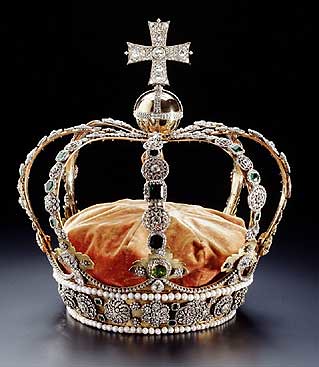
Qaddafi appeared in public wearing a regal crown and carrying a scepter, for the formal signing ceremony of a reconciliation pact with Italy. In tow was his son,
Seif al Islam, designated as his dynastic successor to rule the republic or kingdom. All of this followed a meeting in which 200 tribal leaders conferred the title of “
King of Kings” upon the once anti-monarchist revolutionary.
 The heir to the throne of Libya addressed, in Arabic, a crowded meeting room before taking some questions. The event, organised by the Conservative and Reformists (ECR) group, was attended by MEPs across party lines, curious to see the monarch-in-waiting of the oil-rich country.



 Posts
Posts


