Death of a centenarian
Her Royal Highness Infanta Dona Maria Adelaide de Bragança van Uden who could celebrate her 100th birthday on 31st January has passed away today, 24th February. She was in good health when the whole Portuguese nation celebrated the landmark birthday of the youngest daughter of King Miguel II.
On her 100th birthday she was created Grand Chevalier de l’Ordre du Mérite of Portugal. The official statement called her "an example of life by moral stature."
During World War II, she lived in Vienna, where she worked as a nurse. She was active in the Resistance movement, arrested and was sentenced to death by the Gestapo, after being accused of listening to the BBC. For more information about her role in the resistance, see the book, The Hand of Compassion: portraits of moral choice during the Holocaust by Kristen Monroe.
According to the Monarchist website Arautos s'El-Rei , a private family funeral will be held for Infanta Dona Maria Adelaide de Bragança van Uden . (As cerimónias fúnebres da Senhora Infanta D. Maria Adelaide serão reservadas apenas à sua Família mas em breve será anunciado o local e a hora da Missa do 7º Dia.)
Friday, 24 February 2012


Tuesday, 21 February 2012
One documentary, two reviews, but one conclusion: No Australian republic
On BBC1 Andrew Marr presented the three-part documentary series The Diamond Queen on the last three Monday evenings looking at the life and reign of Queen Elizabeth II, with special interviews and remarkable archive footage.
The Sydney Morning Herald quoted Her Majesty’s Australian Prime Minister, Julia Gillard as putting “the” republic on the backburner: "Right now I think in the life of the Australian nation, it is not the question at the forefront of people's minds." Her comments drew a response from interviewer and respected British journalist Andrew Marr, who said: "Even that republican Prime Minister doesn't see a republic looming anytime soon."
The Daily Telegraph goes further in explaining the republican Aussies’ problem: “Trailing [Her Majesty] during last year’s hugely popular visit to Australia, Marr repeated a hilarious quote from a leading republican there: ‘I wish she’d stop coming; she sets [our] cause back years every time she comes.’”
There you have the reason, why our sovereign is so rarely allowed to enter her Australian realm.
On BBC1 Andrew Marr presented the three-part documentary series The Diamond Queen on the last three Monday evenings looking at the life and reign of Queen Elizabeth II, with special interviews and remarkable archive footage.
The Sydney Morning Herald quoted Her Majesty’s Australian Prime Minister, Julia Gillard as putting “the” republic on the backburner: "Right now I think in the life of the Australian nation, it is not the question at the forefront of people's minds." Her comments drew a response from interviewer and respected British journalist Andrew Marr, who said: "Even that republican Prime Minister doesn't see a republic looming anytime soon."
The Daily Telegraph goes further in explaining the republican Aussies’ problem: “Trailing [Her Majesty] during last year’s hugely popular visit to Australia, Marr repeated a hilarious quote from a leading republican there: ‘I wish she’d stop coming; she sets [our] cause back years every time she comes.’”
There you have the reason, why our sovereign is so rarely allowed to enter her Australian realm.
Monday, 20 February 2012
Saturday, 18 February 2012
Good news from Greece
There was a time, not so long ago, when news from Greece were joyful:
Arrival of HRHPrincess Anne-Marie of Denmark in her new homecountry.
Their Majesties' wedding on 18th September 1964 was the first televised royal wedding in Greece. This wedding was watched by millions of people around the world and was international headline news. All of Athens seemed to celebrate the wedding. Prime Minister Georgios Papandreou attended the wedding in good spirits. King Constantine II publicly heralded the prime minister as a replacement father figure in the wake of his father’s death. King Pavlos I had died on 6th March 1964.
The US magazine Time knew this about the Royal Wedding:

A very apt comment by a French Royalist
Ces vues nous rappellent que la dynastie et le peuple grec faisaient qu'un à l'époque et que la Grèce pouvait montrer au monde sa puissance et sa prospérité. Quel dommage que le jeune couple royal n'est pas pu gouverner plus longtemps leur royaume. Peut-être aujourd'hui il n'y aurait pas la crise et le chaos qui se passe actuellement en Grèce. Si les Grecs voient ces photos, ils doivent se rappeler du bon vieux temps. Espérons que dans quelques années, le roi Constantin ou un de ses descendants pourra remonter sur le trône grec.
And of course this is still true: The Hellenic Republic is losing its sovereignty
There was a time, not so long ago, when news from Greece were joyful:
Arrival of HRHPrincess Anne-Marie of Denmark in her new homecountry.
Their Majesties' wedding on 18th September 1964 was the first televised royal wedding in Greece. This wedding was watched by millions of people around the world and was international headline news. All of Athens seemed to celebrate the wedding. Prime Minister Georgios Papandreou attended the wedding in good spirits. King Constantine II publicly heralded the prime minister as a replacement father figure in the wake of his father’s death. King Pavlos I had died on 6th March 1964.
The US magazine Time knew this about the Royal Wedding:
"Weddings are, so to speak, expensive propositions. In Athens, Finance Minister Constantine Mitsotakis announced that the marriage of Greece's King Constantine, 24, to Denmark's Princess Anne-Marie, 18, cost the treasury $303,000, including $183,300 spent on wedding gifts.
However, an issue of 2,000,000 commemorative 30-drachma pieces will net a profit of $1,063,000, leaving the wily Greeks with $760,000 to play around with, or possibly use as a dowry for Crown Princess Irene."

A very apt comment by a French Royalist
Ces vues nous rappellent que la dynastie et le peuple grec faisaient qu'un à l'époque et que la Grèce pouvait montrer au monde sa puissance et sa prospérité. Quel dommage que le jeune couple royal n'est pas pu gouverner plus longtemps leur royaume. Peut-être aujourd'hui il n'y aurait pas la crise et le chaos qui se passe actuellement en Grèce. Si les Grecs voient ces photos, ils doivent se rappeler du bon vieux temps. Espérons que dans quelques années, le roi Constantin ou un de ses descendants pourra remonter sur le trône grec.
And of course this is still true: The Hellenic Republic is losing its sovereignty
Friday, 17 February 2012
German president resigns after numerous scandals
As the RadicalRoyalist wrote on 21st January and 7th January 2012 German president Christian Wulff has been in trouble since mid-December 2011. This Friday he finally announced his resignation just hours after the prosecutor’s office in Hanover announced that it had asked for the German head of state’s immunity from prosecution to be removed, so that it could open a criminal investigation into allegations that Wulff had improperly granted or accepted favours from businessmen.
 The latest scandal involves media allegations that film producer David Groenewold paid for a vacation Wulff spent on the island of Sylt as well as a short break in Munich during Oktoberfest in 2007. A year earlier, Lower Saxony, which Wulff led as state premier at the time, had approved a four-million-euro credit guarantee for one of Groenewold's projects.
In his resignation announcement Wulff was honest and said he enjoyed being president, but that Germany needed someone in the job who large swathes of society trusted. As president Wulff received an annual payment of approximately €213,000 and he can expect to receive the annual salary for the rest of his life. The German taxpayer will also finance an office plus staff and a chauffeur-driven car (certainly not a VW Beetle). Today Germany pays for five "retired" presidents, one since he left office in 1979.
Aren't republics cost effective?
The alternative to any German president is presented here.
As the RadicalRoyalist wrote on 21st January and 7th January 2012 German president Christian Wulff has been in trouble since mid-December 2011. This Friday he finally announced his resignation just hours after the prosecutor’s office in Hanover announced that it had asked for the German head of state’s immunity from prosecution to be removed, so that it could open a criminal investigation into allegations that Wulff had improperly granted or accepted favours from businessmen.
 The latest scandal involves media allegations that film producer David Groenewold paid for a vacation Wulff spent on the island of Sylt as well as a short break in Munich during Oktoberfest in 2007. A year earlier, Lower Saxony, which Wulff led as state premier at the time, had approved a four-million-euro credit guarantee for one of Groenewold's projects.
In his resignation announcement Wulff was honest and said he enjoyed being president, but that Germany needed someone in the job who large swathes of society trusted. As president Wulff received an annual payment of approximately €213,000 and he can expect to receive the annual salary for the rest of his life. The German taxpayer will also finance an office plus staff and a chauffeur-driven car (certainly not a VW Beetle). Today Germany pays for five "retired" presidents, one since he left office in 1979.
Aren't republics cost effective?
The alternative to any German president is presented here.
Wednesday, 15 February 2012
The Queen in her own words
Sarah Rainey went through archives and found personal remarks of The Queen which The Daily Telegraph published on Her Majesty's Accession Day. Here are just a few examples:
Sarah Rainey went through archives and found personal remarks of The Queen which The Daily Telegraph published on Her Majesty's Accession Day. Here are just a few examples:
On football:
When knighting FA Premier League chairman David Richards at Buckingham Palace in November 2006, the Queen reportedly said: “Football’s a difficult business and aren't they prima donnas? But it’s a wonderful game.”
On modern technology:
When international development secretary Clare Short’s pager went off at a Privy Council meeting in August 1998, the Queen is said to have shaken her head and whispered: “Oh dear, I hope it wasn't anyone important.” A similar thing happened to an embarrassed guest at a Jubilee garden party: “You’d better answer that,” she said.
On meeting people:
When an MP sympathised with her for having to meet so many people every day, the Queen replied: “It’s not as difficult as it might seem. You see, I don’t have to introduce myself; they all seem to know who I am.”
All, it would seem, except one shopper in a store in Sandringham village, who remarked: “You look awfully like the Queen.” “How very reassuring,” Her Majesty is said to have replied.
Sunday, 12 February 2012
Head of Italy’s Royal Family turns 75
Prince Vittorio Emanuele, Prince of Naples, son of King Umberto II of Italy, and head of the Royal House of Savoy celebrates his 75th birthday today. He was born on 12th February 1937 in Naples to then Crown Princess Marie-José and Crown Prince Umberto of Italy. As a coincidence his wife, Princess Marina, Princess of Naples, née Marina Ricolfi-Doria, was also born on 12th February, but in 1935.

After the rigged referendum in May 1946, the newly proclaimed Italian republic sent the whole Royal Family into exile. For more then five decades the Savoy family lived in exile, mostly in Switzerland and Portugal, Prince Vittorio Emanuele lived with his mother in an estate in Merlinge, Switzerland. After his wedding in 1971, Prince Vittorio Emanuele, Princess Marina and their son, Prince Emanuele Filiberto, Prince of Venice and Piedmont, born in Geneva on 22nd June 1972, resided in Geneva, Switzerland.
For 56 years, Prince Vittorio Emanuele lobbied the Italian Parliament against the law prohibiting the return to his home country. In 1999, he filed a case at the European Court of Human Rights, in which the Prince charged that his lengthy exile violated his human rights. In September 2001, the court decided to hold a hearing on the case at a date later to be fixed.
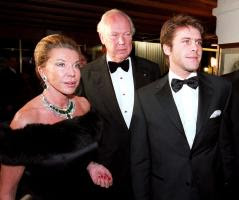 In 2002 Prince Vittorio Emanuele dropped his case at the European Court of Human Rights and instead he and his son, Prince Emanuele Filiberto, wrote a signed letter, published through a law firm, in which they formally expressed their loyalty to the Constitution of Italy. On 23rd October 2002, the provision in the Constitution of Italy that prohibited Prince Vittorio Emanuele's return to Italy was repealed, after he signed an agreement recognizing the republic as the valid government of the state. Prince Vittorio Emanuele was permitted to re-enter the country from 10th November 2002. On 23rd December 2002 he made his first trip home in over half a century. On the one-day visit he, his wife and his son had a 20-minute audience with Pope John Paul II at the Vatican.
The position of Prince Vittorio Emanuele is also claimed by the head of a junior branch of the House of Savoy, his third cousin, Duke Amadeo of Aosta, born 27th September 1943. Duke Amadeo argues that his cousin was no longer eligible to call himself Prince of Savoy because he had failed to secure the legally-required permission of his father, King Umberto II, to marry a Swiss commoner.

The Duke also argued that Prince Vittorio Emanuele forfeited his right to the dynastic title because in order to be allowed to return to Italy from exile in 2002, Prince Victor Emmanuel had to formally recognise the Italian republic as the country's legitimate government. The Duke of Aosta and his family were not forced to go into exile, because the republic did not consider them to be in direct line to the throne, and they stayed in the bilingual autonomous region of Aosta, in the Italian North West. On 22nd July 1964 Duke Amedeo married Princess Claude of France (born 11th December 1943) in Sintra, Portugal. She was the ninth child and fifth daughter of Henri, comte de Paris, de iure King of France, and of Princess Isabelle of Orléans-Braganza, de iure Queen of France.
Prince Vittorio Emanuele, Prince of Naples, son of King Umberto II of Italy, and head of the Royal House of Savoy celebrates his 75th birthday today. He was born on 12th February 1937 in Naples to then Crown Princess Marie-José and Crown Prince Umberto of Italy. As a coincidence his wife, Princess Marina, Princess of Naples, née Marina Ricolfi-Doria, was also born on 12th February, but in 1935.

After the rigged referendum in May 1946, the newly proclaimed Italian republic sent the whole Royal Family into exile. For more then five decades the Savoy family lived in exile, mostly in Switzerland and Portugal, Prince Vittorio Emanuele lived with his mother in an estate in Merlinge, Switzerland. After his wedding in 1971, Prince Vittorio Emanuele, Princess Marina and their son, Prince Emanuele Filiberto, Prince of Venice and Piedmont, born in Geneva on 22nd June 1972, resided in Geneva, Switzerland.
For 56 years, Prince Vittorio Emanuele lobbied the Italian Parliament against the law prohibiting the return to his home country. In 1999, he filed a case at the European Court of Human Rights, in which the Prince charged that his lengthy exile violated his human rights. In September 2001, the court decided to hold a hearing on the case at a date later to be fixed.
 In 2002 Prince Vittorio Emanuele dropped his case at the European Court of Human Rights and instead he and his son, Prince Emanuele Filiberto, wrote a signed letter, published through a law firm, in which they formally expressed their loyalty to the Constitution of Italy. On 23rd October 2002, the provision in the Constitution of Italy that prohibited Prince Vittorio Emanuele's return to Italy was repealed, after he signed an agreement recognizing the republic as the valid government of the state. Prince Vittorio Emanuele was permitted to re-enter the country from 10th November 2002. On 23rd December 2002 he made his first trip home in over half a century. On the one-day visit he, his wife and his son had a 20-minute audience with Pope John Paul II at the Vatican.
The position of Prince Vittorio Emanuele is also claimed by the head of a junior branch of the House of Savoy, his third cousin, Duke Amadeo of Aosta, born 27th September 1943. Duke Amadeo argues that his cousin was no longer eligible to call himself Prince of Savoy because he had failed to secure the legally-required permission of his father, King Umberto II, to marry a Swiss commoner.

The Duke also argued that Prince Vittorio Emanuele forfeited his right to the dynastic title because in order to be allowed to return to Italy from exile in 2002, Prince Victor Emmanuel had to formally recognise the Italian republic as the country's legitimate government. The Duke of Aosta and his family were not forced to go into exile, because the republic did not consider them to be in direct line to the throne, and they stayed in the bilingual autonomous region of Aosta, in the Italian North West. On 22nd July 1964 Duke Amedeo married Princess Claude of France (born 11th December 1943) in Sintra, Portugal. She was the ninth child and fifth daughter of Henri, comte de Paris, de iure King of France, and of Princess Isabelle of Orléans-Braganza, de iure Queen of France.
Wednesday, 8 February 2012
Republicanism does not gain ground
There's little comfort for the republic group in the UK, despite Graham Smith's efforts to claim progress for his cause (there as well as in Australia, therefore he is a welcome writer for the Australian republican publications). In The New Statesman Sunder Katwala wrote on 7th February 2012:
There's little comfort for the republic group in the UK, despite Graham Smith's efforts to claim progress for his cause (there as well as in Australia, therefore he is a welcome writer for the Australian republican publications). In The New Statesman Sunder Katwala wrote on 7th February 2012:
The uncomfortable truth for republicans is that public attitudes to the monarchy have barely shifted.
What is most striking is just how little difference all of that made to public attitudes. There is very limited evidence for the "changing public attitude" which Smith says the media is ignoring. Robert Worcester of pollster MORI has more persuasively identified attitudes to the Monarchy as "the most stable measure of public opinion that exists in this country", remaining remarkably consistent at just under one in five across recent decades.
Support for a republic was 18 per cent in 1969. It was also 18 per cent in 1993, 19 per cent in 2002, 18 per cent again in 2007 and 18 per cent again in 2011. During the turbulent period of 1993-2002, MORI found support for remaining a monarchy remained within the narrow range of 69 per cent to 74 per cent in favour. The Jubilee polls are very likely to find very similar levels of support.
British Future state of the nation polling found a broad appetite for the Jubilee celebrations, with 68 per cent believing that the Jubilee will boost the British national mood, while 7 per cent say it will have a negative impact and 23 per cent say it will make no difference. It is an attitude held by 69 per cent in England and 70 per cent in Wales, and by a majority (55 per cent) in Scotland too.
Perhaps, as Graham Smith claims, "any residual affection" will end with the Queen but it sounds like wishful thinking. The end of a reign and the accession of a new Monarch is as likely to be powerful a moment when the Monarchy is as secure as ever.
Republicans make no effort to understand the Monarchist majority
Republicanism remains, of course, an entirely legitimate democratic project, but its advocates must admit that they are a democratic minority, with a sustained democratic majority for a constitutional monarchy, and has made little apparent effort to understand why most people are not persuaded or to respect the views of those who disagree, tending to portray most people as unthinking drones who have been duped by the propaganda. The challenge for republicans is that, while most people understand the arguments for and against, a majority remain unpersuaded that there would be any significant gain, while many would feel a deep sense of loss at the removal of this living link to British history in order to tidy up the constitution and make the country just a little bit more like everywhere else.
Tuesday, 7 February 2012
Another failed republic - The Maldives president forced to resign
Embattled president Mahomed Nasheed of the Maldives resigned today in the face of growing protests and a police mutiny. He handed power to his deputy Mohamed Waheed Hassan Manik, saying continuing in power would result in his having to use force against his people.
Former political prisoner Mahomed Nasheed beat president Maumoon Abdul Gayoom in 2008 and finished a dictatorial regime that had replaced the century old sultanate of the Maldives in 1968. Although governed as an independent Islamic sultanate from 1153 to 1968, the Maldives was a British protectorate from 1887 until 25 July 1965.
After independence from the UK the sultanate continued to operate for another three years under King Muhammad Fareed Didi. On 11th November 1968, the monarchy was replaced by a republic under the presidency of Ibrahim Nasir.
King Muhammad Fareed Didi, who died one year after he was deposed, had been the first Maldivian Monarch to assume the title of "King" with the style of "Your Majesty" rather than Sultan.

More on the Maldive Royal Family on their website.
Embattled president Mahomed Nasheed of the Maldives resigned today in the face of growing protests and a police mutiny. He handed power to his deputy Mohamed Waheed Hassan Manik, saying continuing in power would result in his having to use force against his people.
Former political prisoner Mahomed Nasheed beat president Maumoon Abdul Gayoom in 2008 and finished a dictatorial regime that had replaced the century old sultanate of the Maldives in 1968. Although governed as an independent Islamic sultanate from 1153 to 1968, the Maldives was a British protectorate from 1887 until 25 July 1965.
After independence from the UK the sultanate continued to operate for another three years under King Muhammad Fareed Didi. On 11th November 1968, the monarchy was replaced by a republic under the presidency of Ibrahim Nasir.
King Muhammad Fareed Didi, who died one year after he was deposed, had been the first Maldivian Monarch to assume the title of "King" with the style of "Your Majesty" rather than Sultan.

More on the Maldive Royal Family on their website.
"Staunchly republican", but not democratic
Should anyone have expected The Age would get the facts right, when one of the paper's journalists wrote – another – condemning editorial on the Queen on her 60th Accession Day anniversary, you were wrong.
After a few nice words about the Queen’s life achievement, the guillotine blade fell: “All this a staunchly republican newspaper like The Age readily concedes. We acknowledge, too, that the enthusiasm for an Australian republic that was strong enough a decade ago to produce a clear majority in favour of change has diminished in recent years.” The Age admitted that “opinion polls now tend to show that support for a republic has dropped below 50per cent”. That's euphemism since the latest opinion poll gave the republicans 34 per cent, hardly a figure as The Age marked it as “not so far below that mark that it could not be reversed”.
The Age repeats the republican myth, that 1999 referendum would have gone in their favour, had the republicans agreed on another model of a politicians’ republic: “The present crop of politicians also remember the scarring experience of the 1999 referendum, when the monarchy survived not because Australians wanted it but because republicans could not agree on a model of republican government. That experience, however, is but a cautionary tale. Next time, there should be a choice of models as well as a choice between the monarchy and the republic. And we should get on with it.” And what, if the majority of Australians still vote to retain the Monarchy? Will The Age (and the republicans) make peace with the Monarchy? Who else will they blame for another defeat next time, if another republican model will be rejected?
 As “a staunchly republican newspaper” The Age will certainly advocate more referenda until the nation’s editorial headmasters will get what they have been hammering into the heads of the naughty Monarchist children.
However, this prophecy might be permitted: The Australian Monarchy will survive The Age’s print editions.
----------------------------------------------------
A letter to the editor of The Age was brought to the RadicalRoyalist's attention. The letter was not published, but the writer gave permission to put it up here:
Should anyone have expected The Age would get the facts right, when one of the paper's journalists wrote – another – condemning editorial on the Queen on her 60th Accession Day anniversary, you were wrong.
After a few nice words about the Queen’s life achievement, the guillotine blade fell: “All this a staunchly republican newspaper like The Age readily concedes. We acknowledge, too, that the enthusiasm for an Australian republic that was strong enough a decade ago to produce a clear majority in favour of change has diminished in recent years.” The Age admitted that “opinion polls now tend to show that support for a republic has dropped below 50per cent”. That's euphemism since the latest opinion poll gave the republicans 34 per cent, hardly a figure as The Age marked it as “not so far below that mark that it could not be reversed”.
The Age repeats the republican myth, that 1999 referendum would have gone in their favour, had the republicans agreed on another model of a politicians’ republic: “The present crop of politicians also remember the scarring experience of the 1999 referendum, when the monarchy survived not because Australians wanted it but because republicans could not agree on a model of republican government. That experience, however, is but a cautionary tale. Next time, there should be a choice of models as well as a choice between the monarchy and the republic. And we should get on with it.” And what, if the majority of Australians still vote to retain the Monarchy? Will The Age (and the republicans) make peace with the Monarchy? Who else will they blame for another defeat next time, if another republican model will be rejected?
 As “a staunchly republican newspaper” The Age will certainly advocate more referenda until the nation’s editorial headmasters will get what they have been hammering into the heads of the naughty Monarchist children.
 However, this prophecy might be permitted: The Australian Monarchy will survive The Age’s print editions.
----------------------------------------------------
A letter to the editor of The Age was brought to the RadicalRoyalist's attention. The letter was not published, but the writer gave permission to put it up here:
It was to be expected that The Age, being 'a staunchly republican newspaper' according to its own account, would present a muted and non-triumphalist coverage of the Queen's extraordinary achievement in reigning for sixty years. Alas, it was also to be expected that its latest propaganda for change to a republic would be intellectually meagre indeed; and it was!
In vain does one look in your editorial for any convincing argument that a republican constitution for Australia would actually be an improvement on one that is monarchical. Contrary to your assertions, the Queen does represent Australians as a credible symbol, for, among other things, she is Sovereign of our mother-country - of what is still, culturally, 'Home'. Think too, please, of this: that the glory of kings and queens is recognised worldwide as a source of unity and inspiration to peoples. There is not, and there never will be, any such charisma for presidents.
Monday, 6 February 2012
 Official Diamond Jubilee portrait of Queen Elizabeth II, Queen of Australia, photographed in the Centre Room of Buckingham Palace, overlooking The Victoria Memorial Statue
The Queen's Diamond Jubilee message in full
Today, as I mark 60 years as your Queen, I am writing to thank you for the wonderful support and encouragement that you have given to me and Prince Philip over these years and to tell you how deeply moved we have been to receive so many kind messages about the Diamond Jubilee.
In this special year, as I dedicate myself anew to your service, I hope we will all be reminded of the power of togetherness and the convening strength of family, friendship and good neighbourliness, examples of which I have been fortunate to see throughout my reign and which my family and I look forward to seeing in many forms as we travel throughout the United Kingdom and the wider Commonwealth.
I hope also that this Jubilee year will be a time to give thanks for the great advances that have been made since 1952 and to look forward to the future with clear head and warm heart as we join together in our celebrations.
I send my sincere good wishes to you all.
ELIZABETH R.
Australia's message to Her Majesty The Queen
6th February 2012

Her Excellency the Governor-General, Ms Quentin Bryce AC CVO, has sent the following message to Her Majesty The Queen, on the occasion of the 60th anniversary of her accession to the Throne:
“It gives me great pleasure, on behalf of the people of Australia, to send Your Majesty loyal and affectionate greetings and congratulations on the 60th anniversary of your accession to the Throne.
The warmth and enthusiasm which greeted Your Majesty and the Duke of Edinburgh on the occasion of your 16th visit to our country last year was a reflection of the immense regard in which you continue to be held.
[My husband] Michael [Bryce] joins me in wishing you a wonderful year ahead”.
The Leader of Her Majesty's Loyal Australian Opposition, the Hon. Tony Abbott posted this message on his website:
The Diamond Jubilee of Her Majesty The Queen
Posted on Monday, 6th February 2012
It was sixty years ago today that Her Majesty The Queen ascended the throne on the death of her father, King George VI.
Though The Queen will formally celebrate her Diamond Jubilee in June it is appropriate that we acknowledge today The Queen’s sixty years of service.
As evidenced by the tens of thousands who greeted her during her most recent visit last year, The Queen has a special place in the hearts of all Australians.
The Queen’s first Australian Prime Minister was Sir Robert Menzies. No less than 11 Australian prime ministers and 17 opposition leaders have come and gone in those sixty years.
Whilst The Queen herself has been unchanging in her commitment to the values of service and loyalty, the Crown has evolved with the people it serves. Over the past sixty years, for instance, the office of Governor-General has evolved into a fully Australian office.
Today Australians will think of our Queen with respect and affection.
I hope all Australians will have the opportunity to celebrate and commemorate The Queen’s Diamond Jubilee during 2012. The Coalition will be supportive of appropriate national commemorations that honour this significant event.
Her Majesty's Australian Prime Minister, the Hon Julia Gillard, had a transcript of a press conference in Canberra on her website:
6th February 2012
I’ve got three matters to deal with today. First I would like to offer my congratulations to the Queen on her Diamond Jubilee. Today is the anniversary, the sixtieth anniversary of her accession to the throne. We will be saying some more about this in Parliament tomorrow and particularly the ways that Australians can get involved in celebrating the Diamond Jubilee this year.
For today it is enough to say that we are marking a remarkable event for our Monarch, she is the only person to reach – the second person to reach the Diamond Jubilee anniversary, a truly remarkable event. I believe Australians remember her visit to Australia last year with a feeling of warmth and many Australians will want to get involved in celebrating this milestone this year.
6th February 2012

Her Excellency the Governor-General, Ms Quentin Bryce AC CVO, has sent the following message to Her Majesty The Queen, on the occasion of the 60th anniversary of her accession to the Throne:
“It gives me great pleasure, on behalf of the people of Australia, to send Your Majesty loyal and affectionate greetings and congratulations on the 60th anniversary of your accession to the Throne.
The warmth and enthusiasm which greeted Your Majesty and the Duke of Edinburgh on the occasion of your 16th visit to our country last year was a reflection of the immense regard in which you continue to be held.
[My husband] Michael [Bryce] joins me in wishing you a wonderful year ahead”.
The Leader of Her Majesty's Loyal Australian Opposition, the Hon. Tony Abbott posted this message on his website:
The Diamond Jubilee of Her Majesty The Queen
Posted on Monday, 6th February 2012
It was sixty years ago today that Her Majesty The Queen ascended the throne on the death of her father, King George VI.
Though The Queen will formally celebrate her Diamond Jubilee in June it is appropriate that we acknowledge today The Queen’s sixty years of service.
As evidenced by the tens of thousands who greeted her during her most recent visit last year, The Queen has a special place in the hearts of all Australians.
The Queen’s first Australian Prime Minister was Sir Robert Menzies. No less than 11 Australian prime ministers and 17 opposition leaders have come and gone in those sixty years.
Whilst The Queen herself has been unchanging in her commitment to the values of service and loyalty, the Crown has evolved with the people it serves. Over the past sixty years, for instance, the office of Governor-General has evolved into a fully Australian office.
Today Australians will think of our Queen with respect and affection.
I hope all Australians will have the opportunity to celebrate and commemorate The Queen’s Diamond Jubilee during 2012. The Coalition will be supportive of appropriate national commemorations that honour this significant event.
Her Majesty's Australian Prime Minister, the Hon Julia Gillard, had a transcript of a press conference in Canberra on her website:
6th February 2012
I’ve got three matters to deal with today. First I would like to offer my congratulations to the Queen on her Diamond Jubilee. Today is the anniversary, the sixtieth anniversary of her accession to the throne. We will be saying some more about this in Parliament tomorrow and particularly the ways that Australians can get involved in celebrating the Diamond Jubilee this year.
For today it is enough to say that we are marking a remarkable event for our Monarch, she is the only person to reach – the second person to reach the Diamond Jubilee anniversary, a truly remarkable event. I believe Australians remember her visit to Australia last year with a feeling of warmth and many Australians will want to get involved in celebrating this milestone this year.
Thursday, 2 February 2012
Accession Day celebration in Melbourne
Melburnians have the opportunity to celebrate the Queen of Australia’s 60th anniversary of the Accession on Monday, 6th February at 2 pm at the Mission to Seafarers, 717 Flinders Street, Melbourne, Victoria 3005. Please inform Phyl if your are coming, Tel. 9645 4417.
 The seafarers' building was designed by Walter Butler in 1916 and is architecturally significant as being a fine urban example of the Arts and Crafts & Spanish Mission style in Melbourne. It was also the place, where Melburnian Monarchists came together to celebrate Prince Charles' 60th birthday.
The building itself is worth a visit since it is an oasis of calm in the city.
Melburnians have the opportunity to celebrate the Queen of Australia’s 60th anniversary of the Accession on Monday, 6th February at 2 pm at the Mission to Seafarers, 717 Flinders Street, Melbourne, Victoria 3005. Please inform Phyl if your are coming, Tel. 9645 4417.
 The seafarers' building was designed by Walter Butler in 1916 and is architecturally significant as being a fine urban example of the Arts and Crafts & Spanish Mission style in Melbourne. It was also the place, where Melburnian Monarchists came together to celebrate Prince Charles' 60th birthday.
The building itself is worth a visit since it is an oasis of calm in the city.
Tuesday, 31 January 2012
January saw another royal visit to Melbourne
Thanks to a francophone website, the RadicalRoyalist learned of a visit of HRH The Duke of Kent KG GCMG GCVO to Melbourne.
The visit was mentioned on Government House's vice regal notes:
Friday, 27th January 2012
HRH The Duke of Kent KG GCMG GCVO, arrived to stay at Government House. The Governor, Alex Chernov AC QC, received HRH The Duke of Kent.
The Governor and Mrs Chernov dined with HRH The Duke of Kent
Monday, 30th January 2012
HRH The Duke of Kent departed Government House.
He came to Melbourne in his capacity as Patron of the Royal Institute of Australia, as President of the All England Tennis and Croquet Club, home of the Wimbledon tennis championships, and as President of the Commonwealth War Graves Commission.
The Duke has been involved in the development and communication of science and innovation over a long period, both as President of the UK’s oldest centre of science communication The Royal Institution and in supporting innovation in particular its contribution to economic growth. There have been a number of examples of recent joint success in both Great Britain and Victoria, notably in Melbourne.
At a lunch, organised by the Australian British Chamber of Commerce, His Royal Highness gave a talk on his experience in science communication and innovation.
This royal visit escaped our attention since The Age stopped publishing vice-regal notes last April. When questioned on the reasons for the discontinued publication this reply was sent:
A second mail never arrived.
Thanks to a francophone website, the RadicalRoyalist learned of a visit of HRH The Duke of Kent KG GCMG GCVO to Melbourne.
The visit was mentioned on Government House's vice regal notes:
Friday, 27th January 2012
HRH The Duke of Kent KG GCMG GCVO, arrived to stay at Government House. The Governor, Alex Chernov AC QC, received HRH The Duke of Kent.
The Governor and Mrs Chernov dined with HRH The Duke of Kent
Monday, 30th January 2012
HRH The Duke of Kent departed Government House.
He came to Melbourne in his capacity as Patron of the Royal Institute of Australia, as President of the All England Tennis and Croquet Club, home of the Wimbledon tennis championships, and as President of the Commonwealth War Graves Commission.
The Duke has been involved in the development and communication of science and innovation over a long period, both as President of the UK’s oldest centre of science communication The Royal Institution and in supporting innovation in particular its contribution to economic growth. There have been a number of examples of recent joint success in both Great Britain and Victoria, notably in Melbourne.
At a lunch, organised by the Australian British Chamber of Commerce, His Royal Highness gave a talk on his experience in science communication and innovation.
This royal visit escaped our attention since The Age stopped publishing vice-regal notes last April. When questioned on the reasons for the discontinued publication this reply was sent:
In all honesty, I don't know why we no longer publish vice-regal. I would assume it's do with the limited space in the paper, as opposed to the unlimited space available on the internet, but that's just an educated guess. I will, however, ask around, and if anyone can tell me definitively I'll let you know.
A second mail never arrived.
A Portuguese Infanta's 100th birthday
She is living history: Infanta Dona Maria Adelaide de Bragança van Uden was born on 31st January 1912 as the youngest daughter of [King] Miguel (II), Duke of Bragança and Princess Maria Theresa of Löwenstein-Wertheim-Rosenberg in Saint-Jean-de-Luz, France, and is the last surviving granddaughter of a Portuguese monarch, King Miguel I of Portugal and his wife Princess Adelaide of Löwenstein-Wertheim-Rosenberg. Her godparents were King Manuel II, the last reigning King of Portugal, and his mother, Queen Amélia of Portugal, née Princess of France of the House of Bourbon-Orléans.

Dona Maria Adelaide's siblings were Dona Isabel Maria of Bragança, Infanta of Portugal (1894–1970) who married Franz Joseph, 9th Prince of Thurn and Taxis, Dona Maria Benedita of Bragança, Infanta of Portugal (1896–1971), Dona Mafalda of Bragança, Infanta of Portugal (1898–1918), Dona Maria Anna of Bragança, Infanta of Portugal (1899–1971) who married Karl August, 10th Prince of Thurn and Taxis, Dona Maria Antónia of Bragança, Infanta of Portugal (1903–1973), Dona Filippa Maria of Bragança, Infanta of Portugal (1905–1990) and Dom Duarte Nuno, Duke of Bragança (1907–1976), father of the current head of the Portuguese Royal Family, Dom Duarte Pio.
Infanta Maria Adelaide is a cousin (among others) of Princess Elisabeth Amalia of Liechtenstein, Queen Elisabeth of the Belgians, grandmother of the present King of the Belgians, Albert II, Crown Princess Marie Gabrielle of Bavaria, Grand Duchess Marie-Adélaïde of Luxembourg, Grand Duchess Charlotte of Luxembourg, Crown Princess Antoinette of Bavaria, Duke Xavier of Parma and not to forget: Empress Zita of Austria, crowned Queen of Hungary.
She was educated in the Sacré Coeur College in Riedenburg, Austria, married in Vienna, 13th October 1945, Dr. Nicolaas van Uden (Venlo, 5th March 1921 – Lisbon, 5th February 1991) a medical biochemist and a great scientific authority in the field of yeast development.
Infanta Maria Adelaide lived in Vienna, Austria, working as a nurse and social assistant. During World War II, when there were bombardments, she was travelled at night to the place to provide aid to the victims. She was part of the Nazi resistance movement, caught by the Gestapo and sentenced to death. Portugal's dictator António de Oliveira Salazar intervened with the Germans, claiming that Infanta Maria Adelaide was a "national heritage". The intervention of the Portuguese diplomacy resulted in the release and her immediate deportation, which settled in Switzerland. It was there that her brother Dom Duarte Nuno, Duke of Bragança, and sister-in-law Dona Maria Francisca , Duchess of Bragança, lived. After the war, the family finally returned in Austria. In 1949, Dona Maria Adelaide could return to her ancestors' home country, Portugal.
According to the official succession list Infanta Maria Adelaide is 6th in line to the Portuguese throne.
The blog Família Real Portuguesa, always a valuable source of information, published today’s programme for Her Royal Highness’ birthday celebrations.
Feliz aniversário, Sua Alteza Real!
She is living history: Infanta Dona Maria Adelaide de Bragança van Uden was born on 31st January 1912 as the youngest daughter of [King] Miguel (II), Duke of Bragança and Princess Maria Theresa of Löwenstein-Wertheim-Rosenberg in Saint-Jean-de-Luz, France, and is the last surviving granddaughter of a Portuguese monarch, King Miguel I of Portugal and his wife Princess Adelaide of Löwenstein-Wertheim-Rosenberg. Her godparents were King Manuel II, the last reigning King of Portugal, and his mother, Queen Amélia of Portugal, née Princess of France of the House of Bourbon-Orléans.

Dona Maria Adelaide's siblings were Dona Isabel Maria of Bragança, Infanta of Portugal (1894–1970) who married Franz Joseph, 9th Prince of Thurn and Taxis, Dona Maria Benedita of Bragança, Infanta of Portugal (1896–1971), Dona Mafalda of Bragança, Infanta of Portugal (1898–1918), Dona Maria Anna of Bragança, Infanta of Portugal (1899–1971) who married Karl August, 10th Prince of Thurn and Taxis, Dona Maria Antónia of Bragança, Infanta of Portugal (1903–1973), Dona Filippa Maria of Bragança, Infanta of Portugal (1905–1990) and Dom Duarte Nuno, Duke of Bragança (1907–1976), father of the current head of the Portuguese Royal Family, Dom Duarte Pio.
Infanta Maria Adelaide is a cousin (among others) of Princess Elisabeth Amalia of Liechtenstein, Queen Elisabeth of the Belgians, grandmother of the present King of the Belgians, Albert II, Crown Princess Marie Gabrielle of Bavaria, Grand Duchess Marie-Adélaïde of Luxembourg, Grand Duchess Charlotte of Luxembourg, Crown Princess Antoinette of Bavaria, Duke Xavier of Parma and not to forget: Empress Zita of Austria, crowned Queen of Hungary.
She was educated in the Sacré Coeur College in Riedenburg, Austria, married in Vienna, 13th October 1945, Dr. Nicolaas van Uden (Venlo, 5th March 1921 – Lisbon, 5th February 1991) a medical biochemist and a great scientific authority in the field of yeast development.
Infanta Maria Adelaide lived in Vienna, Austria, working as a nurse and social assistant. During World War II, when there were bombardments, she was travelled at night to the place to provide aid to the victims. She was part of the Nazi resistance movement, caught by the Gestapo and sentenced to death. Portugal's dictator António de Oliveira Salazar intervened with the Germans, claiming that Infanta Maria Adelaide was a "national heritage". The intervention of the Portuguese diplomacy resulted in the release and her immediate deportation, which settled in Switzerland. It was there that her brother Dom Duarte Nuno, Duke of Bragança, and sister-in-law Dona Maria Francisca , Duchess of Bragança, lived. After the war, the family finally returned in Austria. In 1949, Dona Maria Adelaide could return to her ancestors' home country, Portugal.
According to the official succession list Infanta Maria Adelaide is 6th in line to the Portuguese throne.
The blog Família Real Portuguesa, always a valuable source of information, published today’s programme for Her Royal Highness’ birthday celebrations.
Feliz aniversário, Sua Alteza Real!
Monday, 30 January 2012
King Abdullah II of Jordan turns 50 today
His Majesty King Abdullah II bin Al-Hussein, The King of the Hashemite Kingdom of Jordan, celebrates his 50th birthday this 30th January.
The following biography is from the King's official website and gives the best insight into his life:
The 41st-generation direct descendant of the Prophet Mohammad (peace be upon him), His Majesty King Abdullah II assumed his constitutional powers as monarch on 7th February 1999.
 Following the leadership legacy of his father, the late King Hussein, King Abdullah has made the welfare of Jordan’s people the cornerstone of his policies for national development, regional peace and global coexistence. The King’s special concern for the future of Jordan’s young people has put youth engagement, education and opportunity at the top of his agenda. At home, he has paired economic reforms with political liberalisation and an innovative program of national development. He has overseen sweeping educational reforms, which today are energising Jordan's private sector and preparing Jordan's youth for global competitiveness and leadership.
To provide real solutions to Jordan’s pressing economic needs, King Abdullah ushered in a new era of structural reform and modernisation, integration with the world economy and globalisation. The King has worked to bring together the public and private sectors – both domestic and global – through large-scale joint initiatives aimed at meeting the urgent challenges of job creation, opportunity for Jordan's young population and poverty alleviation. King Abdullah personally championed Jordan's accession to the World Trade Organisation, presided over Jordan’s becoming the first Arab country to sign a free trade agreement with the United States and has forged new bilateral and multilateral economic alliances with countries from Asia to Latin America.
In diplomatic affairs, King Abdullah has been the voice of Jordan’s progressive policies to expand global justice and cooperation. Taking up the historical role of the Hashemite Family, he has championed the rights, achievements and values of Muslims worldwide. In 2004, he worked with leading Islamic scholars to release the Amman Message, reaching a global audience with Islam's guiding principles of peace, tolerance and dialogue among faiths.
In the footsteps of the late King Hussein, King Abdullah renewed a firm commitment to peace in the region on the basis of the two-state solution and the establishment of a viable, independent and geographically contiguous Palestinian state with East Jerusalem as its capital, living in peace alongside Israel, in accordance with UN resolutions and the 2002 Arab Peace Initiative.
King Abdullah is the eldest son of His Majesty King Hussein Bin Talal (1935-1999) and Her Royal Highness Princess Muna Al Hussein. Born in Amman on 30th January 1962, he is the namesake of King Abdullah I, his great-grandfather, the founder of modern Jordan.
King Abdullah began his education at the Islamic Educational College in Amman. He later attended St. Edmund's School in Surrey, England, and concluded his high school education at Deerfield Academy in the United States. Later, he pursued advanced studies at Pembroke College, Oxford, and Georgetown University.
The young prince was a man of action on the athletic field and the training ground. In 1980, he enrolled in the Royal Military Academy at Sandhurst (UK) and was commissioned as second lieutenant in 1981. He served in the British Army in the 13/18th Royal Hussars Regiment, with duties as a reconnaissance troop leader in the United Kingdom and Germany.
In 1985, then-Prince Abdullah returned to Jordan to serve in the armed forces (Armoured Corps, 3rd Division). Rising through the ranks to lieutenant-colonel, he attended advanced military courses in both Jordan and the UK. Among other duties, he served on attachment to the Special Forces and qualified as a Cobra attack helicopter pilot. After service as commander of the 2nd Armoured Battalion, 40th Armoured Brigade, he was named deputy commander, Jordanian Special Forces, in January 1993.
In November 1993, Prince Abdullah became commander of Jordan's Special Forces. In 1996, he was given the task of reorganising the Special Forces and other elite units into the new Special Operations Command (SOCOM). In 1998, as SOCOM commander, he was promoted to the rank of major general.
In his off-duty hours, the Prince became well known for his interest in land, sea and air sports, including free-fall parachuting. He shared his father's passion for cars and motorcycles and became a Jordan National Rally champion. Today, he continues to enjoy aquatic sports, including boating and scuba diving. During his time in the military, King Abdullah also developed an interest in ancient weapons and today, he maintains a world-class collection of military artefacts.
King Abdullah’s service in the army was always a source of personal pride and his respect for those who serve their nation has been a conspicuous quality of his leadership. Today, the King describes Jordan's armed forces as the “foremost symbol of honour, bravery, sacrifice and belonging."
During his years as an army officer, then-Prince Abdullah was regularly dispatched on official diplomatic and military missions. He also frequently served his country in the capacity of regent in King Hussein's absence.

In 1993, then-Prince Abdullah met Rania Al-Yassin. Six months later, the couple were engaged and they married on 10th June 1993. As a princess, Queen Rania began the powerful social work and advocacy which she continues to this day. The Royal Couple's first child, Prince Hussein, the Crown Prince, was born on 28th June 1994. Since then, they have had three more children: Princess Iman (27th September 1996); Princess Salma (26th September 2000); and Prince Hashem (30th January 2005).
Happy Birthday, Your Majesty!
His Majesty King Abdullah II bin Al-Hussein, The King of the Hashemite Kingdom of Jordan, celebrates his 50th birthday this 30th January.
The following biography is from the King's official website and gives the best insight into his life:
The 41st-generation direct descendant of the Prophet Mohammad (peace be upon him), His Majesty King Abdullah II assumed his constitutional powers as monarch on 7th February 1999.
 Following the leadership legacy of his father, the late King Hussein, King Abdullah has made the welfare of Jordan’s people the cornerstone of his policies for national development, regional peace and global coexistence. The King’s special concern for the future of Jordan’s young people has put youth engagement, education and opportunity at the top of his agenda. At home, he has paired economic reforms with political liberalisation and an innovative program of national development. He has overseen sweeping educational reforms, which today are energising Jordan's private sector and preparing Jordan's youth for global competitiveness and leadership.
To provide real solutions to Jordan’s pressing economic needs, King Abdullah ushered in a new era of structural reform and modernisation, integration with the world economy and globalisation. The King has worked to bring together the public and private sectors – both domestic and global – through large-scale joint initiatives aimed at meeting the urgent challenges of job creation, opportunity for Jordan's young population and poverty alleviation. King Abdullah personally championed Jordan's accession to the World Trade Organisation, presided over Jordan’s becoming the first Arab country to sign a free trade agreement with the United States and has forged new bilateral and multilateral economic alliances with countries from Asia to Latin America.
In diplomatic affairs, King Abdullah has been the voice of Jordan’s progressive policies to expand global justice and cooperation. Taking up the historical role of the Hashemite Family, he has championed the rights, achievements and values of Muslims worldwide. In 2004, he worked with leading Islamic scholars to release the Amman Message, reaching a global audience with Islam's guiding principles of peace, tolerance and dialogue among faiths.
In the footsteps of the late King Hussein, King Abdullah renewed a firm commitment to peace in the region on the basis of the two-state solution and the establishment of a viable, independent and geographically contiguous Palestinian state with East Jerusalem as its capital, living in peace alongside Israel, in accordance with UN resolutions and the 2002 Arab Peace Initiative.
King Abdullah is the eldest son of His Majesty King Hussein Bin Talal (1935-1999) and Her Royal Highness Princess Muna Al Hussein. Born in Amman on 30th January 1962, he is the namesake of King Abdullah I, his great-grandfather, the founder of modern Jordan.
King Abdullah began his education at the Islamic Educational College in Amman. He later attended St. Edmund's School in Surrey, England, and concluded his high school education at Deerfield Academy in the United States. Later, he pursued advanced studies at Pembroke College, Oxford, and Georgetown University.
The young prince was a man of action on the athletic field and the training ground. In 1980, he enrolled in the Royal Military Academy at Sandhurst (UK) and was commissioned as second lieutenant in 1981. He served in the British Army in the 13/18th Royal Hussars Regiment, with duties as a reconnaissance troop leader in the United Kingdom and Germany.
In 1985, then-Prince Abdullah returned to Jordan to serve in the armed forces (Armoured Corps, 3rd Division). Rising through the ranks to lieutenant-colonel, he attended advanced military courses in both Jordan and the UK. Among other duties, he served on attachment to the Special Forces and qualified as a Cobra attack helicopter pilot. After service as commander of the 2nd Armoured Battalion, 40th Armoured Brigade, he was named deputy commander, Jordanian Special Forces, in January 1993.
In November 1993, Prince Abdullah became commander of Jordan's Special Forces. In 1996, he was given the task of reorganising the Special Forces and other elite units into the new Special Operations Command (SOCOM). In 1998, as SOCOM commander, he was promoted to the rank of major general.
In his off-duty hours, the Prince became well known for his interest in land, sea and air sports, including free-fall parachuting. He shared his father's passion for cars and motorcycles and became a Jordan National Rally champion. Today, he continues to enjoy aquatic sports, including boating and scuba diving. During his time in the military, King Abdullah also developed an interest in ancient weapons and today, he maintains a world-class collection of military artefacts.
King Abdullah’s service in the army was always a source of personal pride and his respect for those who serve their nation has been a conspicuous quality of his leadership. Today, the King describes Jordan's armed forces as the “foremost symbol of honour, bravery, sacrifice and belonging."
During his years as an army officer, then-Prince Abdullah was regularly dispatched on official diplomatic and military missions. He also frequently served his country in the capacity of regent in King Hussein's absence.

In 1993, then-Prince Abdullah met Rania Al-Yassin. Six months later, the couple were engaged and they married on 10th June 1993. As a princess, Queen Rania began the powerful social work and advocacy which she continues to this day. The Royal Couple's first child, Prince Hussein, the Crown Prince, was born on 28th June 1994. Since then, they have had three more children: Princess Iman (27th September 1996); Princess Salma (26th September 2000); and Prince Hashem (30th January 2005).
Happy Birthday, Your Majesty!
Friday, 27 January 2012
Rob Hulls resigns from politics - and about time, too
The Deputy Opposition Leader in the Victorian Parliament, Rob Hulls, today announced his resignation after more than 15 years in State Parliament. He served in Her Majesty's Victorian governments as attorney-general and has been in the position of Deputy Opposition Leader and education spokesman since Labor lost power in November 2010.
As fierce republican he did everything to damage the position of the Monarchy in Victoria and beyond. See:
- The Crown vs. The DPP
- Creeping republicanism
- "Rabid Monarchists"
- "The proposition by Mr Hulls is an affront in itself"
His retirement (to a lucrative position on a bank board like other ex-politicians?) is more than welcome news.
The Deputy Opposition Leader in the Victorian Parliament, Rob Hulls, today announced his resignation after more than 15 years in State Parliament. He served in Her Majesty's Victorian governments as attorney-general and has been in the position of Deputy Opposition Leader and education spokesman since Labor lost power in November 2010.
As fierce republican he did everything to damage the position of the Monarchy in Victoria and beyond. See:
- The Crown vs. The DPP
- Creeping republicanism
- "Rabid Monarchists"
- "The proposition by Mr Hulls is an affront in itself"
His retirement (to a lucrative position on a bank board like other ex-politicians?) is more than welcome news.
Wednesday, 25 January 2012
Portuguese President demands more money despite cuts for everybody else
Ignored by the international media, a scandal has erupted in Portugal caused by the stubborn greed of Anibal Cavaco Silva, the Portuguese republic’s president. He had chosen the first anniversary of his re-election to complain about his impoverished living conditions.
While the debt crisis hit Portugal hard, the country’s governments (a Socialist one until 5th June 2011, after the its election defeat a coalition of Social Democrats [PDS] and Christian Democrats [CDS-PP]) are taking tough austerity measures to minimize the budget deficit. Amongst other measures the Socialist government decided that public servants cannot receive a salary and a pension at the same time. Under the new law Mr. Cavaco Silva renounced his presidential salary of €6523.93. As a former bank manager and university professor he is already entitled to a pension of €10,042.00 a month. On the anniversary of his election he complained that he cannot have a decent life with just €141,000 a year, in his case there is no scrapping of the 13th and 14th monthly holiday and Christmas payments.
 A new member of the Occupy Movement: Anibal Cavaco Silva can't live on €10,042 a month.
His public outburst into a TV camera was not well received since the average Portuguese pensioner who lives on €600 a month and does no longer benefit from the once usual 13th and 14th payment. Price hikes on public transport, salary cuts for public servants and other austerity measures do not bother Mr. Cavaco Silva: He insists on a proper pension for himself and his wife, otherwise he would not be able to keep his standard of living.
The outrage is widespread and internet activists not only call for his resignation (Sr. Professor Cavaco, demita-se), but petitions can be signed to force Mr. Cavaco Silva out of office. Petição Pedido de Demissão do Presidente da República . Protesters gathered outside Portugal’s presidential palace to donate money and food to the head of state.
The best comment was already made last year. On 2nd March 2011 Dom Duarte Pio, heir to the Portuguese Crown, commented on the high abstention rate at the presidential elections: 60 percent of the Portuguese no longer care about the presidency. (Jornal de Notícias: O chefe da Casa Real Portuguesa, Duarte Pio de Bragança, defende que a elevada abstenção nas últimas eleições presidenciais significa que a Presidência da República, 'aparentemente, já não merece consideração da parte da maioria dos portugueses'.") But perhaps they do care about how much he is paid.
Ignored by the international media, a scandal has erupted in Portugal caused by the stubborn greed of Anibal Cavaco Silva, the Portuguese republic’s president. He had chosen the first anniversary of his re-election to complain about his impoverished living conditions.
While the debt crisis hit Portugal hard, the country’s governments (a Socialist one until 5th June 2011, after the its election defeat a coalition of Social Democrats [PDS] and Christian Democrats [CDS-PP]) are taking tough austerity measures to minimize the budget deficit. Amongst other measures the Socialist government decided that public servants cannot receive a salary and a pension at the same time. Under the new law Mr. Cavaco Silva renounced his presidential salary of €6523.93. As a former bank manager and university professor he is already entitled to a pension of €10,042.00 a month. On the anniversary of his election he complained that he cannot have a decent life with just €141,000 a year, in his case there is no scrapping of the 13th and 14th monthly holiday and Christmas payments.
 A new member of the Occupy Movement: Anibal Cavaco Silva can't live on €10,042 a month.
His public outburst into a TV camera was not well received since the average Portuguese pensioner who lives on €600 a month and does no longer benefit from the once usual 13th and 14th payment. Price hikes on public transport, salary cuts for public servants and other austerity measures do not bother Mr. Cavaco Silva: He insists on a proper pension for himself and his wife, otherwise he would not be able to keep his standard of living.
The outrage is widespread and internet activists not only call for his resignation (Sr. Professor Cavaco, demita-se), but petitions can be signed to force Mr. Cavaco Silva out of office. Petição Pedido de Demissão do Presidente da República . Protesters gathered outside Portugal’s presidential palace to donate money and food to the head of state.
The best comment was already made last year. On 2nd March 2011 Dom Duarte Pio, heir to the Portuguese Crown, commented on the high abstention rate at the presidential elections: 60 percent of the Portuguese no longer care about the presidency. (Jornal de Notícias: O chefe da Casa Real Portuguesa, Duarte Pio de Bragança, defende que a elevada abstenção nas últimas eleições presidenciais significa que a Presidência da República, 'aparentemente, já não merece consideração da parte da maioria dos portugueses'.") But perhaps they do care about how much he is paid.
Saturday, 21 January 2012
Beware if you dance with Wulff
The German president Christan Wulff has been in trouble since mid-December 2011. He did not help his cause by sacking his spokesman without naming any reason on 22nd December. Before the sudden disappearance of Olaf Glaeseker, Christian Wulff had called him “my factotum” and even said “we are like Siamese twins” and "he is my alter ego".
 How embarrassing this must be for Wulff to be confronted with this news footage, after Olaf Glaeseker’s office was raided last Thursday, 19th January. He is suspected of corruption and bribery. The offices of event manager Manfred Schmidt, who worked closely with the Wulff's office, when he was still Premier of Lower Saxony, were also searched.
 Spiegel.de reports:
HIH Prince Georg Friedrich at Bellevue Palace
 Meanwhile at Bellevue Palace, presently occupied by Christian Wulff, Prince Georg Friedrich of Prussia had been seen last Monday, 16th January. However, the hope that Wulff was preparing a hand-over of the highest office in Germany to the Hohenzollern Prince, are premature. Wulff isn't ready yet to resign. Instead His Imperial Highness, his wife, HIH Princess Sophie of Prussia and twenty other guests dined at Bellevue Palace. Christian Wulff had invited the heir to the German Crown because after last year's 950 anniversary of the House of Hohenzollern, Germany commemorates this year the 300th anniversary of the birth of King Frederik II of Prussia.
Considering the scandals in which the republican head of Germany is involved, this is certainly a good time to reflect on the advantages of a Monarchy or have read that the Queen had to go to a TV studio to apologise for lies and mistakes? The politicians' president cannot shake of his political past which is plastered with helpful friends and financiers.
The German president Christan Wulff has been in trouble since mid-December 2011. He did not help his cause by sacking his spokesman without naming any reason on 22nd December. Before the sudden disappearance of Olaf Glaeseker, Christian Wulff had called him “my factotum” and even said “we are like Siamese twins” and "he is my alter ego".
 How embarrassing this must be for Wulff to be confronted with this news footage, after Olaf Glaeseker’s office was raided last Thursday, 19th January. He is suspected of corruption and bribery. The offices of event manager Manfred Schmidt, who worked closely with the Wulff's office, when he was still Premier of Lower Saxony, were also searched.
 Spiegel.de reports:
 Both media reports and official investigations have led to suspicions that Glaeseker had improperly funded a series of conferences called "North-South Dialogue," which Schmidt had organized. The series took place between 2007 and 2009 and were sponsored by Wulff and then-Baden Württemberg Premier Günther Oettinger. In December SPIEGEL reported on allegations that Schmidt earned several hundred thousand Euros that had been provided by business sponsors at a single 2009 event.State prosecutors in Lower Saxony say that Wulff is not currently a target of any investigation.
In return, it is thought that Schmidt made his holiday home available for free to Glaeseker and his wife for three vacations. At the time, Glaeseker was the government spokesman for Lower Saxony and, as a state official, was not allowed to accept such expensive gifts.
HIH Prince Georg Friedrich at Bellevue Palace
 Meanwhile at Bellevue Palace, presently occupied by Christian Wulff, Prince Georg Friedrich of Prussia had been seen last Monday, 16th January. However, the hope that Wulff was preparing a hand-over of the highest office in Germany to the Hohenzollern Prince, are premature. Wulff isn't ready yet to resign. Instead His Imperial Highness, his wife, HIH Princess Sophie of Prussia and twenty other guests dined at Bellevue Palace. Christian Wulff had invited the heir to the German Crown because after last year's 950 anniversary of the House of Hohenzollern, Germany commemorates this year the 300th anniversary of the birth of King Frederik II of Prussia.
Considering the scandals in which the republican head of Germany is involved, this is certainly a good time to reflect on the advantages of a Monarchy or have read that the Queen had to go to a TV studio to apologise for lies and mistakes? The politicians' president cannot shake of his political past which is plastered with helpful friends and financiers.
Friday, 20 January 2012
Exhibition of the Art of Queen Margrethe II of Denmark
On 28th January 2012 Copenhagen's Museum of modern Art - ARKEN - opens the doors to the exhibition THE ESSENCE OF COLOUR – The Art of Queen Margrethe II of Denmark. This is the biggest exhibition hitherto of the Queen’s art, where the public can follow her artistic development over the past 35 years. Over 130 acrylic paintings, water-colours and découpages are presented – including a series of brand new works that have never before been shown to the public.

“The exhibition offers unique insight into the artist Margrethe II. We meet an open, vulnerable, searching human being who is able to convert her reflections on the fundamental existential conditions of human life into simple, lucid art,” says the director of ARKEN, Christian Gether, of The Essence of Colour.

In 1969 the Danish Queen read Tolkien’s epic fantasy, which inspired among other things the series of water-colours Landscapes for Lost Legends. Since then, nature has been a central theme in the Queen’s art. “It is not only charming, it is also vast and frightening – and most fascinating of all when it is vast and frightening,” explains the Queen in conversation with Christian Gether about her sombre, depopulated landscapes. This is a mythical universe where the intensity, depth and atmosphere of the subject are created by colours. At the same time the tones in the Queen’s water-colours and paintings express emotions beyond the reach of words. The Queen herself says to Christian Gether: “For me it is always the colour, first and foremost.”
Humour as an artistic ploy
The Queen’s works reflect a special relationship with history and the present. This is most clearly seen in the découpages; incredible compositions of cuttings from art periodicals and art sale catalogues, teeming with references to the history of style and architectural details that create a setting for a burlesque sense of humour. The découpages have been used among other ways as scenery in the filming of The Snow Queen and The Wild Swans by Hans Christian Andersen, where they have evoked a fascinating, highly distinctive pictorial universe.
Traces of lived life
In her most recent works the Queen moves from the large landscapes to small natural fragments and ‘zooms in’ on individual elements such as rocks, carcases and bones. The bone series is brand new and has never been exhibited before. The urge to paint bones came irresistibly, just as the urge to paint stones and carcases was something inherent that simply had to come to expression through the brush. The bone pictures are not ‘true to life’ and the Queen describes them as “large, strange pictures of imaginary bones on a yellow ground.” There is something latently eerie about them, and reflections on mortality inevitably spring to mind. There are both humour and seriousness in these raw Vanitas symbols with forms so organic that you feel like reaching out and touching them.
As a viewer one can simply enjoy the insight into the artistic universe that the Queen has so generously chosen to share with the public.
On 28th January 2012 Copenhagen's Museum of modern Art - ARKEN - opens the doors to the exhibition THE ESSENCE OF COLOUR – The Art of Queen Margrethe II of Denmark. This is the biggest exhibition hitherto of the Queen’s art, where the public can follow her artistic development over the past 35 years. Over 130 acrylic paintings, water-colours and découpages are presented – including a series of brand new works that have never before been shown to the public.

“The exhibition offers unique insight into the artist Margrethe II. We meet an open, vulnerable, searching human being who is able to convert her reflections on the fundamental existential conditions of human life into simple, lucid art,” says the director of ARKEN, Christian Gether, of The Essence of Colour.

In 1969 the Danish Queen read Tolkien’s epic fantasy, which inspired among other things the series of water-colours Landscapes for Lost Legends. Since then, nature has been a central theme in the Queen’s art. “It is not only charming, it is also vast and frightening – and most fascinating of all when it is vast and frightening,” explains the Queen in conversation with Christian Gether about her sombre, depopulated landscapes. This is a mythical universe where the intensity, depth and atmosphere of the subject are created by colours. At the same time the tones in the Queen’s water-colours and paintings express emotions beyond the reach of words. The Queen herself says to Christian Gether: “For me it is always the colour, first and foremost.”
Humour as an artistic ploy
The Queen’s works reflect a special relationship with history and the present. This is most clearly seen in the découpages; incredible compositions of cuttings from art periodicals and art sale catalogues, teeming with references to the history of style and architectural details that create a setting for a burlesque sense of humour. The découpages have been used among other ways as scenery in the filming of The Snow Queen and The Wild Swans by Hans Christian Andersen, where they have evoked a fascinating, highly distinctive pictorial universe.
Traces of lived life
In her most recent works the Queen moves from the large landscapes to small natural fragments and ‘zooms in’ on individual elements such as rocks, carcases and bones. The bone series is brand new and has never been exhibited before. The urge to paint bones came irresistibly, just as the urge to paint stones and carcases was something inherent that simply had to come to expression through the brush. The bone pictures are not ‘true to life’ and the Queen describes them as “large, strange pictures of imaginary bones on a yellow ground.” There is something latently eerie about them, and reflections on mortality inevitably spring to mind. There are both humour and seriousness in these raw Vanitas symbols with forms so organic that you feel like reaching out and touching them.
As a viewer one can simply enjoy the insight into the artistic universe that the Queen has so generously chosen to share with the public.
Thursday, 19 January 2012
The Huhne affair follow-up
As written yesterday by the RadicalRoyalist, the discussion on a possible new Royal Yacht Britannia has a political background, on which The Age wasted not one syllable.
The Daily Telegraph published a follow-up today: Chris Huhne: all the malice of Machiavelli - but sadly none of his skill:
As written yesterday by the RadicalRoyalist, the discussion on a possible new Royal Yacht Britannia has a political background, on which The Age wasted not one syllable.
The Daily Telegraph published a follow-up today: Chris Huhne: all the malice of Machiavelli - but sadly none of his skill:
The staff at No 10 were wreathed in smiles as they read yesterday’s papers. Chris Huhne’s attempt to smear the Tories had backfired. The Lib Dem Energy Secretary was named as the person who had leaked a letter from Michael Gove calling for a replacement for the Royal Yacht Britannia.
Huhne had hoped to show that the Conservatives were wasting taxpayers’ money – but was instead, joyously, exposed as being helplessly out of the loop. Gove, in earlier missives that he hadn’t sent to Huhne, stressed that private donations should pay for the yacht.
Hee hee hee: the hateful Huhne was left with egg on his face.
Wednesday, 18 January 2012
Royal Yacht Britannia: What the "Newspaper of the Year" misses out
Were The Age a good newspaper, one could argue on its articles. But very often they aren’t their own articles, but copy&paste stuff from elsewhere. Take the last two news items on the Royal Yacht Britannia: Pay for your own yacht, PM tells Queen (17th January 2012 by Bloomberg, AAP ) and Royal yacht plan hits choppy seas (18th January 2012, Gregory Katz puzzled it together from agency material [AP] and a New York Times article) ) Funny that The Age’s mast head claims to be "Newspaper of the year". That may be so, but it does not say, that The Age is a serious newspaper – it tells you more about how bad other Australian daily newspapers must be.
So, concerning the Royal Yacht Britannia and a possible replacement to mark the Queen‘s Diamond Jubilee, The Age was only too happy to re-print the negative attitudes of Deputy Prime Minister Nick Clegg, Labour Party MP Tom Watson and even Conservative Prime Minister David Cameron whose "spokesman, Steve Field, said it would not be appropriate for public funds to be spent on a new yacht during times of economic hardship. But he said the government would be supportive of private efforts to provide a new ship for the queen".

What The Age did not see – or did not want to see – was that the question of a Royal Yacht has more of a political aspect and does involve the Royal Family only marginally. British Education Secretary Michael Gove had written his letter to Culture Secretary Jeremy Hunt, who is overseeing jubilee celebrations, in December. Why was it leaked to The Guardian this month? And who did leak it? With what purpose? The Daily Telegraph claimed, a source from PM Cameron’s office said it was the “perceived wisdom” that the letter was leaked by Mr Huhne, the Liberal Democrat Energy Secretary. The leaked document was used to attack the Conservatives for allegedly planning to "waste taxpayers’ money". It later emerged that the letter was the last in a series of missives between Cabinet colleagues – with the earlier correspondence making it quite clear that no public money was involved.
Mr Huhne was only copied in to the final letter, a copy of which was leaked to The Guardian and appears to have been misinterpreted. The Energy Secretary was previously exposed for leaking information about another Cabinet colleague to the same newspaper. One senior Conservative source said: “The whole leak, and its timing was very odd. This was something that came up in the autumn – ministers are interested in helping to replace the yacht but there will be no public money.”
That’s what happens in a coalition government, where two parties try to keep their profile up and to please their supporters. A nice opportunity for publicity searcher Huhne to present himself again in shining light. The BBC wrote on him in May 2011:
Most observers agree that it would be a good idea to have a swimming ambassador that could be used not only for the Royal Family, but for other purposes as well, as in 1982, when the Royal Yacht Britannia was used as a hospital ship in the Falklands War.
The British government would be supportive of private efforts to provide a new ship for the queen, was reported from PM Cameron. Certainly, the sum of £60 million ($A89.73 million) necessary to build a Royal Yacht, could be raised by private donations, however, details of who will be approached to provide money is likely to prove controversial within Whitehall amid fears the project may be dominated by wealthy Russian and Middle Eastern backers. These nouveaux riches will certainly be all too helpful to support the idea, if it gives them an entry ticket to the British society.
All these points that give a more complete picture of the matter, cannot be found in The Age. Newspaper of the Year? Which year was that?
Were The Age a good newspaper, one could argue on its articles. But very often they aren’t their own articles, but copy&paste stuff from elsewhere. Take the last two news items on the Royal Yacht Britannia: Pay for your own yacht, PM tells Queen (17th January 2012 by Bloomberg, AAP ) and Royal yacht plan hits choppy seas (18th January 2012, Gregory Katz puzzled it together from agency material [AP] and a New York Times article) ) Funny that The Age’s mast head claims to be "Newspaper of the year". That may be so, but it does not say, that The Age is a serious newspaper – it tells you more about how bad other Australian daily newspapers must be.
So, concerning the Royal Yacht Britannia and a possible replacement to mark the Queen‘s Diamond Jubilee, The Age was only too happy to re-print the negative attitudes of Deputy Prime Minister Nick Clegg, Labour Party MP Tom Watson and even Conservative Prime Minister David Cameron whose "spokesman, Steve Field, said it would not be appropriate for public funds to be spent on a new yacht during times of economic hardship. But he said the government would be supportive of private efforts to provide a new ship for the queen".

What The Age did not see – or did not want to see – was that the question of a Royal Yacht has more of a political aspect and does involve the Royal Family only marginally. British Education Secretary Michael Gove had written his letter to Culture Secretary Jeremy Hunt, who is overseeing jubilee celebrations, in December. Why was it leaked to The Guardian this month? And who did leak it? With what purpose? The Daily Telegraph claimed, a source from PM Cameron’s office said it was the “perceived wisdom” that the letter was leaked by Mr Huhne, the Liberal Democrat Energy Secretary. The leaked document was used to attack the Conservatives for allegedly planning to "waste taxpayers’ money". It later emerged that the letter was the last in a series of missives between Cabinet colleagues – with the earlier correspondence making it quite clear that no public money was involved.
Mr Huhne was only copied in to the final letter, a copy of which was leaked to The Guardian and appears to have been misinterpreted. The Energy Secretary was previously exposed for leaking information about another Cabinet colleague to the same newspaper. One senior Conservative source said: “The whole leak, and its timing was very odd. This was something that came up in the autumn – ministers are interested in helping to replace the yacht but there will be no public money.”
That’s what happens in a coalition government, where two parties try to keep their profile up and to please their supporters. A nice opportunity for publicity searcher Huhne to present himself again in shining light. The BBC wrote on him in May 2011:
No-one could accuse Chris Huhne of lacking ambition.And what about the Labour MP Tom Watson who shot to fame by telling The Guardian: "When school budgets are being slashed, parents will be wondering how Gove came even to suggest this idea"? He had not hesitations to claim taxpayers money for his London flat , which was exposed in what is known at the “expenses scandal” of the British Parliament in 2009. The BBC reported:
Within months of arriving in Parliament in 2005, the Lib Dem MP for Eastleigh was challenging for the leadership of his party, after the resignation of Charles Kennedy. ... He shot to the top of the leadership betting after a series of outspoken attacks on the Conservatives in the run-up to the referendum on changing the voting system.
IAIN WRIGHT AND TOM WATSONIt seems, he could leave his "young family" and return to the Commons and give silly press statements.
Claim: The two Labour ministers have claimed more than £100,000 for a shared London flat since May 2005, according to the Telegraph. The ministers each claimed for their share of the legal costs involved in purchasing the property and then later for the fees to buy the freehold. Neither minister has yet responded.
Response: Neither has yet responded. Tom Watson stood down as a minister on 5 June, saying the the "pressure on my young family has been painful" during his time in office.
Most observers agree that it would be a good idea to have a swimming ambassador that could be used not only for the Royal Family, but for other purposes as well, as in 1982, when the Royal Yacht Britannia was used as a hospital ship in the Falklands War.
The British government would be supportive of private efforts to provide a new ship for the queen, was reported from PM Cameron. Certainly, the sum of £60 million ($A89.73 million) necessary to build a Royal Yacht, could be raised by private donations, however, details of who will be approached to provide money is likely to prove controversial within Whitehall amid fears the project may be dominated by wealthy Russian and Middle Eastern backers. These nouveaux riches will certainly be all too helpful to support the idea, if it gives them an entry ticket to the British society.
All these points that give a more complete picture of the matter, cannot be found in The Age. Newspaper of the Year? Which year was that?
Friday, 13 January 2012

Queen Margrethe II of Denmark 40 years on the Throne
This Friday festivities start to celebrate Queen Margrethe II's accession to the Danish throne on 14th January 1972. A timely present was the result of an opinion poll, published on 29th December 2011. The Megafon poll was published in the daily Politiken: "Almost eight out of ten Danes have a high opinion of their royal family and would rather live under a monarchy than a republic."
77 percent of all Danes declared they were in favour of the Monarchy, only 16 percent would prefer a republic. In the last couple of years, those in favour of a republic dropped from 25 to 15.8 percent.
 Prime Minister Jens-Otto Krag proclaimed the new Queen from the balcony of Amalienborg Palace on 15th January 1972: "King Frederik IX is dead! Long live Queen Margrethe II!"
 In her first address to the people, Queen Margrethe II said: "My beloved father, our King, is dead. The task that my father had carried for nearly 25 years is now resting on my shoulders. I pray to God to give me help and strength to carry the heavy heritage. May the trust that was given to my father also be granted to me."
Her Majesty was born on 16th April 1940, at Amalienborg Palace to then Crown Prince Frederik and Swedish-born Princess Ingrid. When Crown Princess Margrethe Alexandrine Porhildur Ingrid became Queen of Denmark on 14th January she choose the motto: "God's Help, the Love of the People, Denmark Strength."
As Danish Monarch, Queen Margrethe II has a seat on the State Council, a position she has occupied since 1958, when she turned 18. In addition, she is the supreme commander of the Danish Defense Forces, a position she has been prepared for, having performed voluntary service with the Women's Flying Corps in 1958-1970 when she received comprehensive training in the corps.
As Head of State, the Queen signs all Acts of Parliament, participates in the formation of a new government, receives regular reports from the Prime Minister. The Queen receives every Ambassador from foreign countries and also formally appoints and dismisses civil servants.
 King Frederik IX's funeral in Roskilde: Queen Ingrid, Queen Margrethe II, Crown Prince Frederik, Prince Joachim.
  King Frederik IX was laid to rest on the 24th January 1972. In the first row Queen Ingrid, the Queen Mother, Queen Margethe II and Prince Henrik. Behind them are King Constantine II of the Hellenes, his wife, Queen-Annemarie, Princess Benedikte of Sayn-Wittgenstein-Berleburg and her husband, Prince Richard of Sayn-Wittgenstein-Berleburg.
Married to His Royal Highness, Prince Henrik, né Henri de Laborde de Monpezat, Queen Magrethe has two sons, Crown Prince Frederik Andre Henrik Christian and Prince Joachim Holger Waldemar Christian.
Beyond her official duties, Queen Margrethe II has been actively engaged in a number of artistic modes of expression: painting, church textiles, watercolors, prints, illustrations, sketches, decoupage works, scenography, and embroidery. She illustrated many books, including the 2002 reissue of J.R.R. Tolkien's The Lord of the Rings. Her semi-abstract paintings have meanwhile become fixtures in museums and art galleries both in Denmark and abroad.
Queen by the people's vote
The Danish Act of Succession of 27th March 1953 was accepted in a referendum on 28th May 1953 and sets the line of succession to the Danish Throne. The 1953 referendum changed the act making it possible for a woman to inherit the throne in the event that she has no older or younger brothers, a system known as male preference primogeniture, similar to the existing British Succession Laws. As the then reigning King Frederick IX (11th March 1899 – 14th January 1972) had three daughters and no sons, this had the effect that Princess Margrethe became the Heiress Presumptive instead of her uncle Prince Knud.
As King Frederick IX's wife, Queen Ingrid (28th March 1910 – 7th November 2000), was not expected to have any more children, this effectively ensured that Princess Margrethe would become Queen of Denmark, which she did.
 Queen Anne-Marie of the Hellenes, youngest daughter of King Frederik IX of Denmark and sister of then Crown Princess Margrethe of Denmark.
Another referendum was held on 7th June 2009 on changing the Act of Succession so that primogeniture no longer puts males over females. In other words, the first-born child would become heir to the throne regardless of gender. The actual line of succession was not changed, because Queen Margarethe's heir is her eldest son, Crown Prince Frederik then follows his first born child, Prince Christian.

Sunday, 8 January 2012
German Protesters shout 'Wulff must go!'
 Protesters waved shoes in front of the German president's palace Saturday as the opposition issued fresh attacks against him. President Wulff remains under serious pressure over a private loan scandal.

Deutsche Welle published a report on the scandal in the German republic in English.
It took them a while, but finally German Monarchists published a statement on the president's affair here.
 Protesters waved shoes in front of the German president's palace Saturday as the opposition issued fresh attacks against him. President Wulff remains under serious pressure over a private loan scandal.
Deutsche Welle published a report on the scandal in the German republic in English.
It took them a while, but finally German Monarchists published a statement on the president's affair here.
Saturday, 7 January 2012
A president in training - no end in sight
The scandal involving German president Christian Wulff has been brewing for a month, The Age published just two articles on the topic, both reprints from The New York Times, both they don't go into the details of this failed republican representative: On 3rd January 2012 Wulff scandal a worry for Merkel and on 7th January 2012 Germany finds openness has its limits, a misleading headline, since it is president Wulff, who finds openness harmful.
The German republican model is frequently cited by Australian republicans as one option Australia could adopt should they manage to find a majority to reject the Australian Monarchy. Yet the German model was never properly investigated by the Australian republicans (see: Germany’s president gets elected - and nobody took notice)
Christian Wulff was state premier of Lower Saxony before he managed - with some difficulties - to be elected German president. In 2010 it took him three rounds to gain a majority in the Federal Convention (Bundesversammlung consisting of all members of the Bundestag, and a corresponding number of representatives from the federal states). Though Christian Democrats and Liberals, who have been in a coalition government since October 2009, had a solid 21-majority in the Federal Convention, in the first round only 600 of the government’s 644 electors chose to cast a vote in favour of Christian Wulff, when an overall majority of 623 was required. In the second round his share improved slightly to 615.
In the third round, when the absolute majority was no longer required, Mr. Wulff got his ticket to the Bellevue Palace by managing 625 votes (see: A president nobody knows - and no one wants) His predecessor, Horst Köhler, left office, “because he felt insulted and refused to face the public debate on his statements on Afghanistan. This discloses: The wooden Köhler did always try – and was not up to the job. ...” as The Süddeutsche Zeitung put it.
A private loan
The scandal swirling around Mr. Wulff arose on 12th December 2011 but goes back a couple of years and dates to the time, when he was still state premier of Lower Saxony. Early 2010 he had to admit to the state parliament, that had acted against the existing “ministerial law” that forbids members of the state government from accepting gifts. Mr. Wulff and his wife had accepted a free upgrade from a German airline from economy to business class. And he had accepted free accommodation in holiday resorts that were owned by his friend Egon Geerkens. In this context the Greens asked Premier Wulff, what other business relations he had with Mr. Geerkens.
In a response to that question, he gave this answer: “Zwischen Ministerpräsident Wulff und den in der Anfrage genannten Personen und Gesellschaften hat es in den letzten zehn Jahren keine geschäftlichen Beziehungen gegeben.“ (“Between Premier Wulff and the persons and companies concerned there had been no business relations in the past ten years.“) This was formally correct, because the private low-interest loan of € 500,000 was granted in October 2008 by Mr. Geerkens’ wife and not by the business man himself. However, in the follow up to this story it came out, that the former shop assistant Edith Geerkens never had the means to provide a loan. It was her husband who had transferred the money to her bank account and to disguise the traces even more he insisted that Mr. Wulff should receive the money via an anonymous Federal Bank cheque.
The Geerkens couple may or may not have gained political or business advantages through their relationship with Mr. Wulff and their loan, it was just one of a couple of "friendship" services Mr. Wulff received. The proximity to power seems to drive controversial entrepreneur Carsten Maschmeyer. He's the founder of the scandal ridden financial services firm AWD, his fortune is estimated at about € 650 million.
That gives him plenty of money for a friendly favour or two. He's alleged to have donated € 330,000 to the election campaigns of former Chancellor Gerhard Schröder from the Social Democrats. His generosity wasn't tied, however, to one party or the other. He was apparently also willing to help out Mr. Wulff, who is a member of the Christian Democratic Union (CDU).
Mr. Maschmeyer reportedly paid € 43,000 in 2008 to publicize the then-state premier's book titled "Better Tell the Truth, a title that is haunting him today." Mr. Maschmeyer claims, however, that Mr. Wulff was not aware of his financial support for the book.
 Financial Times: The sheep in the Wulff's fur.
President threatens newspaper - which he denies, but refuses to publish the transcript
On 12th December 2011 Germany’s biggest tabloid newspaper BILD was about to publish the private loan story. Mr. Wulff, who was on a state visit in the Gulf countries and had given a speech on the freedom of press in Kuwait the previous evening, called the editor-in-chief of BILD and threatened legal action if it published a story on a private home loan he received at cheap interest rates.
BILD confirmed media reports that the president had left a message on its chief editor Kai Diekmann's voicemail, in which he threatened the paper with legal action and expressed outrage about its plans to publish details of a private home loan that has prompted widespread criticism. After not reaching Mr. Dieckmann, he left a voice message. Mr. Wulff said BILD was going too far and had "crossed a red line" it would be a “declaration of war”. He complaint about what he called the "unbelievable story" about his € 500,000 loan. Wulff finally reached BILD’s editor-in-chief one day later, expressing regret over the tone and content of his earlier phone call.
Mr. Wulff‘s office said last Monday, 2nd January 2012, that he greatly values media freedom and doesn't comment on private or telephone conversations.
 Headline: "Wulff really feels sorry for himself."
To contain the damage, Mr. Wulff granted an interview to two journalists from the public TV stations ARD and ZDF. He apologised for the message left on the voicemail, saying he had merely wanted BILD to delay the report for a day, which the newspaper actually did, but Mr. Wulff had withdrawn written answers shortly before the newspapers deadline on 12th December. Mr Wulff said in the interview was an effort to be open about what had happened.
But Mr. Diekmann said in an open letter published on Thursday that Mr. Wulff had been less than forthcoming. "In order to prevent misunderstandings regarding the content and motive of your phone call, we view it as necessary to publish a transcript of your message," Mr. Diekmann wrote. He asked Mr. Wulff for permission to do so, in keeping with German laws regarding the privacy of personal communications.
In his own open letter, Mr Wulff said no. "The words that were spoken in an exceptionally emotional situation were intended for you and no one else," he wrote. "I apologised to you shortly afterwards. You accepted this apology. That put an end to the dispute between us, and I believe that it should remain so."
 Wulff: "I am still in training"
In his TV interview Mr. Wulff (52) claimed he was still in presidential training ("Ich lerne noch"). Having assumed the post of president in July 2010, he still wants to be treated as an apprentice who is learning on the job – and that after a political life that started at the tender age of 16. He has never done anything else but be a politician. The best representative for a politicians’ republic, you’d think.
In a Monarchy the heir to the throne starts his/her training at a very early age and not only, when they assume office.
The scandal involving German president Christian Wulff has been brewing for a month, The Age published just two articles on the topic, both reprints from The New York Times, both they don't go into the details of this failed republican representative: On 3rd January 2012 Wulff scandal a worry for Merkel and on 7th January 2012 Germany finds openness has its limits, a misleading headline, since it is president Wulff, who finds openness harmful.
The German republican model is frequently cited by Australian republicans as one option Australia could adopt should they manage to find a majority to reject the Australian Monarchy. Yet the German model was never properly investigated by the Australian republicans (see: Germany’s president gets elected - and nobody took notice)
Christian Wulff was state premier of Lower Saxony before he managed - with some difficulties - to be elected German president. In 2010 it took him three rounds to gain a majority in the Federal Convention (Bundesversammlung consisting of all members of the Bundestag, and a corresponding number of representatives from the federal states). Though Christian Democrats and Liberals, who have been in a coalition government since October 2009, had a solid 21-majority in the Federal Convention, in the first round only 600 of the government’s 644 electors chose to cast a vote in favour of Christian Wulff, when an overall majority of 623 was required. In the second round his share improved slightly to 615.
In the third round, when the absolute majority was no longer required, Mr. Wulff got his ticket to the Bellevue Palace by managing 625 votes (see: A president nobody knows - and no one wants) His predecessor, Horst Köhler, left office, “because he felt insulted and refused to face the public debate on his statements on Afghanistan. This discloses: The wooden Köhler did always try – and was not up to the job. ...” as The Süddeutsche Zeitung put it.
A private loan
The scandal swirling around Mr. Wulff arose on 12th December 2011 but goes back a couple of years and dates to the time, when he was still state premier of Lower Saxony. Early 2010 he had to admit to the state parliament, that had acted against the existing “ministerial law” that forbids members of the state government from accepting gifts. Mr. Wulff and his wife had accepted a free upgrade from a German airline from economy to business class. And he had accepted free accommodation in holiday resorts that were owned by his friend Egon Geerkens. In this context the Greens asked Premier Wulff, what other business relations he had with Mr. Geerkens.
In a response to that question, he gave this answer: “Zwischen Ministerpräsident Wulff und den in der Anfrage genannten Personen und Gesellschaften hat es in den letzten zehn Jahren keine geschäftlichen Beziehungen gegeben.“ (“Between Premier Wulff and the persons and companies concerned there had been no business relations in the past ten years.“) This was formally correct, because the private low-interest loan of € 500,000 was granted in October 2008 by Mr. Geerkens’ wife and not by the business man himself. However, in the follow up to this story it came out, that the former shop assistant Edith Geerkens never had the means to provide a loan. It was her husband who had transferred the money to her bank account and to disguise the traces even more he insisted that Mr. Wulff should receive the money via an anonymous Federal Bank cheque.
The Geerkens couple may or may not have gained political or business advantages through their relationship with Mr. Wulff and their loan, it was just one of a couple of "friendship" services Mr. Wulff received. The proximity to power seems to drive controversial entrepreneur Carsten Maschmeyer. He's the founder of the scandal ridden financial services firm AWD, his fortune is estimated at about € 650 million.
That gives him plenty of money for a friendly favour or two. He's alleged to have donated € 330,000 to the election campaigns of former Chancellor Gerhard Schröder from the Social Democrats. His generosity wasn't tied, however, to one party or the other. He was apparently also willing to help out Mr. Wulff, who is a member of the Christian Democratic Union (CDU).
Mr. Maschmeyer reportedly paid € 43,000 in 2008 to publicize the then-state premier's book titled "Better Tell the Truth, a title that is haunting him today." Mr. Maschmeyer claims, however, that Mr. Wulff was not aware of his financial support for the book.
 Financial Times: The sheep in the Wulff's fur.
President threatens newspaper - which he denies, but refuses to publish the transcript
On 12th December 2011 Germany’s biggest tabloid newspaper BILD was about to publish the private loan story. Mr. Wulff, who was on a state visit in the Gulf countries and had given a speech on the freedom of press in Kuwait the previous evening, called the editor-in-chief of BILD and threatened legal action if it published a story on a private home loan he received at cheap interest rates.
BILD confirmed media reports that the president had left a message on its chief editor Kai Diekmann's voicemail, in which he threatened the paper with legal action and expressed outrage about its plans to publish details of a private home loan that has prompted widespread criticism. After not reaching Mr. Dieckmann, he left a voice message. Mr. Wulff said BILD was going too far and had "crossed a red line" it would be a “declaration of war”. He complaint about what he called the "unbelievable story" about his € 500,000 loan. Wulff finally reached BILD’s editor-in-chief one day later, expressing regret over the tone and content of his earlier phone call.
Mr. Wulff‘s office said last Monday, 2nd January 2012, that he greatly values media freedom and doesn't comment on private or telephone conversations.
 Headline: "Wulff really feels sorry for himself."
To contain the damage, Mr. Wulff granted an interview to two journalists from the public TV stations ARD and ZDF. He apologised for the message left on the voicemail, saying he had merely wanted BILD to delay the report for a day, which the newspaper actually did, but Mr. Wulff had withdrawn written answers shortly before the newspapers deadline on 12th December. Mr Wulff said in the interview was an effort to be open about what had happened.
But Mr. Diekmann said in an open letter published on Thursday that Mr. Wulff had been less than forthcoming. "In order to prevent misunderstandings regarding the content and motive of your phone call, we view it as necessary to publish a transcript of your message," Mr. Diekmann wrote. He asked Mr. Wulff for permission to do so, in keeping with German laws regarding the privacy of personal communications.
In his own open letter, Mr Wulff said no. "The words that were spoken in an exceptionally emotional situation were intended for you and no one else," he wrote. "I apologised to you shortly afterwards. You accepted this apology. That put an end to the dispute between us, and I believe that it should remain so."
 Wulff: "I am still in training"
In his TV interview Mr. Wulff (52) claimed he was still in presidential training ("Ich lerne noch"). Having assumed the post of president in July 2010, he still wants to be treated as an apprentice who is learning on the job – and that after a political life that started at the tender age of 16. He has never done anything else but be a politician. The best representative for a politicians’ republic, you’d think.
In a Monarchy the heir to the throne starts his/her training at a very early age and not only, when they assume office.
Tuesday, 3 January 2012
You could have guessed it
The Queen's decision to award former Australian Prime Minister John Howard one of the highest honours in the Commonwealth was not well received by The Age: It's an honour, Mr Howard. Why?
Mr. Howard had been appointed to the Order of Merit. The Order of Merit, founded by 1902 by King Edward VII, is a special mark of honour conferred by the Sovereign on individuals of exceptional distinction in the arts, learning, sciences and other areas such as public service. Appointments to the Order are the Sovereign's personal gift and ministerial advice is not required. The Order is restricted to 24 members as well as additional foreign recipients. It is in the personal gift of The Queen as Sovereign of Australia, New Zealand, Canada, the United Kingdom and twelve other countries.

Appointments can only be made when a member dies. John Howard and British artist David Hockney take places left by the death of artist Lucian Michael Freud, OM, CH (8th December 1922 – 20th July 2011) and Dame Joan Alston Sutherland, OM, AC, DBE (7th November 1926 – 10th October 2010).
 While in The Age's internet poll 51 percent agreed that John Howard is deserving to become a member of the Order of Merit, 100 percent of the letters to the editor (all in all seven) published today were against John Howard and the Australian Monarchy. The silliest of all came from Lyn Mitchell: "Now it's definitively time to become a republic." Only she and The Age's editor might draw a connection between honouring a retired politician and introducing a politicians' republic.
The Queen's decision to award former Australian Prime Minister John Howard one of the highest honours in the Commonwealth was not well received by The Age: It's an honour, Mr Howard. Why?
Mr. Howard had been appointed to the Order of Merit. The Order of Merit, founded by 1902 by King Edward VII, is a special mark of honour conferred by the Sovereign on individuals of exceptional distinction in the arts, learning, sciences and other areas such as public service. Appointments to the Order are the Sovereign's personal gift and ministerial advice is not required. The Order is restricted to 24 members as well as additional foreign recipients. It is in the personal gift of The Queen as Sovereign of Australia, New Zealand, Canada, the United Kingdom and twelve other countries.

Appointments can only be made when a member dies. John Howard and British artist David Hockney take places left by the death of artist Lucian Michael Freud, OM, CH (8th December 1922 – 20th July 2011) and Dame Joan Alston Sutherland, OM, AC, DBE (7th November 1926 – 10th October 2010).
 While in The Age's internet poll 51 percent agreed that John Howard is deserving to become a member of the Order of Merit, 100 percent of the letters to the editor (all in all seven) published today were against John Howard and the Australian Monarchy. The silliest of all came from Lyn Mitchell: "Now it's definitively time to become a republic." Only she and The Age's editor might draw a connection between honouring a retired politician and introducing a politicians' republic.
Subscribe to:
Posts (Atom)

 Posts
Posts


