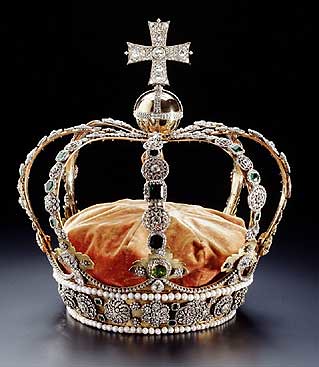
Monday, 27 July 2009

Shahanshah Mohammed Reza Pahlavi
(6th October 1919, Tehran – 27th July 1980, Cairo)


On this day 29 years ago The Shahanshah of Iran, Mohammed Reza Pahlavi, died in Cairo.

To commemorate this great Monarch I recommend the Mad Monarchist's recent posting.

The Shahanshah and the Shahbanu visited Australia on 20th and 21 September 1974. Iranian Monarchists put the documentary of this visit up on YouTube.


Part 2 show Their Imperial Majesty's visit to Melbourne, where they were welcomed by the Lord Mayor, Ron Walker, AC CBE.

Of special interest is the then Prime Minister Gough Whitlam's speech, starting at 9'30'' with: "A great man. There have been many things Your Imperial Majesty has done which have inspired the Australian government ...". And he wasn't even talking about himself, good Gough.

Unfortunately most commentary is in Farsi, but just to see Melbourne in 1974 welcoming the Iranian Shah and His wife, makes this video worth watching.


«In memoriam»
Se souvenir du plus francophile des rois étrangers du XXe siècle:
Sa Majesté le Shah d'Iran ...


Call for a demonstration in Paris on 26th July 2009 to commemorate His Imperial Majesty.

Sunday, 19 July 2009

19th July 1890: Birth of King George II of the Hellenes

The biographical data of His Majesty King George II originate from Balkanalysis.

Prince George was born on 19th July 1890, to this day 119 years ago, in the Royal residence of Tatoi near Athens, son of King Konstantinos I and Queen Sophia. The King died as the Greek head of state on April 1st, 1947 in the Royal Palace in Athens.

The young heir to the throne was educated at the Evelpides military academy and pursued higher military studies in the German Military Academy. At that time it was ordinary for the Royal Families in Europe to have their male members educated only in military schools and quite often they took part in wars, as was the case with Prince George . In 1913 during the the Second Balkan War, he served as a captain on the front lines, and accompanied his victorious father - Konstantinos I - who was the King of the Hellenes, and so, commander of the Greek forces.

The alliances and potential alliances for the Greeks in the First World War caused a widening gap between the parliamentary government of Venizelos, who was eager to join forces with the Entente, and the Royal Family, who preferred neutrality and had strong affiliations with the Germans.

The result of the Greek divide ultimately led to victory for Venizelos and the expulsion of the Royal Family in 1917. During his three-year exile abroad, Crown Prince George became engaged to the Romanian Princess Elisabeth and firmly clung to his royal credentials; he also used the period to expand his European high society network.

In 1920, just a few months after the signing of the short-lived Sèvres Treaty that gave Greece control in Asia Minor, Venizelos spectacularly lost the elections and the Royal Family managed after a referendum to return to Greece. Crown Prince George subsequently married Princess Elizabeth in 1921, whilst his sister, Princess Helena, married the heir of the Romanian throne, Crown Prince Carol - thus cementing the good relations between their two states. Moreover, George took part in the fateful Asia Minor military expedition and was made a colonel, responsible for drafting strategy for the troops upfront.

The expedition of the Greek Army in Anatolia resulted in catastrophe; after early gains, an overextension of forces resulted from entering too deep into the Anatolian landmass. This left the Greek army vulnerable and it was finally driven back to the sea by the resurgent Turkish nationalist forces led by Mustafa Kemal Pasha.

The dismaying news created a chaotic situation in Athens. A coup d’état led by Greek officers resulted in the resignation of George’s father, and the elevation of George to the throne on September 27, 1922 (Greek: Γεώργιος Β', Βασιλεύς των Ελλήνων). During his two-year residence as head of state, the young sovereign had to deal with the increasing propaganda against the Royal Family as an institution in Greek society. He also witnessed the execution of six members of the Greek government charged with being responsible for the disastrous Anatolian campaign.

George II as King and the Second Exile
In October 1923, after the Lausanne Treaty that created a new Mediterranean order and permanent boundaries, an attempt was made to overthrow the leaders of the 1922 revolution by several right-wing officers, including Metaxas, the would-be Prime Minister of Greece from 1936-1941. Even though King George was not involved, he was easily accused of being the culprit, and was forced to leave Greece in December 1923. As could be expected, he went to Romania. In April 1924, a Hellenic Republic was proclaimed.

The second period of exile for the Greek King had strong implications that would influence Greek politics for years to come. First of all, King George II divorced his Romanian wife and moved to Britain, where he took up residence in the storied Brown’s Hotel of London. During his stay in London from 1929-1935, George became an adherent of the British way of life and cultivated further his important relations with the English aristocracy, something that would play a major role in his future come-back in Greek public affairs.
Moreover, the exiled monarch travelled abroad regularly throughout the Greek Diaspora, in order to extract support. He managed to build a stern persona, an image as some sort of a firm and wise ruler capable of uniting a Greece so often characterised by fractiousness, instability and corruption. During this time it is highly likely that the king-in-exile managed to win British support through skilfully managing his royal family relations.

The opportunity George was looking for appeared in 1935. An unsuccessful coup d’état by Greek officers led by Colonel Plastiras changed the political climate in Greece, swinging the balance in favour of the monarchy. Meanwhile, the still mighty British Empire, fearing the expansion of the Italian and German powers, wanted to appoint a staunch supporter in one of the most important geo-strategic regions, the Balkans.

Thus, in November 1935 a referendum for the reinstatement of King George passed by a resounding 97 percent. This overwhelming approval initiated his second return to his country of birth. The reinstated King was able to have real popular support because the Greek Republic (1924-1936) was not successful. It collapsed in chaos leaving serious unresolved issues to be dealt with, such as social inequality, failures in foreign policy and general public disappointment and apathy.

Even though King George II was not generally in favour of dictatorship, the unresolved political tensions in Greece, simultaneous with a growing militarisation in Europe, proved to be decisive factors in that direction. On August 4th, 1936, George signed a government paper that declared a state of emergency in Greece; in essence, a dictatorship was being established. It was led by the Prime Minister Ioannis Metaxas, a longtime military officer well known for his monarchist sentiments.

Despite the fact that Metaxas was also in favour of the Germans, this fondness did not play a significant role in the actual governance of the state. The Greek army was almost completely loyal to the monarchy, and Metaxas was above all an officer loyal to his king.

When the Italian Army attacked Greece on October 28th, 1940, the defiant Greeks were able to claim the first great victory that the Allied forces had won against the Axis since the beginning of the war. It increased the prestige of King George II, who was very active in monitoring the progress of the military campaign against Italy. He also pressed the English in sending help to Greece, managing to redirect large British forces from the major front of North Africa, so vital to the British due to their interests in the Suez Canal.

On April 6th, 1941 Greece denied access to German troops, and a much tougher campaign started. The Greek army, after several weeks of intense fighting, was defeated and German troops occupied Athens on April 27th. At that time the King was determined to continue the resistance, despite lingering pro-German sentiment amongst the Greek political class. He formed a government under Emmanouel Tsouderos (a former opponent of the King’s), who also happened to be from the island of Crete - the place of the latest epic battle between the Greeks and the Germans.

On April 23rd, 1941, King George II and his government left Athens and went to Crete to continue the fight. After fierce skirmishes known collectively as “The Battle of Crete” German paratroopers occupied Crete and King George, along with most of his cabinet, narrowly escaped to Egypt and British protection. From that time onwards, London and Cairo were to play host to the Greek government-in-exile. Meanwhile, King George toured the world - including Great Britain, South Africa, Canada and the USA - trying to win support for Greece from the Allied governments and their peoples. He also declared the end of dictatorship and tried to compromise with his former political opponents.

The occupation by Germany brought major societal changes to the country. Greece saw the emergence of a renewed Communist Party and strong anti-monarchist forces. When Greece was liberated in October 1944, the King didn’t return immediately. In December 1944, the first round of confrontations between the Greek government and the Communists broke out in Athens. The one-month struggle between them signalled just the prelude to a three-year civil war that raged from 1946-1949.

The political strife in Greece resulted in a virtual British occupation of the country. Fearing Soviet expansion and the Communist rise, the Allied powers sought to aid through all means necessary the government in the fight against the rebels.

A coalition dominated by the new People's Party was elected and their leader Constantinos Tsaldaris in the opening session of parliament called for the return of the King and initiated a constitutional plebiscite. Once again in yet another election 68% vote for the return of the King, some of whom may have seen Greece's return to a monarchy as being better then being run by the communists. King George arrived in Greece on September 27th, 1946, and he lived only until April 1st, 1947, when he died of a sudden heart attack. During that short period of time, King George II experienced the beginning of the Greek Civil War, the enacting of the Truman Doctrine - the formal announcement of the Cold War - and the liberation of the Dodecanese after a generation of Italian occupation.

King George II: His Importance and Legacy
George II was a king who lived throughout, and in some periods ruled over, some of the most important events in modern Greek history. In fact, he shaped them in ways that are still being felt in Greek life today. His pro-British stance led Greece to the Allies in WWII, resulting in a devastating German occupation - but an eventual victory in being firmly allied on the ‘right side’ of history in the world’s greatest-ever conflict.
This alliance was cemented, sometimes brutally, by the civil war that followed WWII. Yet King George’s decisiveness against the Communist threat kept Greece firmly in the Western camp - a result that was clearly beneficial of the country, as history has borne out.

On the other hand, the King’s support for dictatorship helped keep alive a violent political climate in Greece, and the association of military power with politics condoned under King George II was a recurrent phenomenon that haunted the nation again during the disastrous Colonel’s Regime of 1967, which led up to the Turkish invasion of Cyprus.

As a person, King George II was a reserved, aloof character, who never became truly popular, as his father and his grandfather (George I) had been. King George II was more of a statesman, disinterested in the trappings of everyday life. King George would be the only modern royal not to leave an heir, and his successor was King Paul (Greek Παύλος, Βασιλεύς των Ελλήνων, 14th December 1901 – 6th March 1964), his younger brother.

To understand the broader international image and impact of a man who lived and travelled for such lengthy periods abroad, historians will have to examine more intensively King George’s role in helping the Allies win the war, and his deep connections to the British royal family, which invested enough political capital to have George installed on the Greek throne thrice in less than a generation. It is more than certain that a thorough survey will some day unveil many more interesting facts and dimensions of the life and career of King George II, as both a man and a monarch.

Saturday, 18 July 2009

Emperor and Empress of Japan at Hawai’ian National Cemetery


Emperor Akihito and Empress Michiko greet dignitaries at the National Memorial Cemetery of the Pacific, 15th July . Emperor Akihito and Empress Michiko visited Punchbowl Cemetery to lay a wreath and pause for moment of silence. The imperial couple's visit to the cemetery is the first since 1994. (Photos by Lance Cpl. Achilles Tsantarliotis)

This week Emperor Akihito and Empress Michiko of Japan visited Haiwai’i. In the centre of their stay on a return flight from the Dominion of Canada was laying a ceremonial wreath to honour those who died in World War II.

Governor Linda Lingle and Navy Adm. Timothy Keating, commander, US Pacific Command, greeted the Imperial Couple as a 21-gun salute announced their arrival.

They represent ... the oldest monarchy in the world. And that makes it special," said Gene Castagnetti, National Cemetery Director.

It has been 15 years since Emperor Akihito and Empress Michiko visited the national shrine.

In the air, a US plane and one representing Japan flew over, symbolizing the diplomatic bridge, Their Majesties’ hope to preserve between the two nations, with their intentions made known as they etched their signatures in the official guestbook of the final resting place where history has brought Japan and the USA together.

Emperor Akihito of Japan and Retired Marine Col. Gene Castagnetti share a moment of silence at the National Memorial Cemetery of the Pacific (Punchbowl), 15th July.(Photo by Sgt. Juan D. Alfonso)

Emperor Akihito of Japan at a wreath laying ceremony at the National Memorial Cemetery of the Pacific (Punchbowl), 15th July. During their stay, the imperial couple paid tribute to fallen service members. Their July 14 arrival marks their first visit in more than 50 years. Nale is the U.S. Marine Corps Forces, Pacific, career retention specialist. (Photo by Sgt. Juan D. Alfonso)

Emperor Akihito and Empress Michiko of Japan bow their heads for a moment of silence at the National Memorial Cemetery of the Pacific, 15th July. (Photo by Lance Cpl. Achilles Tsantarliotis)

Thursday, 16 July 2009

No Comment

Yesterday's front page of the Murdoch newspaper mX showing the republican politician and musician Peter Garrett presently in charge as the ALP's Federal Environment Minister to supervise the destruction of the environment in Australia.

Sunday, 12 July 2009

Australian Recruits start bootcamp with pledging allegiance to Her Majesty

A number of new Australian Defence Force recruits have been sworn-in at a ceremony before departing to commence their initial training.


Before they start recruit training they take the Oath of Allegiance, which is certified with a document that says:

This is to certify that XXXX having pleadged allegiance to Her Majesty Queen Elizabeth II, Queen of Australia, Her Heirs and successors, has undertaken to loyally and faithfully serve Her Majesty as a member of the Royal Australian Air Force ...


Thursday, 9 July 2009

Australian World War II Victoria Cross recipient dies

While the Sydney Morning Herald reported: "
Mr Kenna went to London for the Queen's coronation in 1953 and was presented to her when she visited the newly-restored Hall of Memory at the Australian War Memorial in Canberra in 2000. He appeared on a postage stamp in that year."

... The Age left the Monarchist part of Mr Kenna's biography unmentioned:
"Mr Kenna was born in Hamilton, in Victoria's west, in 1919 and returned there when discharged from service in December 1946.
He worked at the local council and played for the local footy team, was active in army reunions and has led Melbourne's annual Anzac Day march.
Before enlisting in the army in August 1940, he had worked as a plumber in his hometown."

Of course, both Fairfax media failed to mention that he received the Victoria Cross from HRH Prince Henry, The Duke of Gloucester, during his service as Governor-General of Australia in 1947.

This failure of leaving out what was obviously a big part of his life, makes me wonder, once more, just how much we can trust the Australian media to provide the whole story on any topic let alone the state of our Monarchy.

Monday, 29 June 2009

The solution for Afghanistan is not another term for Karzai

Western media reported today that “Hamid Karzai appears likely to win [so-called presidential elections on 20th August 2009], while at the same time being deeply unpopular”.

Mr Karzai's unpopularity and the likelihood of his victory have cast a pall of resignation over the campaign, with many Afghans preparing for another five years of a leader they feel they already know too well.

Only 31 per cent of Afghans said they would vote for Mr Karzai again, down from the 54 per cent of votes he received in the 2004 election. Only 7 per cent favoured Mr Abdullah and just 2 per cent Mr Ghani, and they are considered to be Mr Karzai's most serious rivals.
How odd, everybody knows that Hamid Karzai’s rule has been a disaster, opposition candidates are even more unpopular than the the US-installed Karzai, but opinion polls did not ask for the obvious alternative: Give the Afghan people back the Monarchy! Only the Afghan Monarchy has a chance to unite the country and keep the Taliban at bay.

Another five years of Karzai’s presidency will bring many more deaths among the Western armed forces and among the Afghan people.

It is sad to see that Western politicians have no vision to see the obvious soution.

Sunday, 28 June 2009

Aussie republicans in praise of a Monarch


Both politicians have an established reputation of being staunch republicans. However, when it comes to the praise of a Monarch, Kevin Rudd and Malcolm Turnbull can choose words as if they were loyal servants of Her Majesty.

King Juan Carlos I and Queen Sofia of Spain paid a visit to Australia from 24th to 26th June 2009. On their arrival in Canberra the Queen's representative, Governor-General Quentin Bryce, received the royal couple at the airport in Canberra. Later that day the King and Queen were officially welcome by Prime Minister Kevin Rudd and the Leader of the Opposition, Malcolm Turnbull.

Prime Minister Kevin Rudd:
"Australia and Spain share more than history though. Both of our nations also bring together a modern story of democracy and development; and of contribution to international affairs.

"Your Majesties are renowned patrons of democracy, having overseen, for more than three decades, Spain’s enduring transformation into one of the world’s great democracies.
"

The following sentence was not included in the official transcript that was published on the prime minister's website:

"And I for one, Your Majesty, recall as a young man, your courageous efforts in those difficult time."

The Leader of the Opposition Malcolm Turnbull:
"It is a great honour to welcome Your Majesties this evening to this seat of our national parliament. I join with the prime minister on behalf of the people of Australia in welcoming His Majesty on his first visit since the bicentennial celebration in 1988.

"Her Majesty, of course, joined us as an honoured guest at the Sydney Olympics in 2000. Welcome back, Ma’am.

"Tonight the presence of Their Majesties offers an opportunity to reflect on the deepening and the strengthening of the relations between two vibrant and successful modern democracies and to pay tribute to the role of the Spanish Royal Family in promoting freedom and democracy.

"Very few Kings in history could claim to have been as courageous in their defence of democracy as you have been, Sir."


Malcolm Turnbull could have added the Queen's brother's efforts to restore democracy in her home country Greece. After all, it was King Constantine who tried in a counter coup in December 1967 to oust the colonels' regime and restore democracy. His efforts failed and he paid a heavy price. He went into exile, of which he has officially not returned. And what is more, a smear campaign has blackened his image in Greece and abroad.

"As we know, His Majesty created a new history for an ancient nation in those eventful days between 1975 and 1978. Not only by reclaiming the role of Head of State after the death of General Franco, but by the relinquishing power to a parliamentarian democracy under a new constitution.

"For many of us the end of totalitarianism in Europe was marked by the fall of the Berlin Wall. Yet in many ways, Sir, it was the advent of the Spanish democracy under your expert stewardship that helped inspire the hunger for freedom and liberty among so many peoples’ and nations’ labouring under the suffocating rule of dictatorship: Democratic elections in June 1977, the promulgation of a new constitution by 1978, ratification in a popular referendum and then subsequently signed into law in a powerful symbolic moment by the King in His parliament.

"So it was that the heir of an ancient dynasty became the father of a modern democracy.

"Only 30 years on no one thinks of Spain as other than a respected member of the community of advanced democracies, a robust and well regulated modern economy, the 9th largest in the world."


King Juan Carlos proposed the following toast:

Ladies and gentlemen,
will you please join me in a toast to Her Majesty the Queen and the people of Australia.


No republican present refused to drink to the Queen of Australia.

And one could ask, why a form of state should be abolished (in Australia) that has produced such a fabulous Monarch.

Thursday, 25 June 2009

'A king cannot kill his own people.'
-
Dictators can


Iranian journalist Amir Taheri reflected the question Is Iran replaying its revolution of 30 years ago? and has some surprising answers:

"In 1979, the Shah was criticized for having violated the 1906 Constitution, notably by preventing political pluralism and imposing a one-party system. Today's movement started as a protest of the alleged rigging of the June 12 presidential election, in violation of the 1979 Constitution.

"The 1979 uprising represented an unusually broad coalition, with at least a dozen leftist groups and almost as many Islamist factions along with nationalist, social-democratic and liberal outfits.

"The same is true today. Dozens of different opposition groups -- ranging all the way from moderate Khomeinist to Monarchist -- have come together to challenge the regime under a single umbrella.

"The ruling establishment back then remained reasonably united until the very end. Even after the
Shah had left the country, no key regime figure switched sides. Today, however, the ruling elite is split down the middle.

"In 1979, a majority of Iranians would probably have voted for the shah, had there been elections. Few, however, were prepared to fight for him in the streets. This time, the regime may well lose a free and fair election but still is capable of fielding large numbers of supporters who are ready to die and kill for it.

"The
Shah had no stomach for bloody repression. His constant, and rather charmingly naive, motto was: 'A king cannot kill his own people.'"
His Imperial Majesty Shah Mohammad Rezā Pahlavi, Shah of Iran,
(in Farsi: محمدرضا شاه پهلوی)
(26 October 1919 in Tehran – 27 July 1980 in Cairo),
Emperor (Shahanshah = King of Kings) of Iran from 16 September 1941.

"In contrast, Khamenei has built his career as a tough street fighter. In his Friday sermon in Tehran declaring war on the opposition, he made it clear that he wouldn't shy away from a bloodbath in order to prevent regime change.

"The perception that the
Shah was weak and unwilling to hit back played a crucial role in disheartening his supporters and encouraging his opponents. That perception was one reason so many of his closest aides simply fled the country at the first opportunity."

Thursday, 18 June 2009

Strange behaviour

Roy Hattersley in The Guardian on 16th June 2009: “As a privy councillor I am entitled to give advice to the Queen. If she wants the monarchy to continue on its untroubled way, she should tell her son to respect the restraints of his position. … She might also point out that his reverence for all things ancient does not seem to include respect for the constitution and that republicans like me rejoice at the damage he does to the idea of monarchy."

The Guardian: “Roy Hattersley is a Guardian columnist. He served in Jim Callaghan's cabinet and later became deputy leader of the Labour party.” But he became a privy councillor in 1975 and was created a life peer in 1993 as Baron Hattersley of Sparkbrook. Is this a case of one Labour peer looking after the interests of another (Lord Richard Rogers)?

Why did Roy Hattersley accept to be appointed a privy councillor if “republicans like me rejoice at the damage … to the idea of monarchy"? Wasn’t it against his republican conscience to take the Oath of Allegiance to Her Majesty and Her heirs and successors?

I have reached the point where I don’t believe any oath any republican swears to anything. Just take a look at our republican lot. I could swear they are betraying us.

Wednesday, 17 June 2009

Prince Charles accused of abuse of power

Lord Richard Rogers (75), who was sacked last week from a multibillion-dollar development in London, has accused the Prince of Wales of “an abuse of power” and “unconstitutional behaviour”. The Age re-printed an article on 17th June that was published by The Guardian last week. The dispute however, is older and involves “the modernist design” for the Chelsea Barracks site in London. The 12.8-acre site is opposite the historic Royal Hospital and the proposed scheme would have built 552 flats in towers of copper, glass and concrete. Naturally Prince Charles, who takes a special interest in architecture, objected and hundreds of thousands of people did as well.

Since the Prince saw off Lord Rogers and his “monstrous carbuncle” extension to the National Gallery 25 years ago, there is no love lost between these two men. The little detail of a long standing dispute is, of course, not mentioned in The Age, because it would explain Lord Rogers’ fury.

And perhaps the audience would like to know, how much “the leading British architect” (The Age) would have earned had this project gone through. How much money out of the £3-billion-project would have found the way to Lord Rogers? His scathing attack on Prince Charles, could it be fueled by pure self-interest? How about a little bit of investigative journalism, dear Age?

Even Rupert Murdoch’s daily The Times conceded: "Lord Rogers is magnificent in his fury - but wrong. There are plenty of issues that the Prince of Wales can't touch: Gordon Brown, the constitution, Europe, the Middle East and whether the country goes to war. Architecture is not one of them.

The problem lies deeper, as an editorial in The Sunday Herald explained:
"Massive housing and commercial developments, new superstores and roads ... such projects come before the public for scrutiny only when developers have already had cosy exploratory chats with local planners and carved up the whole deal behind the scenes. Even then, they are pushed through the so-called planning process with unseemly, and sometimes mischievous, haste. Ever noticed how public consultation plans for municipal mega-projects, with tight schedules for objecting attached, suddenly get launched on a Friday afternoon before a holiday period when no-one can be bothered to scour the council notice section of the local newspaper?

"It's no good architects coming over all democratic and squeaky clean here. With the exception of a few less ruthlessly commercial practitioners committed to working with communities, architects are in on these deals from the beginning, drawing up plans for their developer paymasters and generally schmoozing with the municipal mafia. They have a direct financial interest in seeing such projects go ahead; at least HRH doesn't.
"

Prince Charles told Royal Institute of British Architects as recently as on 12th May 2009: "Few people dare to speak out ... for the very good reason that if they do they find themselves abused and insulted, accused of being old-fashioned, out of touch, reactionary, anti-progress, even anti-science - as if it was some kind of unholy blasphemy to question the state of our surroundings, of our natural environment, our food security, our climate and our own human identity and meaning. Little wonder, then, that most people shy away from pointing out that the Emperor isn't actually wearing very many clothes any more." The whole speech can be read here.

So, why did The Age re-print the article? After all, if they want examples of architectural monsters and overriding democratic planning procedures, the journalists don’t have to look to London. Melbourne itself delivers lots of examples. Take a stroll through the streets and your eyes will spot one catastrophe next to the other. And unfortunately the heir to the throne does not come to our rescue.

Unconstitutional behaviour” in Victoria
Actually, The Age ran a story on planning in Victoria. True, it was more about Victorian Planning Minister Justin "Harry" Madden, but there were discoveries, that really should let Lord Rogers see “unconstitutional behaviour”:

… Since the mid-2000s, and especially under Premier John Brumby, Labor has started to wind back objector and appeal rights, over-riding councils in a way that would have seemed unbelievable a decade ago.

"Last year,
Madden announced that planning decisions for 27 key commercial centres — including Coburg, Frankston and Footscray — would be taken from councils and given to specially appointed development assessment committees. The program was to begin with five centres. So far this year, he has also seized planning control for 11 major housing and commercial developments, mainly in inner and middle suburbs. Among them is the large riverside industrial plot in Fairfield known as the Amcor site, the future of which was under consideration by the left and green-leaning City of Yarra.

"Other projects include the contentious proposed conversion of the Northcote Bowl into apartments, and the troubled redevelopment of Pentridge in Coburg, currently in the hands of the Labor and Greens-dominated Moreland City Council. Such actions are viewed with real suspicion in the gentrified streets of this former Labor heartland.
Last month, the Government also announced it would fast-track $3 billion in housing and education projects as part of the federal stimulus package, denying councils and residents the right to object or appeal. Under the Government's guidelines for the program, hundreds of largely private housing developments could be rubber-stamped if they contain a component of social housing. No stated minimum of social housing has been stipulated, sparking concern that it will be used as a smokescreen for poorly planned public-private development.

"Notable too is the recent ascendancy of
Madden's Development Facilitation Unit. Just a few years ago, the unit was a minor office in planning, a one-man operation focused on trouble-shooting projects with problems, such as the Pentridge revamp. Now it has grown into a major part of Madden's department.

"While the minister insists he is a
'reluctant interventionist', when The Age suggests that "planning" has largely given way to ' facilitation', he says he does not apologise for that. 'The great challenges at the moment are in housing and, because of the economic circumstances at the moment, jobs,' he says. 'We're committed to delivering housing and jobs in this state. The Opposition and the Greens are anti-growth, anti-housing, and anti-jobs.'…

"An often overlooked influence on his attitude is that he is, by training, an architect. Like developers and builders, the architect's instincts are hostile to consultation with those who do not understand 'the profession' [here you have an explanation for the hatred architects show against Prince Charles]. Objections and appeals only frustrate creativity, and money-making.

"The Victorian president of the Australian Institute of Architects, Karl Fender, is a fan. 'The first thing about Justin is, he's an architect, and therefore he brings an intelligence based on his education to the portfolio ...'

"The scaling back of planning democracy is not unique to Victoria, or even Australia. Nor is it simply a response to the global financial crisis. It has been a trend across the Western world as deregulation has permeated all spheres of public policy since the 1980s. Other states are moving in the same direction, South Australia in particular. But under Brumby and Madden, Victoria is now among the national leaders in sweeping aside obstacles to development.

"But privately, some Labor insiders worry about the sidelining of councils and residents, and fear that in the drive to get billions of dollars
'out the door', projects are being called in and signed off at a dizzying pace without the usual checks and balances. Corruption flourishes in such conditions.

"Labor councillors are among a group of concerned local government figures who this week published an open letter in
The Age accusing Madden of demolishing a cornerstone of Victorian planning — 'the rights of residents to have a say about their neighbourhood … The use of the economic downturn to justify the denial of these fundamental rights is short-term thinking with disastrous long-term consequences.'"

The last word should go to a letter writer of The Times:
"Who do you trust -- the builders, the MPs or Prince Charles?
The one who will not financially profit from more ugly buildings. Thank you for speaking out. Prince Charles is the voice of the people.
Mama S, Atlanta, USA

Tuesday, 16 June 2009

One republican
- unfortunately only one -
quits politics


Peter Costello, federal Member of Parliament for the Victorian seat of Higgins and also Her Majesty's Australian treasurer and deputy prime minister from 1996 to 2007, decided not to seek re-election at the next federal election. The republican Liberal was an outspoken supporter of the 1999 republican model of a president chosen by politicians that was rejected in a referendum by the Australian people.

That did not stop him advocating “a” republic for Australia.

His departure from politics could be good news if he were to be replaced by a new MP who supports the Australian Monarchy as it is layed out by the Constitution. However, claimants to the soon to be vacated seat include ambitious ultra-right youngsters who seek all for themselves and nothing for the people. Their republicanism can easily match that of Peter Costello.

Why is it that young politicians hardly have any loyalty except perhaps for their supporting party factions and donators/sponsors?

Friday, 12 June 2009

Dom Pedro Luiz is to be seen on the left.

Communiqué from Prince Dom Luiz on the death of Prince Pedro Luiz

Prince Dom Luiz, head of the Imperial Family of Brazil

Pierced with sorrow, I fulfill my duty as Head of the Imperial House of Brazil to communicate the disappearance of my beloved nephew and much-regretted D. Pedro Luiz de Orleans e Bragança, in the fateful May 31 ocean crash of the Air France Rio-Paris flight.

Given the harrowing pain of his parents, D. Antonio and D. Christine, his brother and sisters, D. Amélia, D. Rafael and D. Maria Gabriela, and my dear Mother, D. Maria, I turn to them with special solicitude and affection.

And with the whole Imperial Family, I turn with the same solicitude and affection to all those who have lost their loved ones in the crash. To all these families - so very special to Brazil - the Imperial Family extends its condolences and asks God for the eternal repose of each and every victim.

Over the last few days, D. Pedro Luiz's parents and I have received so many manifestations of genuine mourning for the tragic event that I can only see these events as a living and authentic expression of the sense of family and ties of affection that unites the Imperial Family and all Brazilians, whether monarchist or not.

D. Pedro Luiz – the fourth in the line of dynastic succession - was a young Prince who rose in his generation as a promise, having attracted the interest and attention of many for his pleasant ways, undeniable qualities and for the traditions he represented.

As a result of his excellent upbringing and fine sense of duty, instilled by his parents, after having graduated in Business Administration at IBMEC in Rio de Janeiro, and his post-graduation at FGV, he took the initial steps of a promising career at BNP Paribas in Luxembourg, and showed great concern and commitment to show foreigners the great potential of our country.

But his presence was especially dear among those who believe the monarchy is the solution for today's Brazil .

D. Pedro Luiz was president of honor of Monarchic Youth and participated in noteworthy activities and events to the benefit of the monarchic ideal, often in the company of his parents. He represented the Imperial House on occasion, and I am especially pleased to recall his presence in Portugal for the celebration of the 500th anniversary of the discovery of Brazil .

While this is a moment of apprehension and sadness, it can not be devoid of hope. Our hopes turn particularly to D. Pedro Luiz's brother, D. Rafael – to whom I wish courage and determination in the face of misfortune, and whom I urge to be a true example of Prince to his generation, turned to the good of Brazil and to setting an example of Christian virtues.

To close this painful communiqué, I turn my eyes to Our Lady Aparecida, Queen and Patroness of Brazil, Whom beseech with confidence to receive D. Pedro Luiz in eternity. And I ask for special prayers for him, as well as for his parents, brothers and my dear Mother, from all those who, in a spirit of faith, have supported the Imperial Family at this time of mourning.

São Paulo , June 5, 2009
Dom Luiz de Orleans e Bragança
Head of the Imperial House of Brazil

Monday, 8 June 2009

Queen's Birthday Poll

Channel Ten's question of ther week:

Is it time Australia became a republic?


Yes 20.8%

No 79.2%


I wonder how the republicans will deal with this result.
Where are all those republican writers on Queen's Birthday Holiday?

I have to admit: I was wrong. I expected the united republican media hunt to have a field day on Queen’s Birthday Holiday. I was prepared to read the re-heated phrases from previous years, but the usual suspects, the famous “Melbourne commentators and republicans” must have been occupied elsewhere.

However, The Age fulfilled my expectations and printed an editorial in connection with the Queen’s Birthday’s honours list. “The one truly incongruous note about today's holiday is that officially it marks the Queen's birthday even though the monarch — whose real birth date is April 21 — has precious little to do these days with either the Australian awards system or Australia. The empire is long gone, and widely shared loyalties to the Queen with it; most Australians' allegiance is to the country they live in. Imperial honours were discarded in 1975, yet today's honours are still awarded on a day supposedly devoted to our head of state.

The Imperial honours were dropped by politicians, not by popular demand of the people. France kept the "Légion d'honneur", which was established by the first consul, Napoléon Bonaparte, in 1802. The country went through many changes, but the honours list remained.

And why does The Age claim, Queen's Birthday were “a day supposedly devoted to our head of state”? It is republicans who have to accept a fact they dislike. This day IS devoted to our Queen.

By all means retain a long holiday weekend, but … [t]his holiday requires an identity to match its place and purpose in a country that is already republican at heart.” Wishful thinking: This country’s media are republican oriented, but the country itself is still “Monarchist at heart.” The circles journalists and their employers mingle in are the ones who dream of a republic, but they cannot specify their dreams and tell us, what kind of republic they want.

This year The Age did not run a campaign like the one in 2008, when a “Kids Day” was high on their agenda. “Resurrection Day” might be an option, after a couple of republicans groups decided to resurrect in a newly formed Coalition of Australian Republicans (CAR) the day before Queen’s Birthday Holiday. Or could “CAR Day” be acceptable to our republican media?

Sunday, 7 June 2009

Republican revival meeting

May be the Aussie republicans should push for renaming Queen’s Birthday Holiday into Resurrection Day.

Why? Look, what they try to do according to The Brisbane Times, The Age's sister newspaper in Queensland : “Members of the newly formed Coalition of Australian Republicans (CAR) think there's no better time than the Queen's Birthday weekend to resurrect the battle against our ties to the British monarchy.

Resurrected, that means arisen from the dead? And why British Monarchy instead of Australian Monarchy, as we actually have? While being dead, the republicans must have missed that the ties with the British Monarchy were cut on 2nd March 1986, the "Queen signed the Australia Bill, formally severing the last constitutional ties with Britain."

The Brisbane Times has more reveling news about the resurrected republicans: “Previously feuding anti-monarchists … have joined forces. … Others in the CAR group include Women for an Australian Republic, the Copernican Republicans, the Foundation for Constitutional Renewal, Patriots for the Australian Republic, Republic Now! and the Republican Party of Australia.

I wonder what they stand for. “There was a lot of hostility and disunity among republicans last time so it's heart-warming to see we've mended our bridges and are working together for the future good of the country.” They give the impression that the revival meeting of Australian Republican Movement's Michael Keating and Real Republic's David Muir healed their discords. Well, aren’t revival meetings meant to save the sinners?

One thing is sure: The republicans are not short of lollies. The Brisbane Times: “Former Brisbane lord mayor Clem Jones left $2million for the republic campaign when he died in 2007. Mr Muir, a Brisbane solicitor, is chairman of the Clem Jones Foundation administering the funds.”I am sure solicitor Muir collects his fees from administering the funds and has a personal interest in keeping the republic question alive.

But think of of the good deeds that could be done with $2million, however, it all goes into a campaign that is doomed to fail – again.

The republicans will need many more revival meeting to resurrect their cause from the dead. Or is republicanism one of the undead cases that refuse to find eternal peace until a courageous person hammers a wooden stick into its heart?
King Albert and Prince Philippe, Duke of Brabant, eldest son and heir of the Belgian Monarch.

75th Birthday of King Albert II of the Belgians

Better than I could ever praise King Albert II of the Belgians one of his loyal subjects did this on the Monarch's birthday. The blog The Cross of Laeken celebrates the 75th birthday of this very popular King.

Here are just two excepts:

"Today, Belgium's reigning monarch, H.M. King Albert II, celebrates his 75th birthday. He was born June 6, 1934, the second son and third child of King Leopold III and Queen Astrid of the Belgians. He was named after his illustrious grandfather, King Albert I, tragically deceased in a climbing accident only a few months before. At the age of 14 months, Prince Albert (titled "Prince of Liège") lost his mother, equally tragically, in a car crash. He would know no mother until his father's re-marriage, amidst World War II and Nazi occupation, with Lilian Baels, a lovely young Flemish commoner.

"The royal family's captivity in Germany and Austria from 1944-1945 was a terrible ordeal for Prince Albert. The lack of food caused him to develop hunger edema. A leg injury treated perfunctorily by an SS guard turned into gangrene, but, fortunately, Lilian's vehement insistence on obtaining proper medical attention saved the leg of the future King."

I do highly recommend to read the whole posting on The Cross of Laeken.

Happy birthday, Your Majesty!

Bon anniversaire, Sire!

Gelukkige verjaardag, Majesteit!

Saturday, 6 June 2009

Call to all Royalists - European Elections

Dear Madam, dear Sir,

Dear friends,

Alliance Royale is a political party created in 2001 to reintroduce the question of the monarchy into the political debates. Our sole objective is to use the election campaigns to make our fellow citizens understand that the royal principle is making a relevant and timely response to the difficulties our country has been facing for many years. We were therefore present in different local or national elections during the past few years.

As in 2004, Alliance Royale will present candidates in the forthcoming European elections. Wishing to stay out of conflicts that divide the French Royalist opinion, Alliance Royale has opted for neutrality in dynastic matters since its creation. It develops proposals that are primarily designed to meet the legitimate questions being asked by voters about the decision that a king and his councils could make in the current situation. We understand very well that other royalist movements can legitimately advocate an other political vision. These differences should not be a cause of division between us.

That is why we offer all of them to gather around the urgent and important issue : meeting the citizens of our respective countries to invite them to build their future by reviving the identity of European countries founded on christian monarchies.

We invite you to join our European campaign. This is not to set aside your own sensitivity or to give up your freedom of speech, but to align with us on what we share : the defense and promotion of the royal principle. You can do this in several ways :

- in providing institutional support to our lists, which would result in information to your members and supporters and in a mention that we would add to our campaign documents like "With the support of" followed by your logo,

- in calling your members and supporters to be on our list of candidates (especially women, to meet the requirements of parity), as did Italian and French Royalist movements.
There is no other engagement expected from movements or candidates beyond this temporary cooperation. This does not say that there is no disagreement on any particular issue that could be discussed, as long as we avoid unnecessary controversy that could weaken a loyal support to our common objective for the duration of the campaign.

Hoping that this offer will attract your attention and that you will be willing to respond positively, we remain at your disposal to answer your questions.

Cyrille Henrys
General Delegate of Alliance Royale

At Gallia Watch you the party's ten reasons why it is important to vote for the AR in English.
Poster, photos and lists of all candidates can be downloaded from the Alliance Royale's website.

Thursday, 4 June 2009

Queen's Birthday Holiday

Much to the annoyance of republicans Australia is celebrating Queen’s Birthday on Monday, 8th June. The well-known republicans certainly have already written their malicious anti-Monarchist articles and the editors of our major newspapers have pre-selected them for publishing. We will know soon enough what inflamed them this year. I bet it will be a repeat of their old prejudices and false accusation.

Nothing new. We, however, Her Majesty’s loyal Australian subjects, not only enjoy the holiday, but we rejoice in celebrating our Monarch’s birthday.

The Queen's Official Birthday (Queen's Birthday) is celebrated as a public holiday in several Commonwealth countries although it is also celebrated in Fiji, now a republic.

The exact date of the celebration varies from country to country, and it does not usually mark the real birthday of the sovereign (Queen Elizabeth II, was born on 21 April 1926).

Australia (except Western Australia), observes the Queen's Birthday on the second Monday in June, marking it with a public holiday. It also serves as the opening weekend to Australia's snow season.

Australians have enjoyed this holiday since 1788 when Governor Phillip declared a holiday on the birthday of King George III. Until 1936 it was held on the actual birthday of the Monarch, but after the death of King George V it was decided to keep the date at mid-year.


Queen Elizabeth, Queen of Australia, and Prince Philip, the Duke of Edinburgh, in his Royal Australian Air Force uniform. This is the official portrait of the Australian sovereign as it is handed out by Her Australian government.

The royal couple wear the insignia of The Order of Australia. The Order of Australia, instituted by Her Majesty The Queen on 14 February 1975, was established as "an Australian society of honour for the purpose of according recognition to Australian citizens and other persons for achievement or for meritorious service".

Tuesday, 2 June 2009

Air France flight 447 killed the Brazilian Imperial Family’s Heir Presumptive

French media reported it were unlikely to find any survivors of the 228 people on board a Paris-bound Air France plane which disappeared over the Atlantic after taking off from Rio de Janeiro last Monday.

His Imperial and Royal Highness Dom Pedro Luiz de Orléans e Bragança, Prince of Brazil, was aboard Air France flight 447 and died at the age of 26.

The late Dom Pedro Luiz, born 12th January 1983, was an attractive young man, actively involved in Brazilian Monarchist affairs, and great hopes were placed in his future as the Heir Presumptive, after his bachelor uncles, Dom Luiz I and Dom Bertrão, and his father, Dom Antonio.

Through his mother, Princess Christine of Ligne, Dom Pedro Luiz was also related to the Grand Ducal Family of Luxembourg. His mother's grandmother was Grand Duchess Charlotte of Luxembourg, who is grandmother of the present Grand Duke of Luxembourg, Henri I.

The late Dom Pedro Luiz has a younger brother, Dom Rafael Antonio Maria José Francisco Miguel Gabriel Gonzaga de Orléans e Bragança, Prince of Brazil (born 1986) and two sisters, Princess Amélia (born 1984) and Princess Maria Gabriela (born 1989), who are in the line of succession after their bachelor uncles, HI&RH Dom Luíz de Orléans e Bragança (born 1938), Head of the Imperial House of Brazil, and HI&RH Dom Bertrão de Orléans e Bragançca (born 1942), and their father, HI&RH Dom Antônio of Orléans-Bragança (born 1950).

Requiescat in pace.

Brazilian News

The Imperial Family of Brazil's website