Accession Day: King Juan Carlos I
35 Years on the Spanish throne
On 22nd November 1975 Don Juan Carlos, the Prince of Spain, was proclaimed King of Spain in the Spanish Cortes. Spain had been a Kingdom without King since 1947, when a referendum approved the Monarchy that had been toppled by republicans in 1931.
For 35 years King Juan Carlos of Spain has enjoyed the unquestioning loyalty of his subjects and the discreet respect of the media. The King's role in helping restore democracy in Spain after the dictatorship of Franco won him the enduring gratitude and respect of a majority of Spaniards.
Born in Rome on 5th January 1938, the King returned to Spain at the age of ten, where he studied and was groomed as the successor to Franco. He was proclaimed King after General Franco's death, but steered the country toward a parliamentary system and now has little actual power.
During an attempted military coup in February 1981, the King went on television to denounce the putsch and urged the Spanish people to support the democratically elected government.
The Royal Family remains popular among Spaniards, who in May 2007 voted King Juan Carlos the greatest Spaniard of all time, beating out Christopher Columbus and Miguel de Cervantes, the author of "Don Quixote."
Tuesday, 23 November 2010


Thursday, 18 November 2010
70th Birthday of His Majesty Sultan Qaboos of Oman

Sultan Qaboos ibn Said Al Said (Arabic: قابوس بن سعيد آل سعيد;) was born on 18th November 1940. He ascended to the throne of Oman on 23rd July 1970 deposing his father, Sultan Sa‘id ibn Taymur.
Since 1962 the Dhofar Rebellion, a Marxist rebel group supported by the neighbouring South Yemeni’s Marxist regime threatened the country. Since his father seemed unable to fight back the Marxist terror, Sultan Qaboos had to act. He introduced major social reforms to deprive the rebellion of popular support and modernised the state's administration. The rebellion ended in 1975 with the intervention of Iranian Imperial ground forces – the last time a Monarch gave assistance to another Monarch in need - and major offensives by the expanded Sultan of Oman's Armed Forces.
Sultan Qaboos is the only son of Sultan Said ibn Taimur and Princess Mazoon al-Mashani. He is one of the 8th generation of the Al Bu Sa‘idi dynasty. He received his primary and secondary education in Salalah and at Pune, in India, and was sent to a boarding school in the UK in 1956. At 20 he entered the Royal Military Academy Sandhurst. After graduating from Sandhurst, he joined a British Infantry regiment, The Cameronians, and served in the 1st Battalion in Germany for one year. He also held a staff appointment with the British Army.
After his military service, Sultan Qaboos studied local government subjects in Britain and, after a world tour, returned home to Salalah where he studied Islam and the history of his country. Sultan Qaboos ibn Sa‘id is a religious liberal Muslim of the Ibadi school of jurisprudence, which has traditionally dominated Oman.
His Majesty’s rule has made Oman one of the best administered countries – not only in the Middle East. In November 2010, The United Nations Development Programme's (UNDP) listed Oman as the most-improved nation in last 40 years from among 135 countries worldwide. On the Index of Economic Freedom, Oman is ranked third freest among the seventeen countries in the Middle East/North Africa region; its economy overall is ranked forty-second freest in the world, reflecting a score higher than the regional average
Despite Oman’s economic liberalization, the Sultanate remains dependent on the oil revenues that account for 75 percent of the country’s export earnings and 40 percent of its gross domestic product. But oil production is declining and is bearing on the country’s economy, which His Majesty tries to counter by diversifying Oman's economy. In recent years Oman became a popular tourist destination.
The future of the Monarchy
Sultan Qaboos ibn Sa‘id has no children and has three sisters. There are however other male members of the Omani Royal Family including several paternal uncles and their families. Using primogeniture the successor to Sultan Qaboos would appear to be one of the children of his late uncle, His Royal Highness Prince Tariq ibn Taimur Al-Said, the former, first and only Prime Minister in Oman's history.

Sultan Qaboos ibn Said Al Said (Arabic: قابوس بن سعيد آل سعيد;) was born on 18th November 1940. He ascended to the throne of Oman on 23rd July 1970 deposing his father, Sultan Sa‘id ibn Taymur.
Since 1962 the Dhofar Rebellion, a Marxist rebel group supported by the neighbouring South Yemeni’s Marxist regime threatened the country. Since his father seemed unable to fight back the Marxist terror, Sultan Qaboos had to act. He introduced major social reforms to deprive the rebellion of popular support and modernised the state's administration. The rebellion ended in 1975 with the intervention of Iranian Imperial ground forces – the last time a Monarch gave assistance to another Monarch in need - and major offensives by the expanded Sultan of Oman's Armed Forces.
Sultan Qaboos is the only son of Sultan Said ibn Taimur and Princess Mazoon al-Mashani. He is one of the 8th generation of the Al Bu Sa‘idi dynasty. He received his primary and secondary education in Salalah and at Pune, in India, and was sent to a boarding school in the UK in 1956. At 20 he entered the Royal Military Academy Sandhurst. After graduating from Sandhurst, he joined a British Infantry regiment, The Cameronians, and served in the 1st Battalion in Germany for one year. He also held a staff appointment with the British Army.
After his military service, Sultan Qaboos studied local government subjects in Britain and, after a world tour, returned home to Salalah where he studied Islam and the history of his country. Sultan Qaboos ibn Sa‘id is a religious liberal Muslim of the Ibadi school of jurisprudence, which has traditionally dominated Oman.
His Majesty’s rule has made Oman one of the best administered countries – not only in the Middle East. In November 2010, The United Nations Development Programme's (UNDP) listed Oman as the most-improved nation in last 40 years from among 135 countries worldwide. On the Index of Economic Freedom, Oman is ranked third freest among the seventeen countries in the Middle East/North Africa region; its economy overall is ranked forty-second freest in the world, reflecting a score higher than the regional average
Despite Oman’s economic liberalization, the Sultanate remains dependent on the oil revenues that account for 75 percent of the country’s export earnings and 40 percent of its gross domestic product. But oil production is declining and is bearing on the country’s economy, which His Majesty tries to counter by diversifying Oman's economy. In recent years Oman became a popular tourist destination.
The future of the Monarchy
Sultan Qaboos ibn Sa‘id has no children and has three sisters. There are however other male members of the Omani Royal Family including several paternal uncles and their families. Using primogeniture the successor to Sultan Qaboos would appear to be one of the children of his late uncle, His Royal Highness Prince Tariq ibn Taimur Al-Said, the former, first and only Prime Minister in Oman's history.
Republicans catch a cold, while the Leader of Her Majesty’s Loyal Opposition is in royal wedding fever
Once again The Age demonstrated its mediocre journalism. On day two after the news of the engagement of Prince William and Katherine Middleton The Age’s Europe correspondent Paola Totaro’s report A match fit for the times was placed on the front page, while yesterday’s Age had the news hidden on page 12 as “World News”. Today’s page 14 was exclusively dedicated to “the Royal Wedding”.
Tony Wright, not the usual royal editor of The Age, wrote:
The Age’s editorial “Here’s to William and Kate” had the usual republican rants like: “The Age, which believes in a republican Australia, can also believe in fairytales. Congratulations!”
The printed version contained an opinion piece by Monica Hesse from The Washington Post. Why The Age had to fall back on an American writer remains a mystery. Was an article from the Guardian newspaper not available? What about the usual suspects from the republican Australian journo camp, didn’t they want to spread their well-known hatred of the Australian Monarchy?
It could be asked why The Age did not find a Monarchist columnist who could comment of the good news from Buckingham Palace, but gave space to an article of Klaas Woldring, convenor of Republic Now Association Inc., "Time to breathe life into an archaic constitution". Although he admits that “the republic has been removed from the public policy agenda”, he calls the Australian Constitution “this costly, undemocratic and inflexible document”. And he also states: “A sovereign people can rewrite its Constitution at any time. That is the essence of its sovereignty.” Did he forget that in 1999 the sovereign people of Australia said NO to a republic?
Message from the Governor-General
Once again The Age demonstrated its mediocre journalism. On day two after the news of the engagement of Prince William and Katherine Middleton The Age’s Europe correspondent Paola Totaro’s report A match fit for the times was placed on the front page, while yesterday’s Age had the news hidden on page 12 as “World News”. Today’s page 14 was exclusively dedicated to “the Royal Wedding”.
Tony Wright, not the usual royal editor of The Age, wrote:
“Julia Gillard could hardly looked more radiant ...: ‘The world awoke this morning to happy news,’ Ms Gillard beamed to the House of Representatives, delivering the glad tidings of a new betrothal.
"No sooner had Ms. Gillard finished gushing and offering the nation’s best wishes than Tony Abbott was on his feet, declaring himself ‘Leader of Her Majesty’s Loyal Opposition’. “I rise also to congratulate Prince William, our future king and Miss Kate Middleton on their engagement,” he said. ‘Every Australian should rejoice at their happiness.’
”Malcolm Turnbull, once the most prominent republican in the land, peered into the middle distance.
“Mr. Abbott was so swept away that when Speaker Henry Jenkins childed him a little later for interjecting when normal political combat had resumed, he pleaded ‘royal wedding fever’.”

The Age’s editorial “Here’s to William and Kate” had the usual republican rants like: “The Age, which believes in a republican Australia, can also believe in fairytales. Congratulations!”
The printed version contained an opinion piece by Monica Hesse from The Washington Post. Why The Age had to fall back on an American writer remains a mystery. Was an article from the Guardian newspaper not available? What about the usual suspects from the republican Australian journo camp, didn’t they want to spread their well-known hatred of the Australian Monarchy?
It could be asked why The Age did not find a Monarchist columnist who could comment of the good news from Buckingham Palace, but gave space to an article of Klaas Woldring, convenor of Republic Now Association Inc., "Time to breathe life into an archaic constitution". Although he admits that “the republic has been removed from the public policy agenda”, he calls the Australian Constitution “this costly, undemocratic and inflexible document”. And he also states: “A sovereign people can rewrite its Constitution at any time. That is the essence of its sovereignty.” Did he forget that in 1999 the sovereign people of Australia said NO to a republic?
Message from the Governor-General
Your Royal Highness,
on behalf of all Australians, Michael and I send our heartfelt congratulations and best wishes to you and Miss Catherine Middleton upon the announcement of your engagement to marry next year.
Australians were delighted, earlier this year, to have the opportunity to welcome you to Australia. Our time with you in Sydney was memorable and thoroughly enjoyable. [Did the Governor-General forget that HRH was also in Melbourne and country Victoria? RR]
Your genuine fondness for Australia and Australians shone through in all your interactions, and I know that these feelings are very much reciprocated.
I am sure that Australians look forward with anticipation and excitement to hearing of your wedding preparations as they unfold. It is a unifying time of much joy and celebration. And, naturally, we will take immense pleasure in welcoming you both on the occasion of your first visit to Australia together some time in the future.
Your Royal Highness, your announcement has warmed our nation’s heart.
Friday, 12 November 2010
The Duchess of Cornwall attends a service to commemorate journalists
The Duchess of Cornwall joined families of British journalists who have died over the last decade reporting conflicts around the world, in a memorial service held in their honour on 10th November 2010.

Attending the service at St. Bride’s church on Fleet Street, which is often regarded as the spiritual home for journalists throughout the world, were also a number of well-known media figures.
Addressing the congregation rector David Meara, said: "As consumers of news in a fast-changing world, we demand a great deal of our journalists and foreign correspondents.

"We expect them to keep us informed about difficult and complex situations in the trouble spots of the world, often at great personal risk, and sometimes, tragically, they pay the ultimate price.
"Their families, many of whom are with us today, know only too well that bearing witness to the truth has a personal cost."
Among the congregation was Helen Garston, the widow of Sunday Mirror defence correspondent Rupert Hamer, 39, who was killed in January in Afghanistan. He died when a vehicle he was travelling in was hit by a bomb while he was embedded with the US Marine Corps.

After the service, The Duchess attended a reception where she met with the families and those who attended.
The Duchess of Cornwall joined families of British journalists who have died over the last decade reporting conflicts around the world, in a memorial service held in their honour on 10th November 2010.

Attending the service at St. Bride’s church on Fleet Street, which is often regarded as the spiritual home for journalists throughout the world, were also a number of well-known media figures.
Addressing the congregation rector David Meara, said: "As consumers of news in a fast-changing world, we demand a great deal of our journalists and foreign correspondents.

"We expect them to keep us informed about difficult and complex situations in the trouble spots of the world, often at great personal risk, and sometimes, tragically, they pay the ultimate price.
"Their families, many of whom are with us today, know only too well that bearing witness to the truth has a personal cost."
Among the congregation was Helen Garston, the widow of Sunday Mirror defence correspondent Rupert Hamer, 39, who was killed in January in Afghanistan. He died when a vehicle he was travelling in was hit by a bomb while he was embedded with the US Marine Corps.

After the service, The Duchess attended a reception where she met with the families and those who attended.
Thursday, 11 November 2010
The Queen met Australian Victoria Cross and George Cross holders
 Her Majesty Queen Elizabeth, Queen of Australia, met Australian Victoria Cross and George Cross holders (left to right) Michael Pratt GC, Mark Donaldson VC and Keith Payne VC, at a reception for the Victoria Cross and George Cross Association on 10th November 2010.
 Her Majesty Queen Elizabeth, Queen of Australia, met Australian Victoria Cross and George Cross holders (left to right) Michael Pratt GC, Mark Donaldson VC and Keith Payne VC, at a reception for the Victoria Cross and George Cross Association on 10th November 2010.
Saturday, 6 November 2010
Rare Species
Panda bears are a rare species, but equally rare are real Monarchs.

Here Queen Sofia of Spain meets a baby Panda bear in Madrid's zoo. At the Madrid Zoo & Aquarium a pair of twin pandas were born on 7th September 2010, conceived through artificial insemination in a joint effort by Spain's National Research council other scientiests. The cubs are the first of their species to be born in Spain since 1982 and only the third litter to be born in Europe.

Panda bears are a rare species, but equally rare are real Monarchs.

Here Queen Sofia of Spain meets a baby Panda bear in Madrid's zoo. At the Madrid Zoo & Aquarium a pair of twin pandas were born on 7th September 2010, conceived through artificial insemination in a joint effort by Spain's National Research council other scientiests. The cubs are the first of their species to be born in Spain since 1982 and only the third litter to be born in Europe.

Sunday, 31 October 2010
US for revival of active monarchy in Nepal?
Since Prime Minister Madhav Kumar Nepal resigned on 30th June under pressure from the Maoists, the Constituent Assembly, which has failed to draft a republican constitution and could not agree on anything but to depose King Gyanendra, has failed for the tenth time to elect a Prime Minister.
The Telegraph, Nepal, reported on moves to give the country the Monarchy back:
Since Prime Minister Madhav Kumar Nepal resigned on 30th June under pressure from the Maoists, the Constituent Assembly, which has failed to draft a republican constitution and could not agree on anything but to depose King Gyanendra, has failed for the tenth time to elect a Prime Minister.
The Telegraph, Nepal, reported on moves to give the country the Monarchy back:
Can the world lone super-power, United States, afford another failed state in South Asia? Perhaps not!
With war torn Afghanistan already a failed state, Pakistan zeroing in the failed state status and, continued political instability already pushing Nepal to imminent economic collapse, should the US revise its Nepal policy?
The Nepali Patra Weekly, October 29, 2010, claims that the US has all of a sudden acquired an active posture in Nepali politics. The US is entirely convinced that the Nepali political actors and political parties were an incompetent lot and to expect positive results from them would be a self defeating exercise, writes the weekly referring to various sources in Kathmandu.
"The US is overly concerned over the increasing hobnobbing between leaders of the largest party in the Constituent Assembly, Unified Maoists and Communist China. The current state of Nepali politics is not appropriate for institutionalizing democracy in the country. And, the continuation of political deadlock could lead to the state capture by the Maoists with the support of the Chinese", the US has also comprehended.The US basically fears that Nepal could become ultimately another North Korea in Asia, the weekly reveals.
Sources have told the weekly newspaper that the US is in favor of "reviving monarchy in Nepal".
Interestingly, the report reveals that the US is not in favor of reinstating Gyanendra Shah as just as a Constitutional Monarch but it wants to see the former sovereign as an "active monarch". Sudden twist in Nepali politics?

Monday, 4 October 2010

Prince Charles declared Commonwealth Games open
There was no mucking about: The Indian daily The Hindu put it in its headline: Prince Charles declares Games open. In a colourful ceremony the Indian capital Delhi the heir to the throne and to the title as Head of the Commonwealth received the Queen’s baton, which has traversed 190,000 kilometres through all 71 participating countries and territories. The Prince of Wales read out Her Majesty’s message and under the applause of some 60,000 spectators declared the Commonwealth Games open.

After Prince Charles, Ms. Pratabha Patil, or “Madame President”, as the Prince of Wales addressed her, read out her welcome message and added: “Let the Games begin.”
Considering the row ahead of the Commonwealth Games, this was a compromise everybody could live with.
 The South African team entered the arena with the meanwhile infamous vuvuzelas. A new national symbol of South Africa?
 Drummers from various Indian states dominated the opening ceremony.
Thursday, 30 September 2010
Prince Charles to open the Commonwealth Games – not another politician
At the beginning of this week, Prince Charles’ office sought to play down the reported row over whether the heir to the throne or Indian president Pratibha Patil would open the Commonwealth Games saying at both would have “a prominent role” in the opening ceremonies.
“The Prince of Wales will read out the Queen’s baton message, ending by declaring the Games open," it said in a statement. The reference to “declaring the Games open” left it open to interpretation, according to observers.
“There is no row. Both the Prince of Wales and the president of India will have a prominent role in the opening ceremony in Delhi. The Queen has asked the Prince of Wales to represent Her at the opening of the Commonwealth Games.”
Earlier The Daily Mail quoted an anonymous Indian “official source” as saying: “Although there has not been an official announcement, we have decided the president will open the Games.”
Why is it that politicians always try to set themselves in the first fiddle, when they obviously have no right to do so? There is no doubt that The Queen is Head of the Commonwealth and therefore the one and only person to open the Commonwealth Games. Her heir and successor is Prince Charles – also as Head of the Commonwealth - and he will be sent to represent Her Majesty. She did not ask the Indian president or any other politician to be her representative. India may try to override the shortcomings in the preparations to this year’s Commonwealth Games by setting new rules. But being the second biggest nation on earth does not give India the right to embarrass the heir to the throne and all other Commonwealth nations who are loyal to the principle of this free association of nations.
The only acceptable compromise could be that His Royal Highness and Ms. Patel will both proclaim the Games open simultaneously.
At the beginning of this week, Prince Charles’ office sought to play down the reported row over whether the heir to the throne or Indian president Pratibha Patil would open the Commonwealth Games saying at both would have “a prominent role” in the opening ceremonies.
“The Prince of Wales will read out the Queen’s baton message, ending by declaring the Games open," it said in a statement. The reference to “declaring the Games open” left it open to interpretation, according to observers.
“There is no row. Both the Prince of Wales and the president of India will have a prominent role in the opening ceremony in Delhi. The Queen has asked the Prince of Wales to represent Her at the opening of the Commonwealth Games.”
Earlier The Daily Mail quoted an anonymous Indian “official source” as saying: “Although there has not been an official announcement, we have decided the president will open the Games.”
Why is it that politicians always try to set themselves in the first fiddle, when they obviously have no right to do so? There is no doubt that The Queen is Head of the Commonwealth and therefore the one and only person to open the Commonwealth Games. Her heir and successor is Prince Charles – also as Head of the Commonwealth - and he will be sent to represent Her Majesty. She did not ask the Indian president or any other politician to be her representative. India may try to override the shortcomings in the preparations to this year’s Commonwealth Games by setting new rules. But being the second biggest nation on earth does not give India the right to embarrass the heir to the throne and all other Commonwealth nations who are loyal to the principle of this free association of nations.
The only acceptable compromise could be that His Royal Highness and Ms. Patel will both proclaim the Games open simultaneously.
Saturday, 25 September 2010
A majority of the Belgians want a unitary Kingdom
While the parties in Belgium are still trying to form a government after the 13th June elections, the daily La Libre Belgique published an interesting opinion poll. A demonstration in favour of a united Belgium, 16th May 2010.
According to the newspaper only 12 percent want a split of the Kingdom of Belgium. Even the Flemish aren’t really keen on a separate state. Just 22 percent desire the final end of Belgium and the birth of an independent Flanders. On the other hand 40 percent of all Belgians would like to see the unitary state back, which existed until the early 1970s. Obviously, they have enough of the internal border that is dividing the country along the languages. 32 percent favour handing over more power to the existing regions.

La Libre Belgique's comment is a big question mark : «A return to the unitary state is impossible. Why such an opinion poll ? Or is it because a re-unified structure carries, in the eyes of the people, a promise that the handling of the public affairs would be less chaotic? We noticed that the return to ‘papa’s Belgium’ was more desired by the young one than by the elderly. For those who did not live in that period, is it more desirable than the present time?»
It would not be a Belgian opinion poll, would it not show a difference in the answers given in the regions. In Flanders only 22 percent want to see the unitary state again, while in Brussels and the Wallonie 50 respectively 51 percent are in favour of the old idea.
Just eight percent favour the status quo – and that figure is the same throughout the regions.
Vive le Roi! Leve de Koning! Es lebe der König!
Discours de S.M. le Roi - Fête Nationale 21/07/2010
While the parties in Belgium are still trying to form a government after the 13th June elections, the daily La Libre Belgique published an interesting opinion poll.
 A demonstration in favour of a united Belgium, 16th May 2010.
According to the newspaper only 12 percent want a split of the Kingdom of Belgium. Even the Flemish aren’t really keen on a separate state. Just 22 percent desire the final end of Belgium and the birth of an independent Flanders. On the other hand 40 percent of all Belgians would like to see the unitary state back, which existed until the early 1970s. Obviously, they have enough of the internal border that is dividing the country along the languages. 32 percent favour handing over more power to the existing regions.

La Libre Belgique's comment is a big question mark : «A return to the unitary state is impossible. Why such an opinion poll ? Or is it because a re-unified structure carries, in the eyes of the people, a promise that the handling of the public affairs would be less chaotic? We noticed that the return to ‘papa’s Belgium’ was more desired by the young one than by the elderly. For those who did not live in that period, is it more desirable than the present time?»
It would not be a Belgian opinion poll, would it not show a difference in the answers given in the regions. In Flanders only 22 percent want to see the unitary state again, while in Brussels and the Wallonie 50 respectively 51 percent are in favour of the old idea.
Just eight percent favour the status quo – and that figure is the same throughout the regions.
Vive le Roi! Leve de Koning! Es lebe der König!
Discours de S.M. le Roi - Fête Nationale 21/07/2010
Thursday, 23 September 2010
A Royal summit in Serbia
The website of the Serbian Royal Family is certainly one of the best of a royal dynasty – easy access, accurate and well up-to-date. Of special significance are the photos displayed on the website. All living Balkan Kings (with the exception of King Leka I of the Albanians) posed for a photo: HM King Simeon II of the Bulgarians (*16th June 1937), HRH Crown Prince Alexander II of Serbia (*17th July 1945), HM King Michael I of Romania (*25th October 1921) and HM King Constantine II of the Hellenes (*2nd June 1940).
 On 17th September Their Royal Highnesses Crown Prince Alexander II and Crown Princess Katherine celebrated their 25th wedding. Among the guests were among others Their Majesties King Constantine and Queen Anne-Marie of the Hellenes, King Simeon and Queen Margarita of the Bulgarians, King Michael of Romania, Their Royal Highnesses Crown Princess Margarita and Prince Radu of Romania, Their Royal Highnesses Prince Guillaume and Princess Sibilla of Luxembourg, Princess Irene of Greece, Princess Desiree, Baroness Silfverschiöld of Sweden and Baron Niclas Silfverschiöld, Princess Margarita of Baden, Their Serene Highnesses Prince Philipp Erasmus and Princess Isabelle of Liechtenstein and Her Serene Highness Princess Ira von Fürstenberg.
The website of the Serbian Royal Family is certainly one of the best of a royal dynasty – easy access, accurate and well up-to-date.
 Of special significance are the photos displayed on the website. All living Balkan Kings (with the exception of King Leka I of the Albanians) posed for a photo: HM King Simeon II of the Bulgarians (*16th June 1937), HRH Crown Prince Alexander II of Serbia (*17th July 1945), HM King Michael I of Romania (*25th October 1921) and HM King Constantine II of the Hellenes (*2nd June 1940).
 On 17th September Their Royal Highnesses Crown Prince Alexander II and Crown Princess Katherine celebrated their 25th wedding. Among the guests were among others Their Majesties King Constantine and Queen Anne-Marie of the Hellenes, King Simeon and Queen Margarita of the Bulgarians, King Michael of Romania, Their Royal Highnesses Crown Princess Margarita and Prince Radu of Romania, Their Royal Highnesses Prince Guillaume and Princess Sibilla of Luxembourg, Princess Irene of Greece, Princess Desiree, Baroness Silfverschiöld of Sweden and Baron Niclas Silfverschiöld, Princess Margarita of Baden, Their Serene Highnesses Prince Philipp Erasmus and Princess Isabelle of Liechtenstein and Her Serene Highness Princess Ira von Fürstenberg.
Wednesday, 22 September 2010
Good journalism?
To illustrate Pope Benedict XVI's visit to the United Kingdom on 17th September The Age had chosen three photos, the biggest showing the Pope holding his white pileolus (The Age called it “skull cap”) while The Queen braved the strong wind with a stiff British upper lip. The Age propably chose this picture because Her Majesty could be thought of having a grumpy look.

There are alternative attitudes to reporting on this visit. The Age might be more oriented to the English media. Continental European newspapers published much friendlier of The Queen, when she received her Vatican guest.
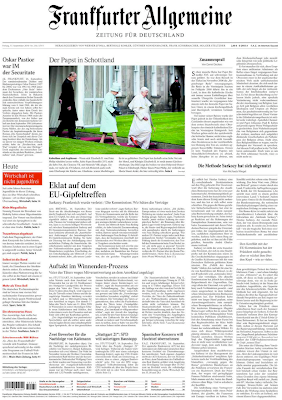
At Paper Media you’ll find 37 front pages of mainly German newspapers, all published on 17th September. Fifteen of them had a photo of the Pope with The Queen (except The Guardian, which had the popemobile instead). Out of these 15, six had chosen the same picture as The Age, but nine had opted for a much more sympathetic scene. Have a look for yourself.

It is well known that The Age follows a strict republican agenda, but don’t you feel, that sometimes they overdo their republican preaching?
This style of picture editing is hardly good journalism.
To illustrate Pope Benedict XVI's visit to the United Kingdom on 17th September The Age had chosen three photos, the biggest showing the Pope holding his white pileolus (The Age called it “skull cap”) while The Queen braved the strong wind with a stiff British upper lip. The Age propably chose this picture because Her Majesty could be thought of having a grumpy look.

There are alternative attitudes to reporting on this visit. The Age might be more oriented to the English media. Continental European newspapers published much friendlier of The Queen, when she received her Vatican guest.

At Paper Media you’ll find 37 front pages of mainly German newspapers, all published on 17th September. Fifteen of them had a photo of the Pope with The Queen (except The Guardian, which had the popemobile instead). Out of these 15, six had chosen the same picture as The Age, but nine had opted for a much more sympathetic scene. Have a look for yourself.

It is well known that The Age follows a strict republican agenda, but don’t you feel, that sometimes they overdo their republican preaching?
This style of picture editing is hardly good journalism.
Monday, 20 September 2010
Scandal-ridden republics
Canada has a proud royalist tradition, however, this does not exclude that the media try to create scandals were there aren't any. Patricia Treble of MACLEANS.CA looked at the Monarchies in Europe and came to the conclusion: Europe’s monarchies: scandal-ridden but such good fun.
When the term "scandal-ridden" comes up, republics outdo crowned democracies by miles. However, on one point Patricia Treble was fair to Monarchies. She admitted that in the end they do not come more expensive than an uncrowned head of state.
Of course Patricia Treble - and most other foreign media people - did not cover the latest scandal concerning president Wulff. His meddling in German politics had the daily newspaper Die Welt publish an article under the headline Christian Wulff, das Problem des bürgerlichen Lagers (Christian Wulff, the bourgeois camp's problem, 17th September 2010)
Canada has a proud royalist tradition, however, this does not exclude that the media try to create scandals were there aren't any. Patricia Treble of MACLEANS.CA looked at the Monarchies in Europe and came to the conclusion: Europe’s monarchies: scandal-ridden but such good fun.
When the term "scandal-ridden" comes up, republics outdo crowned democracies by miles. However, on one point Patricia Treble was fair to Monarchies. She admitted that in the end they do not come more expensive than an uncrowned head of state.
And presidents—the other alternative—aren’t any cheaper, as even the Swedish Republican Association acknowledges. (No country is nutty enough to adopt the U.S. model of combining ceremonial and political leaders into one person, so not having a monarch means having a president.) In June, Germany got a new head of state. Christian Wulff, a state politician in Chancellor Angela Merkel’s party, was elected after three bitterly fought ballots. With the title comes the neoclassical behemoth of Bellevue Palace, the venue of all those state dinners, receptions and official tours. The budget: $40 million.
Of course Patricia Treble - and most other foreign media people - did not cover the latest scandal concerning president Wulff. His meddling in German politics had the daily newspaper Die Welt publish an article under the headline Christian Wulff, das Problem des bürgerlichen Lagers (Christian Wulff, the bourgeois camp's problem, 17th September 2010)
Sunday, 19 September 2010
The royal origin of the Oktoberfest 200 years ago
What started as a horse race at the first royal wedding of the newly created Kingdom of Bavaria in 1810 has become one of the world's best known folk festivals: the Oktoberfest in the Bavarian capital Munich, which was opened yesterday. And before you ask, yes, the Oktoberfest actually starts in September, just as the October Revolution started in November.

 On 12th October 1810 Bavaria’s Crown Prince Ludwig married Princess Therese of Saxe-Hildburghausen (grandparents of the more famous King Ludwig II of Bavaria). To pep up the ceremony, a horse race was proposed and a race track built. Deutsche Welle gave an insight into the royal origin of what the French call "la fête de la bière".
Charging horses weren't the only spectacle at the ceremony, though. Munich came alive with music and decorations, and the rich feast provided by Bavaria's future king prompted archivists to describe the event as a full-scale folk festival. The horse race followed about a week later and drew 30,000 spectators. Visitors could catch a glimpse of the nobility, who entered in an elegant procession and went to a separate pavilion from where they would watch the race. They were followed by another procession of 16 pairs of children wearing the traditional attire associated with various regions in Bavaria. Each pair paid homage to Ludwig and his wife.
The festivities also served as a kind of image campaign for Crown Prince Ludwig's father, King Maximilian I. Napoleon had granted King Max I rule of Bavaria just four years prior, and there were still many foreign influences in the region which worried the nobility. The wedding and revelry were a way to strengthen solidarity in the region.
That may explain why similar celebrations took place the next year and onward. By 1819, the event was declared an annual festival. Today's Oktoberfest takes place on the grounds where the original horse race was held.
Well into the 19th century, the Oktoberfest was much more about the King's solidarity with the folk than a certain beverage with hops. Uncivilized behavior was left to the many animals at the event, including the racehorses, prize-winning bulls and rams, and the soon-to-be-plucked game that served as targets for the marksmen.
The first few carousels and swings appeared in 1818. By the late 1830's, beer and fish stands were on the lawn, but there were still few attractions and merchants. Even in 1881, records show that the festival offerings remained limited. There were 23 show booths, six rides and 12 gaming stands.
Nonetheless, the number of visitors was on the rise, with hundreds of thousands of annual guests on record in the 1880s. By then, Munich's population had increased six fold since the marriage of Crown Prince Ludwig in 1810.
An expanding rail network also made it easier for other Bavarians to visit the festival, and German unification in 1871 was enticing more and more people from beyond Bavaria's borders to visit the festival.
Oktoberfest's "big bang" came in the 1890's, along with electricity and a host of clever entrepreneurs. New rides, attractions, magic shows, menageries and wax figurine cabinets shot up all across the festival grounds.
At the end of the 19th century, Oktoberfest still wasn't a beer fest - in fact, some songs that encouraged drinking were forbidden. But beer and sausage consumption was growing, and the festival was extended to more than 14 days.
Oktoberfest's 100th anniversary in 1910 was held with the rather exaggerated motto: "The biggest Oktoberfest of all time." But it was true that the event had grown immensely and visitors would have scarcely recognized the Munich experienced by author August Lewald in 1835: "The moon hanging in a cloudless sky, the mountain tops ringed with haze, forests lying nearby and the thousand city lights burning alongside a few from villages beyond."
In the new century, the villages grew together and crowded out the forest. The thousand lights became 10,000, powered by electricity rather than gas. Those on the Oktoberfest lawn were drowned in the lights from the Ferris wheels, carousels and increasingly competitive beer halls.
The Kingdom of Bavaria sadly came to an end with the Revolution of 1918-19, and Oktoberfest brought revelers a glimpse of the good old days prior to the war and the loss of the beloved Bavarian Monarchy.
What started as a horse race at the first royal wedding of the newly created Kingdom of Bavaria in 1810 has become one of the world's best known folk festivals: the Oktoberfest in the Bavarian capital Munich, which was opened yesterday. And before you ask, yes, the Oktoberfest actually starts in September, just as the October Revolution started in November.

 On 12th October 1810 Bavaria’s Crown Prince Ludwig married Princess Therese of Saxe-Hildburghausen (grandparents of the more famous King Ludwig II of Bavaria). To pep up the ceremony, a horse race was proposed and a race track built. Deutsche Welle gave an insight into the royal origin of what the French call "la fête de la bière".
Charging horses weren't the only spectacle at the ceremony, though. Munich came alive with music and decorations, and the rich feast provided by Bavaria's future king prompted archivists to describe the event as a full-scale folk festival. The horse race followed about a week later and drew 30,000 spectators. Visitors could catch a glimpse of the nobility, who entered in an elegant procession and went to a separate pavilion from where they would watch the race. They were followed by another procession of 16 pairs of children wearing the traditional attire associated with various regions in Bavaria. Each pair paid homage to Ludwig and his wife.
The festivities also served as a kind of image campaign for Crown Prince Ludwig's father, King Maximilian I. Napoleon had granted King Max I rule of Bavaria just four years prior, and there were still many foreign influences in the region which worried the nobility. The wedding and revelry were a way to strengthen solidarity in the region.
That may explain why similar celebrations took place the next year and onward. By 1819, the event was declared an annual festival. Today's Oktoberfest takes place on the grounds where the original horse race was held.
Well into the 19th century, the Oktoberfest was much more about the King's solidarity with the folk than a certain beverage with hops. Uncivilized behavior was left to the many animals at the event, including the racehorses, prize-winning bulls and rams, and the soon-to-be-plucked game that served as targets for the marksmen.
The first few carousels and swings appeared in 1818. By the late 1830's, beer and fish stands were on the lawn, but there were still few attractions and merchants. Even in 1881, records show that the festival offerings remained limited. There were 23 show booths, six rides and 12 gaming stands.
Nonetheless, the number of visitors was on the rise, with hundreds of thousands of annual guests on record in the 1880s. By then, Munich's population had increased six fold since the marriage of Crown Prince Ludwig in 1810.
An expanding rail network also made it easier for other Bavarians to visit the festival, and German unification in 1871 was enticing more and more people from beyond Bavaria's borders to visit the festival.
Oktoberfest's "big bang" came in the 1890's, along with electricity and a host of clever entrepreneurs. New rides, attractions, magic shows, menageries and wax figurine cabinets shot up all across the festival grounds.
At the end of the 19th century, Oktoberfest still wasn't a beer fest - in fact, some songs that encouraged drinking were forbidden. But beer and sausage consumption was growing, and the festival was extended to more than 14 days.
Oktoberfest's 100th anniversary in 1910 was held with the rather exaggerated motto: "The biggest Oktoberfest of all time." But it was true that the event had grown immensely and visitors would have scarcely recognized the Munich experienced by author August Lewald in 1835: "The moon hanging in a cloudless sky, the mountain tops ringed with haze, forests lying nearby and the thousand city lights burning alongside a few from villages beyond."
In the new century, the villages grew together and crowded out the forest. The thousand lights became 10,000, powered by electricity rather than gas. Those on the Oktoberfest lawn were drowned in the lights from the Ferris wheels, carousels and increasingly competitive beer halls.
The Kingdom of Bavaria sadly came to an end with the Revolution of 1918-19, and Oktoberfest brought revelers a glimpse of the good old days prior to the war and the loss of the beloved Bavarian Monarchy.
Saturday, 18 September 2010
King Fouad II of Egypt
Surprise no. 1: Rupert Murdoch's Wall Street Journal published an article on His Majesty King Fouad II of Egypt.
Big surprise no 2: The article is not only fair to the Monarch in exile, but refers also to his increasing popularity in his home country:
Surprise no. 1: Rupert Murdoch's Wall Street Journal published an article on His Majesty King Fouad II of Egypt.
Big surprise no 2: The article is not only fair to the Monarch in exile, but refers also to his increasing popularity in his home country:
"Farouk fever" has been sweeping Egypt. A TV soap opera on King Farouk was such a hit its producers just unveiled another series about the royals. Books set in the era are selling briskly at the popular Diwan bookstore chain in Cairo. A tour company is marketing cruises along the Nile on a yacht with a "Farouk Suite."
"You are and you left as the king," says Youssef Makar, a friend who is seated nearby. "And to us you will always be the king."
In July 1952, the young Fouad, swaddled in fine Egyptian embroidered cotton, boarded the royal yacht with his parents and three half sisters as they fled the country during the revolution. He was in the arms of his nanny, and Farouk ordered them to walk in front of him. "He is the King," Farouk declared. They landed in Capri and Fouad, carried by his nanny, was the first off the boat.
His father's "comeback" has given Fouad a new optimism. He longs to return to Egypt in some capacity—perhaps as cultural ambassador. Monarchs such as the King of Spain, Juan Carlos, have helped their countries move to democracy, he says: "It works for Spain beautifully."

Sunday, 5 September 2010
A Royal Response
After last week’s Sunday Age published the result of the latest opinion poll indicating that support for a republic in Australia has slumped to a 16-year low, today’s Sunday Age published three letters to the editor. None came from a republican. The first writer points out:
After last week’s Sunday Age published the result of the latest opinion poll indicating that support for a republic in Australia has slumped to a 16-year low, today’s Sunday Age published three letters to the editor. None came from a republican. The first writer points out:
"Perhaps we wonder what we'd get if we appointed our own head of state or, more likely, had one appointed for us by whichever boy's club was making decisions at the time.The second asks:
"After all, in Victoria we have an unelected premier who, in the company of a couple of mates, makes decisions related to planning or public works on our behalf behind closed doors and refuses to tell us how much the consequences of those decisions will cost us (for example, the desalination plant).
"At the same time, he's entertaining people who can financially benefit from these decisions and seeking donations from them to enhance the finances of his own political party, with the intention of using that money to advertise that party [in order] to keep himself and his mates in power. Well, we wouldn't want an Australian head of state like that, would we? God save the Queen!"
"If the media has its way and we pass a referendum, what model would be adopted?The third has a particular demand to the editor of The Sunday Age:
"The American public is split down the middle with their "popularly elected" president. The US president is elected by far fewer than 50 per cent of the voters. The British monarch presides over the British Commonwealth of nations of which we are a part. The current monarch has held the position since 1952. In that time, the US has had 12 presidents and are about to embark on the divisive process again. Please do not inflict that on us.
"Let us adhere to what works for us."
"Does the new opinion poll mean that The Sunday Age will return to reporting in a fair and unbiased way on the Australian monarchy?"The editor did not give an answer to this question. Only time will tell if unbiased journalism returns to The Sunday Age or any other Fairfax publication.
Friday, 3 September 2010

"What a beautiful three days and nights"
Good old Taki Theodoracopulos was invited to attend last week's wedding of HRH Prince Nikolaos of Greece and Denmark and Ms Tatiana Blatnik on the Greek island of Spetses.
"... King Constantine’s speech which was unsurpassed in expressing his love for his son and his country and its people without being awkward in the least. So much so I got up and told him so and he thanked me and put his arm around me.
Many of us were very moved. When I saw the king speaking to a prominent Cretan, I remembered that 69 years before, Constantine and his sister Sophia, the Queen of Spain, were in Crete both suffering from the onslaught of Cretan bedbugs. They were two and one years of age. The royal family was retreating from the German invasion, which came days later."
Monday, 30 August 2010
Republican self-criticism
With support for "a" republic having dropped to a 16-year low,
self-declared republican Leo Shanahan commented:
With support for "a" republic having dropped to a 16-year low,
self-declared republican Leo Shanahan commented:
"Modern Australian republicanism always comes off as a group of people bored for a cause rather than a cause that people have any natural desire to flock to. You get the feeling that plans for an Australian republic are hatched on Saturdays by people watching Sydney club rugby and looking up from the pages of the Good Weekend, desperate to lay some claim to being disenfranchised."
Sunday, 29 August 2010
Australian republicanism at 16-year low
That must have cost The Sunday Age some tears: To admit that "more Australians [are] favouring retaining the monarchy" than to make Australia a republic.
Republicans put all their hope in the Queen of Australia's death - as if the people would rush out in a referendum and kick out King Charles. Can you think of anything more "un-Australian" than to deny a newcomer a fair chance to show his talents?

This idea shows that Australian republicanism is an inplausible concept.
That must have cost The Sunday Age some tears: To admit that "more Australians [are] favouring retaining the monarchy" than to make Australia a republic.
Despite some re-emerging political momentum for the republican cause, voters appear increasingly apathetic about the idea of replacing the Queen and governor-general with an Australia head of state, although many are prepared to accept a republic after Queen Elizabeth's reign ends.
An Age/Nielsen poll taken earlier this month shows support for a republic is now running at 44 per cent. This is the lowest level since 1994, and well down from the peak of 57 per cent in 1999, the year the question was tested in a national referendum.
The national poll of 1400 people found almost half (48 per cent) are now against the idea. Such a level of hostility has not been recorded since the late 1970s, when about 61 per cent were against a republic.
Republicans put all their hope in the Queen of Australia's death - as if the people would rush out in a referendum and kick out King Charles. Can you think of anything more "un-Australian" than to deny a newcomer a fair chance to show his talents?

This idea shows that Australian republicanism is an inplausible concept.
Saturday, 28 August 2010
Royal wedding in Greece
Finally, there is good news coming from Greece. On 25th August the seventh in line to the Greek throne, King Constantine II of the Hellenes second son, HRH Prince Nikolaos of Greece and Denmark married Tatiana Blatnik at the church of Aghios Nikolaos, on the island of Spetses. The last Greek royal wedding took place in September 1964, when the ruling King Constantine married 18 year-old Danish Princess Anne-Marie in a lavish ceremony in the nations' capital Athens.

His Majesty's website describes the Spetses wedding as following:
We are delighted to announce that the wedding of HRH Prince Nikolaos to Tatiana Blatnik took place at the church of Aghios Nikolaos, Spetses.
The ceremony was officiated by His Eminence the Bishop of Hydra, Spetses, Aigina, Ermionida and Trizinia, Efraim.

During the dinner that followed, His Majesty King Constantine delivered the following speech:
Your Majesties, Your Royal Highnesses, Your Eminence, Your Excellencies and dear friends….as the King of Siam put it in the musical The King and I….etcetera, etcetera, etcetera...
Nikolaos…..at last! As Shakespeare wrote in Romeo and Juliet..”Wisely and slow; they stumble that run fast”…and Tatiana….“One fairer than my love? The all-seeing sun ne’er saw her match since first the world begun”…..
A little morality tale for my son on the occasion of his wedding:
A married couple in their early 60s was celebrating their 40th Wedding Anniversary in a quiet, romantic, little restaurant. Suddenly, a tiny and beautiful fairy appeared on their table. She said, 'For being such an exemplary married couple and for being loving to each other for all this time, I will grant you each a wish.
The wife answered, 'Oh, I want to travel around the world with my darling husband.' The fairy waved her magic wand and - suddenly! – two tickets for the Queen Mary II appeared in her hands
The husband thought for a moment: 'Well, this is all very romantic, but an opportunity like this will never come again. I'm sorry my love, but my wish is to have a wife 30 years younger than me.'
The wife, and the fairy, were deeply disappointed, but a wish is a wish. So the fairy waved her magic wand and suddenly!...the husband became 92 years old.
The moral of this story? Always remember this, my son: however magical they may be, fairies are always female!
So…. Pavlo brought into the family a shining diamond, Alexia brought a bright star, and you a beautiful pearl. I remember when you were born, I was in the delivery room and the doctor said in a loud voice “2” meaning the medical team should be alert as the umbilical cord had gone twice round your neck! In my ignorance, I thought my lovely wife was about to produce twins! Thinking back, I am not convinced that the world is quite ready to cope with two Nikolaos’!
Your negotiating skills were apparent to me from the moment you went to Brown University. Whenever the occasion presented itself, and you had to submit your work or an essay which, more often than not, wasn’t ready, you always managed to persuade The Dean to give you an extension.
You impressed me a great deal that you wanted to follow your elder brother, Pavlo, into the Army. Having left the regiment, Pavlo volunteered to re-join at the beginning of the Gulf War and you approached the Brigadier commanding 7th Brigade requesting to join the front line alongside your fellow officers. It was quite a difficult period for your mother and me when it became apparent that you might have to go to war.
I know I don't need to remind you of our country's history, but from the day your great great grandfather, George I, was elected by the Greek national assembly unanimously to become King of the Hellenes until today, when our lives have changed and Greece has become a republic. Service to our country and the Greek people has always been our tradition, and always will be.
As you know, Nikolae, our country and all of us Greeks are going through and will continue to endure difficult times. I have great confidence in the resilience of the Greek People. I can only wish that there is a sign of hope soon so that the crisis is terminated and that Greece finds its way to redevelopment.
This is the first wedding of our family in Greece since we left and we are delighted that it is taking place on this beautiful island, Spetses, with it’s wonderful people. It is a place we have come to love and, don’t forget, very close to here is where your mother and I spent our honeymoon and just across the sea on the mainland, we have started to make our home.
With deep gratitude to the people of Spetses and to the people from different parts of Greece who have come here today – our love and sincere thanks. We would also like to thank the Municipality of Spetses for welcoming this wedding on their island and for their understanding, the Police Authorities represented, the Port Authority and the Fire Brigade for the long hours they have all put in and for their discretion.
Anne-Marie has asked me to mention, as happy as we are to have you here today, we would be really thrilled if you would return and spend some time getting to know this beautiful island.
The advice I gave to your brother in law, Carlos, when he married Alexia, I give to you now….
“To keep your marriage brimming
with love in the loving cup,
whenever you are wrong, admit it,
whenever you are right, shut up”.
There is a song written by Rogers and Hammerstein which you will all be happy to know I am not going to sing… which goes…
"It's a lovely day for a wedding
Every heart is bursting with pride
It's a lovely day for a wedding
But not for the parents of the bride."
Why? Because today they lose their daughter to my son Nikolaos. To my brand new daughter in law… I say from my heart - welcome to our family.
Tatiana, I heard you ask your mother in the midst of all the planning for this great day, how far have you got…..what have you accomplished….the answer, without doubt…..her greatest accomplishment is you….
My friends, it is a lovely day for a wedding and my heart is indeed bursting with pride.
Tatiana, look after your husband. He's not a bad fellow.
And Nikolaos, look after your wife. She's a treasure.
God bless you both.
By the way, the state controlled TV-station ERT reported nothing on the wedding. And there is no hint on the website on what happened on Spetses. That's called freedom of information. Well done, you republicans!
Finally, there is good news coming from Greece. On 25th August the seventh in line to the Greek throne, King Constantine II of the Hellenes second son, HRH Prince Nikolaos of Greece and Denmark married Tatiana Blatnik at the church of Aghios Nikolaos, on the island of Spetses. The last Greek royal wedding took place in September 1964, when the ruling King Constantine married 18 year-old Danish Princess Anne-Marie in a lavish ceremony in the nations' capital Athens.

His Majesty's website describes the Spetses wedding as following:
We are delighted to announce that the wedding of HRH Prince Nikolaos to Tatiana Blatnik took place at the church of Aghios Nikolaos, Spetses.
The ceremony was officiated by His Eminence the Bishop of Hydra, Spetses, Aigina, Ermionida and Trizinia, Efraim.

During the dinner that followed, His Majesty King Constantine delivered the following speech:
Your Majesties, Your Royal Highnesses, Your Eminence, Your Excellencies and dear friends….as the King of Siam put it in the musical The King and I….etcetera, etcetera, etcetera...
Nikolaos…..at last! As Shakespeare wrote in Romeo and Juliet..”Wisely and slow; they stumble that run fast”…and Tatiana….“One fairer than my love? The all-seeing sun ne’er saw her match since first the world begun”…..
A little morality tale for my son on the occasion of his wedding:
A married couple in their early 60s was celebrating their 40th Wedding Anniversary in a quiet, romantic, little restaurant. Suddenly, a tiny and beautiful fairy appeared on their table. She said, 'For being such an exemplary married couple and for being loving to each other for all this time, I will grant you each a wish.
The wife answered, 'Oh, I want to travel around the world with my darling husband.' The fairy waved her magic wand and - suddenly! – two tickets for the Queen Mary II appeared in her hands
The husband thought for a moment: 'Well, this is all very romantic, but an opportunity like this will never come again. I'm sorry my love, but my wish is to have a wife 30 years younger than me.'
The wife, and the fairy, were deeply disappointed, but a wish is a wish. So the fairy waved her magic wand and suddenly!...the husband became 92 years old.
The moral of this story? Always remember this, my son: however magical they may be, fairies are always female!
So…. Pavlo brought into the family a shining diamond, Alexia brought a bright star, and you a beautiful pearl. I remember when you were born, I was in the delivery room and the doctor said in a loud voice “2” meaning the medical team should be alert as the umbilical cord had gone twice round your neck! In my ignorance, I thought my lovely wife was about to produce twins! Thinking back, I am not convinced that the world is quite ready to cope with two Nikolaos’!
Your negotiating skills were apparent to me from the moment you went to Brown University. Whenever the occasion presented itself, and you had to submit your work or an essay which, more often than not, wasn’t ready, you always managed to persuade The Dean to give you an extension.
You impressed me a great deal that you wanted to follow your elder brother, Pavlo, into the Army. Having left the regiment, Pavlo volunteered to re-join at the beginning of the Gulf War and you approached the Brigadier commanding 7th Brigade requesting to join the front line alongside your fellow officers. It was quite a difficult period for your mother and me when it became apparent that you might have to go to war.
I know I don't need to remind you of our country's history, but from the day your great great grandfather, George I, was elected by the Greek national assembly unanimously to become King of the Hellenes until today, when our lives have changed and Greece has become a republic. Service to our country and the Greek people has always been our tradition, and always will be.
As you know, Nikolae, our country and all of us Greeks are going through and will continue to endure difficult times. I have great confidence in the resilience of the Greek People. I can only wish that there is a sign of hope soon so that the crisis is terminated and that Greece finds its way to redevelopment.
This is the first wedding of our family in Greece since we left and we are delighted that it is taking place on this beautiful island, Spetses, with it’s wonderful people. It is a place we have come to love and, don’t forget, very close to here is where your mother and I spent our honeymoon and just across the sea on the mainland, we have started to make our home.
With deep gratitude to the people of Spetses and to the people from different parts of Greece who have come here today – our love and sincere thanks. We would also like to thank the Municipality of Spetses for welcoming this wedding on their island and for their understanding, the Police Authorities represented, the Port Authority and the Fire Brigade for the long hours they have all put in and for their discretion.
Anne-Marie has asked me to mention, as happy as we are to have you here today, we would be really thrilled if you would return and spend some time getting to know this beautiful island.
The advice I gave to your brother in law, Carlos, when he married Alexia, I give to you now….
“To keep your marriage brimming
with love in the loving cup,
whenever you are wrong, admit it,
whenever you are right, shut up”.
There is a song written by Rogers and Hammerstein which you will all be happy to know I am not going to sing… which goes…
"It's a lovely day for a wedding
Every heart is bursting with pride
It's a lovely day for a wedding
But not for the parents of the bride."
Why? Because today they lose their daughter to my son Nikolaos. To my brand new daughter in law… I say from my heart - welcome to our family.
Tatiana, I heard you ask your mother in the midst of all the planning for this great day, how far have you got…..what have you accomplished….the answer, without doubt…..her greatest accomplishment is you….
My friends, it is a lovely day for a wedding and my heart is indeed bursting with pride.
Tatiana, look after your husband. He's not a bad fellow.
And Nikolaos, look after your wife. She's a treasure.
God bless you both.
By the way, the state controlled TV-station ERT reported nothing on the wedding. And there is no hint on the website on what happened on Spetses. That's called freedom of information. Well done, you republicans!
Subscribe to:
Posts (Atom)

 Posts
Posts


