Saturday, 20 July 2013

20th July 1944 - a missed opportunity for Germany


Germany commemorates Graf Stauffenberg who tried to kill Hitler on 20th July 1944.
Today Germany commemorates the 20th July 1944, when an attempt was made to assassinate Adolf Hitler, Führer of the Third Reich, inside his Wolf’s Lair field headquarters near Rastenburg, East Prussia. The apparent purpose of the assassination attempt was to seize political control of Germany and its armed forces from the Nazi Party (including the SS) in order to obtain peace as soon as possible.

Many of the officers involved in “Operation Valkyrie" were monarchists and wanted the Monarchy given back to the German people. They wanted to by-pass Crown Prince Wilhelm and had contacted his son an heir, Prince Louis Ferdinand of Prussia, who should have been “regent". In an obituary The Independent wrote about this fascinating personality:
"The dubious role which some members of the deposed German Imperial family played during the Nazi period was not shared by Prince Louis Ferdinand. Far from it, his spell as an officer in the German Air Force during the Second World War was short-lived, as in 1940 he retreated to his country estate after being expelled from military service by Hitler’s new law restricting the military activities of members of the former Imperial family. He later had close contacts with members of the German underground movement, among them Claus Schenk Graf von Stauffenberg and Dr Carl Goerdeler - who were executed after their involvement in the failed attempt in July 1944 to kill Hitler - and with Klaus Bonhoefer, Otto John and Field Marshal Georg von Kuchler. These activities are described in greater detail in Prince Louis Ferdinand’s fascinating autobiography, Im Strom der Geschichte: die Heimkehr noch Potsdam. This book was first published in 1983 as an extension and amended version of his earlier book Die Geschichte meine Lebens (‘The History of my Life’, 1968). Documents of the underground movement show that he was in fact seriously considered a possible future head of state in the event that the coup planned for 20 July 1944 against Hitler succeeded."

Prince Louis Ferdinand, The Rebel Prince, played a role in the 1944 plot to kill Hitler.
At the end of the Second World War, Prince Louis Ferdinand had to flee with his family from his Eastern estates to West Germany and made the Wümmehof in Bremen his private residence, concentrating on the administration of the rather reduced assets left to the Hohenzollern family and on an extensive restoration of Burg Hohenzollern in Hechingen, southern Germany, the family's original seat.

The castle of Hohenzollern in southern Germany.


Wednesday, 17 July 2013

Philippe/Filip I - Belgium awaits the new King


Crown Prince Philippe, Duke of Brabant, will become Belgium's seventh King.
Three linguistic communities live in Belgium and for all it was Albert II, King of the Belgians. With the acsencion of a new king, the differences in spelling his name became apparent: Will he be know as Philippe (in French?), Filip (in Flemish) or Philipp (in German)? The government declared that he will sign the official documents as Philippe, because his birth was registered in this spelling. And a birth certificate cannot be changed - not even for a king.

But those who oppose the Monarchy will have to accept King Philippe in either spelling. The vast majority of the Belgians could care less about this beat-up controversy that isn't really one.

In His farewell speech King Albert had shown confidence in his heir:
"Je constate que le prince Philippe est bien préparé pour me succéder. Il jouit avec la Princesse Mathilde de toute ma confiance."
"Au fil des années, notamment dans le cadre des missions économiques menées à l'étranger, le Prince Philippe a montré combien ses engagements envers notre pays lui tiennent à cœur."
"I can state that Prince Philippe is well preprared to succeed me. He and Princess Mathilde enjoy my full confidence.
"Over the years especially in leading trade missions abroad, the Prince has shown how much these engagements for our country are dear to his heart."
Prime Minister Elio Di Rupo (PS = Socialist Party) remarked equally that as Crown Prince Philippe "has seriously and with a sense of responsibility prepared himself for his new functions."

The new king's wife, Princess Mathilde, a popular 40-year-old with an outgoing personality will be the country's first queen of Belgian origin. Their oldest child, 12-year-old Princess Elisabeth, will be in line to become Belgium's first reigning queen.

Flemish newspapers on the King's abdication.
What will happen on 21st July?
21st July is the Belgian National Holiday celebrating the first swearing-in ceremony of King Leopold I of the Belgians in 1831. Philippe will become the second King of the Belgians to take the oath of office on 21st July.  

At 9am a Roman Catholic Te Deum mass will be celebrated in Brussels' St Michael's Cathedral.  

At 10:30am King Albert will sign the official documents marking his abdication. The ceremony will take place at the royal palace of Brussels. King Albert of the Belgians will retain the title 'king', but will lose the qualification 'of the Belgians'.

At noon his son will swear his oath of allegiance to the Belgian constitution and become the new King of the Belgians. To mark the accession a canon salute will be fired.

At 1pm the new King and Queen will appear on the balcony of the royal palace of Brussels. They will be joined by the other members of the Belgian Royal Family. No foreign monarchs will attend the ceremony.

At 2:10pm King Philippe will lay a wreath at the Tomb of the Unknown Warrior in Brussels.

At 4:05 King Philippe will inspect the troops. This will be followed at 5pm by a military march-past.

At 7pm the King Philippe and Queen  Mathilde will attend festivities in the Park of Brussels.

At 11pm King Philippe and Queen Mathilde will join the people of Brussels in watching a fireworks display.
The Duke and Duchess of Brabant, soon King Philippe and Queen Mathilde of the Belgians.

Thursday, 4 July 2013

Vive le Roi des Belges!


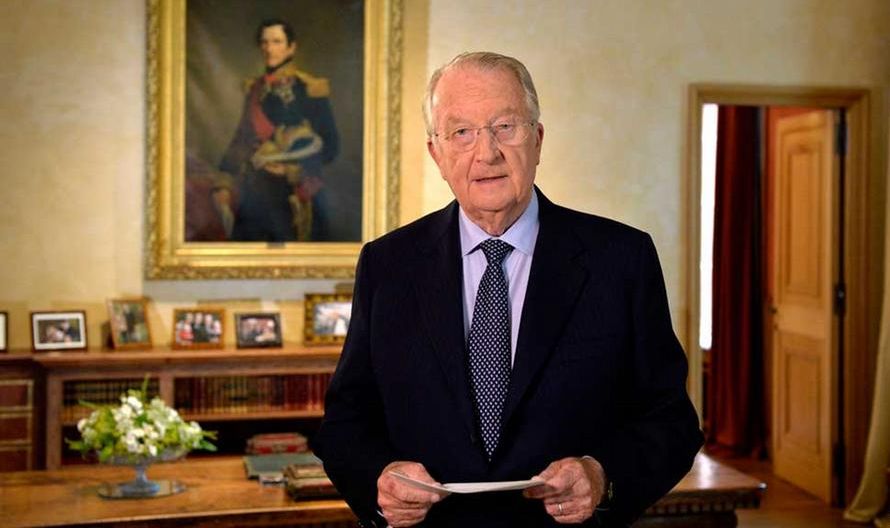
King Albert II of the Belgians announced on Wednesday that he would give up the throne to allow his eldest son, Prince Philippe, Duke of Brabant, to take over.

In 18 days the King will step down - Long live the King!

King Albert II adressing the nation on 3rd July 2013 at 6 pm.

"It is with serenity and full of confidence that I announce my intention to step down on July 21, 2013, our national holiday, in favour of the heir apparent, my son Philippe," King Albert II said. "I realise that my age and my health are no longer allowing me to carry out my duties as I would like to."

"After a reign of 20 years I believe the moment is here to hand over the torch to the next generation. Prince Philippe is well prepared to succeed me."

Ahead of the speech, broadcast on all major television and radio networks, the palace said the King would meet key members of the government. The government later scheduled a press conference at which Prime Minister Elio Di Rupo praised 53-year-old Prince Philippe, who has led trade delegations for Belgium abroad.

"He has already shown repeatedly how much he loves Belgium and the prince is willing to serve the country well. He can count on the support of the government," said Di Rupo.

Letter of King Albert II of the Belgians to his Prime Minister Elio Di Rupo.

The Belgian Royal Family on the country's national day, 21st July.


Prince Philippe is not unknown to Australia. Only in November 2012 he paid a last visit to Western Australia, Victoria, New South Wales, Canberra and Tasmania. He led a Belgian Economic Mission of 147 businessmen and women, who represented 91 companies.    
In November 2012 Prince Philippe visited Australia and started his tour down under in Perth.
After Prince Philippe had left Australia he continued his economic mission in  New Zealand.  

More on Belgium's new Queen Mathilde here - in an article for her 40th birthday in January 2013.

Wednesday, 3 July 2013

First wife of the Shah of Iran has died aged 92


His Imperial Majesty Mohammad Reza Pahlavi Shahanshah Ariyamehr with H.I.H. Princess Fawzia of Egypt, 1st wife of the Shahanshah of Iran.


Princess Fawzia, the first wife of the Shah of Iran and a daughter and sister of Egyptian kings has died aged 92, a member of the Egyptian Royal Family has announced.

Her death was reported on social media by her nephew, King Fuad II, who was Egypt’s King before he was deposed in 1953, when Egypt was deprieved of the Monarchy and declared a republic under the dictatorship of Gamal Abdel Nasser.
“The royal family of Egypt announces to the nation that it is mourning the passing of Her Royal Highness Princess Fawzia Fuad, daughter of His Majesty King Fuad I and sister of His Majesty King Faruk I and aunt of his Majesty King Fuad II and the former Empress of Iran… The funeral procession for Her Royal Highness Princess Fawzia will start after noon prayer on Wednesday.”
Her relatives have said she will be buried in Cairo.

Princess Fawzia became the Queen of Iran after marrying then Crown Prince Mohammad Reza Pahlavi in 1939, they divorced nine years later. She remarried in Egypt in 1949 to Ismail Chirine, an Egyptian army officer.

Princess Fawzia of Egypt and Colonel Ismail H. Chirine.
Fellow blogger Theodore Harvey found the right words:
As Egypt undergoes yet more turmoil with the military ouster of President Morsi today, one more link to an era when Egyptians enjoyed relative stability and liberty is gone. Egypt and Iran are still paying the price for the ouster of her brother & nephew and husband respectively.

80th Birthday of Margrave Max of Baden


The Grand Duchy of Baden was one of the smaller German territories and was amalgamated with Württemberg in 1952. However, both states had a long dynastic history and today the head of the Grand Ducal Family Margrave Maximilian of Baden can celebrate his 80th birthday.
Margrave Max of Baden and his wife, Margravine Valerie, née Archduchess of Austria.


Prince Maximilian Andreas Friedrich Gustav Ernst August Bernhard of Baden was born on 3rd July 1933 at Schloss Salem, Salem, Germany, as the eldest son of Margrave Berthold of Baden and Margravine Theodora of Baden, née Princess of Greece and Denmark. Through his mother, he is the nephew of Prince Philip, Duke of Edinburgh and is first cousin to Charles, Prince of Wales.

On 30th September 1966 he married Archduchess Valerie of Austria. The couple has four children. Hereditary Margrave is Prince Bernhard of Baden (*27th May 1970).

Friday, 21 June 2013

Commemorative Mass for King Juan III


With a solemn commemorative mass in the royal chapel of the Royal Palace in Madrid the Spanish Royal Family and the Spanish Government honoured the centenary of the birth of Don Juan de Borbón y Battenberg. The father of King Juan Carlos was born on 20th June 1913 as the third son of King Alfonso XIII and Queen Victoria Eugenia, née Princess of Battenberg (the family changed its name to Mountbatten in 1917). He died on 1st April 1993 from laryngeal cancer.

The Royal Family during the commemorative mass.

Besides King Juan Carlos I and Queen Sofía many members of the Royal Family were present: Prince Felipe and Princess Letizia, the Prince and Princess of Asturias, the Infantas Elena and Cristina. Prime Minister Mariano Rajoy, former Prime Minister José Luis Rodrîguez Zapatero, and the son of the former Prime Minister Adolfo Suarez, who is suffering from dementia and is no longer participates in public engagements, were among the audience of more than 200 people.

The Prince and Princess of Asturias - the King and Queen of Spain.


Other royal dignitaries also joined the Spanish Royal Family: King Simeon and Queen Margarita of the Bulgarians, Dom Duarte Pio and Duchess Dona Isabel of Bragança and the head of the South-Italian Royal Family Infante Don Carlos and Doña Ana of Bourbon-Two Sicilies.


The mass was celebrated by the military Archbishop of Spain, Juan del Rio, who in his homily recalled the historical and human history of Don Juan.

On 15th January 1941 King Alfonso XIII abdicated in favour of his son, the Infante Don Juan, Count of Barcelona. In 1947 a referendum restored the Monarchy in Spain. When Don Juan met the Spanish dictator Francisco Franco in August 1948, they agreed that the future heir, Don Juan Carlos, should be educated in Spain. It was clear that Franco had no desire to give up his position as head of the Spanish state. He was also aware that his supporters included the anti-royalist Falange movement, and Carlists who backed a rival branch of the Bourbon dynasty. Franco's compromise was to restore the monarchy in name in 1949, appoint himself head of state for life, and reserve the right to name his successor 'as King or Regent'.

Don Juan moved Portugal in 1946 in order to be closer to the Spanish people. He was faced with a dilemma which he never managed to resolve. Should he conclude that Franco intended to cling to power for as long as possible, and side with the liberal opponents of the regime? The issue between Don Juan and Franco was who should succeed the dictator as king in a restored monarchy: Don Juan or his son Don Juan Carlos. Don Juan knew that to sever ties with Franco would destroy his own chances of restoration. Equally, by putting Don Juan Carlos under Franco's tutelage, he knew that he was increasing the chance that Franco would name the younger Bourbon as his successor. That’s what happened in July 1969, and Don Juan was bitterly disappointed by his rejection.

From his exile in Estoril, he issued a statement pointing out that he had not been consulted and the freely expressed opinion of the Spanish people had not been sought. In Franco's final years he increased his contacts with the democratic opposition, and in June 1975, just before the dictator died, he was banned from Spain after attacking the regime at a dinner in Barcelona. After Franco’s death Don Juan realised that his son’s introduction of democratic reforms in Spain was the same as he had always intended to do and on 14th May 1977 Don Juan formally renounced his rights to the throne.

Don Juan de Borbón y Battenberg, Count of Barcelona, heir to the Spanish throne, his wife, María de las Mercedes de Borbón y Orléans, Countess of Barcelona, after they were married in Rome, Italy, 12th October 1935.
Don Juan always claimed that he took up the monarchist cause out of a sense of obligation. Before the war he had served as a naval officer, first with the Spanish navy, and after 1931 at the Royal Naval College in England.

On 1st April 1993 Don Juan died and was interred at the Pantheon of Kings in the Monastery of El Escorial under his rightful title Juan III. On 2nd January 2000, barely seven years later, his wife Doña María de las Mercedes de Borbón, Countess of Barcelona, whom he had married in 1935 in Rome, died and was buried at his side at the Pantheon of Kings in the Monastery of El Escorial.

Sunday, 16 June 2013

Trooping the Colour - the Queen's official birthday


The Royal Family standing on the balcony after Trooping the Colour.

Yesterday tens of thousands of people lined The Mall and crowded in front of Buckingham Palace to watch the military procession of the yearly celebration of Her Majesty's official birthday, known as Trooping the Colour.

It was the 61st occasion that The Queen, who turned 87 on 21st April, has taken the royal salute.

Prince Harry shared the coach with The Duchess of Cornwall and The Duchess of Cambridge.


The Duke of Edinburgh's place at the Queen’s side was instead taken by her cousin, the Duke of Kent.

The Queen first took part in the Trooping the Colour in 1947 and first took the royal salute in 1951, when she deputised for her sick father, King George VI .

The Queen and The Duke of Kent.

Saturday, 15 June 2013

In Melbourne: Honouring the Queen of Australia


After the Royal Over-seas League - Victorian Branch held a lunch a week ago in honour of this year's Queen's Birthday holiday, The Australian Monarchist League celebrated the official birthday of the Queen of Australia together with her 60th coronation anniversary on 14th June.


Both speaker, Sophie Mirabella MP, Shadow Minister for Innovation, Industry and Science, and Philip Benwell MBE, AML National Chair, praised Her Majesty's tireless workload, which she continues despite her 87 years. Sophie Mirabella stressed the continuity of the Australian Monarchy by pointing out that during Her Majesty's reign, she had 11 Australian prime ministers - and 17 leaders of the opposition. Ms. Mirabella, who had been an active member of the No campaign for the 1999 referendum on the introduction of a republic in Australia, mentioned in her speech this year's proposed change to the constitution.

For the Election Day, 14th September 2013, the present government - and most members of the opposition -is proposing a referendum to change the Australian Constitution to create a third tier of government with local councils and to empower Canberra to bypass the States and give taxpayer monies direct to this new tier of government. In 1942, the States had income-taxing powers but temporarily loaned them to Canberra to fund the war effort. Those powers were never handed back and Canberra today uses taxpayer money to force the States to do its bidding.

Sophie Mirabella MP during her speech to the members and friends of the Australian Monarchist League in Melbourne.
While the Liberal Opposition in Parliament agreed to proposed referendum and front benchers are bound to this agreement, Liberal back benchers are allowed to campaign against it. Ms. Mirabella, being a member of the shadow cabinet, made it clear that she will not take part in a No campaign, but she herself would vote no, should the referendum actually be held on 14th September. However, she did welcome the Western Australian and Victorian Liberal Councils’ decision to incorporate a NO vote in their How-to-vote cards on 14th September.

The Australian Monarchist League established a referendum campaign to provide information to those concerned about this referendum and stated: “We are not in opposition to any other group that may be opposing this move to centralise more power into Canberra.” Both the local government referendum information website, a Facebook and a Twitter account have been set up.

Monday, 10 June 2013

Swedish Wedding


On Saturday 8th June, Princess Madeleine of Sweden and Mr Christopher O'Neill were married in the Royal Chapel at the Royal Palace of Stockholm.

The Princess Couple with the bridal attendants.

The wedding began at 16.00, and the service was conducted by Chaplain to The King and Bishop Emeritus Lars-Göran Lönnermark. Princess Madeleine's wedding dress was created by the Italian designer Valentino Garavani. The Princess's tiara is privately owned, and was decorated with sprigs of orange blossom.

Representing the British royal family: Prince Edward, the Earl of Wessex and Sophie, the Countess of Wessex, leaving the Royal Chapel.

Crown Prince Frederik and Crown Princess Mary of Denmark.

The Greek Royal Family was represented by four children of Their Majesties King Constantine II and Queen Anne-Marie of the Hellenes.

Crown Prince Pavlos of Greece and his wife Marie-Chantal.

Prince Nikolaos of Greece and his wife Tatiana.

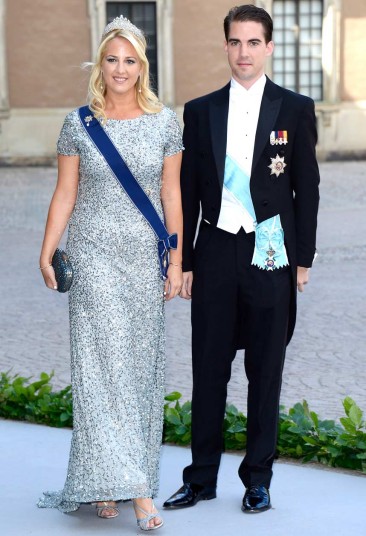
Princess Theodora and her brother Prince Philippos of Greece.


Queen's Birthday Holiday 2013

The Age's editorial writer must feel so relieved. The anti-monarchist editorial for today's Queen’s Birthday holiday ("abolish the Queen's Birthday's honours - and why not the holiday as well?") is done and you can always rely on the old ideas The Age had printed on previous occasions without sounding too repetitive. They did what they obviously do consider their duty. Can we now return to the more pressing issues in Australia? The audience would have expected that The Age would have given far more coverage to the issues surrounding PRISM which have a far more direct impact on our sovereignty the our Queen’s Birthday.

Long live the Queen of Australia!


A Jacobite at the University of Western Australia, Perth


The 8th Annual Limina Conference at the University of Western Australia (UWA), Perth, will take place next Friday, 14th June, on the UWA Crawley campus, courtesy of the University's Advanced Studies Institute.

The overarching title for this year's conference is "Exclusivity: Boundaries of Difference", and the event aims to highlight current research being undertaken at UWA, and more broadly across Western Australia.

Craig Buchanan will be speaking in the first concurrent session of the morning on "Closed Ranks: the Sobieski Stuart Brothers, Jacobite Wish Fulfilment, and the Community of Authority in Great Britain, Ireland, and Beyond". Basically, the paper will look at the brothers and their relationships with some of the leading families of the day - the Dukes of Argyle, the Earl of Moray, Lord Lovat, and the extended Beresford clan, among others.

Craig Buchanan is a part-time PhD candidate within the School of Humanities at the University of Western Australia. He holds an M.Phil. from the University of St Andrews in the field of Scottish political literature, and a BA (Hons) from the University of Stirling.

Conference Schedule-Final

Wednesday, 5 June 2013

Shame: Australian prank call DJ given top award

Some people really have no decency:

Royal prank call DJ Michael Christian was declared the joint "winner" of the metro category of the contest that recognises Southern Cross Austereo network's "best in the land".

Christian, who now works at Austereo's Melbourne station Fox FM, claimed regardless of "everything" that had happened he was still at the 'top of his game'.

That "everything" was a prank call to London's King Edward VII Hospital, where Christian and his colleague were put through to the Duchess of Cambridge's ward by nurse Jacintha Saldanha, who took her own life soon after the hoax.

As "Top Jock winner", Christian will fly to Los Angeles for a studio tour. Could the Americans please give him an appropriate welcome?

Tuesday, 4 June 2013

Today a republican - gone tomorrow


Yesterday the Australian federal Treasurer Wayne Swan stated his republican creed:
"The time may not indeed be right for an immediate referendum, but it is my belief that it is always the right time to argue for the merits of a republic and prepare the ground for future constitutional change. The road to an Australian republic is a long one, without a timetable, and so the journey must continue.
"The case for a republic is as simple as it is compelling, and one that I have been making since my maiden parliamentary speech in 1993."
Funny that he referred to his maiden speech, since yesterday's press conference might be the preface of his swan song, his last political statement. Today he is faced with a disastrous opinion poll "Swan likely to lose seat amid Queensland Labor despair" (The Age, 4th June 2013):
"Deputy Prime Minister Wayne Swan looks set to lose his Brisbane seat of Lilley for a second time, with internal polling suggesting Labor will struggle to retain any Queensland seats north of the Brisbane River at the September 14 federal election.
"The results are so dire for Labor that a ''worst case'' scenario suggests Kevin Rudd could become Labor's ''last man standing'' in Queensland, with the former prime minister the only Queensland MP who is seen as likely to retain his seat.

"The Queensland polling, taken in recent weeks in Mr Swan's electorate, is believed to show that his primary vote has collapsed to just 28 per cent, compared to 41 per cent at the last election.

"Mr Swan has held the seat since 1998, although at the last election his margin narrowed from 8 per cent to 3.2 per cent, with a 10 percentage point fall in his primary vote."
Let's hope for the best that could happen. Wayne Swan will lose his seat in September and have a lot of time afterwards to become a full time republican propagandist. Or should we say "itinerant preacher"? Even The Age's editorial admitted today: "The increasing likelihood is that a federal Coalition government led by Tony Abbott, an ardent monarchist, would consign a republic to the political deep freeze for at least a few more years. "

No need to feel sorry - neither for Mr. Swan nor for The Age. This letter to the editor says it all:
According to internal polling, Wayne Swan is about to receive a well-deserved and long overdue ''efficiency dividend'' from his electorate (4/6). Can't wait.
Lucien Zalcman, North Fitzroy
Seen at Federation Square in Melbourne.
It goes without saying, that The Age, like the ABC, has totally ignored The Queen's Diamond Coronation Jubilee. All they could publish was a re-print from The Sunday Telegraph last Wednesday, 29th May: Working overtime. No wonder, The Age no longer uses the PR sloag: "If it matters to you, it's in The Age." Such an obvious lie wouldn't work anymore.

Queen Máxima charms Germany


King Willem-Alexander and Queen Máxima today arrived in Berlin to begin their first visit to Germany. The royal pair were greeted by Chancellor Angela Merkel in Berlin at the beginning of their two-day visit. The visits to both Hesse and Baden-Württemberg had been planned ahead of Queen Beatrix's abdication. However, the itinerary was extended to include a first official visit to Berlin as head of state for Willem-Alexander. In both states, the royal pair were to meet German and Dutch entrepreneurs.

King Willem-Alexander, Queen Ma1xima and Angela Merkel.
Germany was not the first state visit they paid to a foreign nation. In May King Willem-Alexander and Queen Máxima visit their relatives in Luxembourg. Until 1890 the King of the Netherlands was also Grand Duke of Luxembourg. But Luxembourg did not recognise female succession and when Queen Wilhelmina inherited the throne from her father, King Willem III in 1890, Luxembourg received the former Duke of Nassau as new Grand Duke Adolph I. Ironically King Willem-Alexander and Queen Máxima left Berlin for Wiesbaden, today the capital of the German state of Hesse, but until 1866 the residence of the Dukes of Nassau. When the Prussian annexed Nassau in 1866 they could not have thought, that the Prussian dynasty would lose their throne, but the rulers of Nassau would still be sitting on a throne today.

On Tuesday, the couple - and a delegation representing Dutch business - will continue on to Baden-Württemberg. Like in Hesse, the royal couple could walk on the footsteps of their ancestors: Princess Sophie, daughter of King Wilhelm I of Württemberg, married Dutch King Willem III in 1839 and became Queen of the Netherlands. Unfortunately all three sons born to the royal couple died before they could succeed their father as King of the Netherlands. After Queen Sophie's premature death in 1877, King Willem III married Princess Emma of Waldeck and Pyrmont, a small German principality and today also part of the state of Hesse, on 7th January 1879. She was 41 years the King's junior. In 1880, Princess Wilhelmina was born. She became heiress presumptive in 1884 after the death of the last remaining son from William's first marriage. Many potential male heirs had died between 1878 and 1884. Because Queen Wilhelmina had not yet reached adulthood, Dowager Queen Emma became regent for her daughter. She would remain regent until Queen Wilhelmina's eighteenth birthday in 1898. Queen Wilhelmina reigned until 1948 and is King Willem-Alexander's great grandmother.

The schedule for the visit to the Hesse state capital of Wiesbaden included a reception with state premier Volker Bouffier, who faces an election this September and certainly appreciates a little bit of royal glamour. Also on the itinerary was a visit to a memorial to William the Silent, the founding father of the Dutch royal family who had strong links with Hesse.

A visit to the Opel car factory at Rüsselsheim is planned for Tuesday, along with engagements near Stuttgart at machinery and laser firm Trumpf and the University of Hohenheim.

Sunday, 2 June 2013

The Queen's 60th Coronation anniversary


The 1953 Coronation provided the Queen with a formal initiation rite and an investiture with her official regalia.

Australia's magnifiscent Queen's Birthday stamp 2013
Queen Elizabeth was the 39th sovereign to be crowned at Westminster Abbey; the first was William the Conqueror, whose coronation took place on Christmas Day, 1066.

The 27-year-old Queen swore her oath and was anointed (concealed under a canopy) on her hands, her breast and her head with holy oil of orange flowers, roses, cinnamon, jasmine and sesame with benzoin, musk, civet and ambergris, in imitation of the anointing of the kings of ancient Israel. She put on the Armills (bracelets), the Robe Royal and the Stole Royal. She held the orb and sceptre. Then the crown was placed upon her head.

Everyone shouted “God Save Queen Elizabeth. Long Live Queen Elizabeth. May the Queen live for ever.”

Tuesday, 28 May 2013

Prince Charles: "Cheaper food earns companies bigger profits and is sucking real value out of the food production system"


"The success of a globalized system is being subsidized by many complex, long-term problems that contribute to a potentially toxic mix, making the food it produces not cheap at all.  In fact, it is very expensive."


Addressing the Langenburg Forum at Langenburg Castle in Württemberg, Southern Germany, The Prince of Wales launched a wide-ranging attack on current food production methods.  

In his speech at a conference on regional food security at the castle of his 2nd degree cousin Prince Philipp of Hohenlohe-Langenburg, Prince Charles called for the creation of a more local model of food production and distribution. He said the drive to make food cheaper for consumers and to earn companies bigger profits was sucking real value out of the food production system – value that was critical to its sustainability.

"The recent horsemeat scandals are surely just one example, revealing a disturbing situation where even the biggest retailers seem not to know where their supplies are coming from."
The Prince of Wales said:

Ladies and Gentlemen, I would just like to say how immensely grateful I am to Prince Philipp, Princess Xenia and to Joschka Fischer [former German foreign minister, Greens Party] for their herculean efforts in putting this Langenburg Forum together! I hate to say that it has been over fifty years since I was here last and almost fifty years since my parents visited this wonderful castle, back in 1965. It was two years after a devastating fire which had almost completely gutted the building. So it is a joy to see it so marvellously restored under my late cousin, Kraft’s, expert supervision.

Ladies and Gentlemen,
if I may say so, this is a very important conference. I am sure what you have heard so far about the problems we face and the obstacles to tackling them has given you a clear context in which to be able to consider what comes next this afternoon.

The aim here is to think through how we might create a much more local model of food production and distribution. But also, how that might fit with producing healthy food using far more sustainable methods and how we might do all of this without damaging business. Indeed, how this could improve business.

Prince Charles received a hearty welcome in Langenburg.

As you have heard, the urgency for this comes from the fact that there is not sufficient resilience in the system as it currently stands. It may appear that things are well. Big global corporations may appear to be prospering out of operating on a global monocultural scale but, as I hope you have seen, if you drill down into what is actually happening, things are not so healthy. Our present approach is rapidly mining resilience out of our food system and threatening to leave it ever more vulnerable to the various external shocks that are becoming more varied, extreme and frequent.

The drive to make food cheaper for consumers and to earn companies bigger profits is sucking real value out of the food production system - value that is critical to its sustainability. I am talking here about obvious things like the vitality of the soil and local eco-systems, the quality and availability of fresh water and so on, but also about less obvious things, like local employment and people’s health. It is, as I fear you know only too well, a complex business.

The aggressive search for cheaper food has been described as a “drive to the bottom”, which I am afraid is taking the farmers with it. They are being driven into the ground by the prices they are forced to expect for their produce and this has led to some very worrying short cuts. The recent horsemeat scandals are surely just one example, revealing a disturbing situation where even the biggest retailers seem not to know where their supplies are coming from. And it has also led to a very destructive effect on farming. We are losing farmers fast. Young people do not want to go into such an unrewarding profession. In the U.K., I have been warning of this for some time and recently set up apprenticeship schemes to try to alleviate the problem; but the fact remains that at the moment the average age of British farmers is fifty-eight, and rising.

We also have to consider the problems we expose ourselves to when we ship vast quantities of commodities half way round the world. These long distance supply chains are apt to snap when they are subjected to sudden shocks. Unexpected weather events, hikes in fuel prices, trade disputes and disease; all sorts of unpredictable events threaten to interrupt supplies. And such is the way we now arrange things that most of us, even if we do not realize it, have an umbilical dependency upon this globalized system which is surely a dangerously vulnerable position to be in.

And finally there are the social and economic problems that derive from this pressure to produce cheap food. It is heartening, I must say, to be in this part of Germany where there is the highest density of organic farms in Europe. I've just visited a marvellous example with Herr [Rudolf] Bühler but throughout the continent the way we produce most of our food seems dependent more on chemicals and industrial processing than it does on farmers - and, for that matter, on our ability to cook!

In the U.K., as elsewhere - but particularly I think in the U.S. - the consequences of this are ever more apparent in the deteriorating state of our public health. We all know that Type 2 Diabetes and other obesity-related conditions are rapidly on the increase. The public bill for dealing with these is already massive and I am told it could become completely unaffordable if we do not see a shift in emphasis. And, of course, it will be cities that carry the heaviest part of that burden. It is a peculiar trend…

"How is it, then, that systems of farming which do precisely the opposite - with increasingly dire and damaging effects on both the terrestrial and marine environments, not to mention long-term human health - are able to sell their products in mass markets at prices that in no way reflect the immense and damaging cost to the environment and human health?  A cost that then has to be paid for over and over again elsewhere - chiefly, in all probability, by our unfortunate children and grandchildren, whose welfare I happen to care about."
Am I alone, ladies and gentlemen, in wondering how it is that those who are farming according to organic, or agro-ecological principles - in other words, sustainably, for the long-term, by operating in a way that reduces pollution and contamination of the natural environment to a minimum and maximizes the health of soil, biodiverse ecosystems and humanity - are then penalized? They find that their produce is considered too expensive and too “niche market” to be available to everyone. How is it, then, that systems of farming which do precisely the opposite - with increasingly dire and damaging effects on both the terrestrial and marine environments, not to mention long-term human health - are able to sell their products in mass markets at prices that in no way reflect the immense and damaging cost to the environment and human health? A cost that then has to be paid for over and over again elsewhere - chiefly, in all probability, by our unfortunate children and grandchildren, whose welfare I happen to care about. Surely this is a truly perverse situation which, you would have thought, could be turned on its head to make genuinely sustainably-produced food accessible to everyone, and the polluter to pay the real costs for the side effects of industrialized food? It is to be wondered at how this state of affairs persists - and yet to suggest standing it on its head and transforming the situation is to invite the predictable chorus of vitriolic accusations that you are anti-science, anti-progress, out of touch with commercial pressures and not living in the “real world.”

So, as I hope you can see, the success of a globalized system is being subsidized by many complex, long-term problems that contribute to a potentially toxic mix, making the food it produces not cheap at all. In fact, it is very expensive. The only reason it appears cheap in the shops is because the costs either fall somewhere else, or they are being stored up for the future when, as I have said, they will be met by our children and grandchildren. You only have to look at what is happening to the Baltic Sea to see the sort of legacy I am talking about. And as I heard from many people in Sweden last year, a delicate ecosystem is being suffocated by what is called “eutrophication” - an entirely Man-made problem, caused by excessive amounts of nutrients leeching into the water from farming and other industrial processes. The price of apparently cheap food is costing nothing less than the Earth!

This is why we have to recalibrate and re-gear the system. Food needs to be produced in a more sustainable and eco-friendly manner and how it is then processed and distributed needs to happen at a much more appropriate level. In short, our food systems need to have better networks which are less globally dependent and more locally inter-connected. Moving in that direction could solve lots of problems. Many of the arguments about “feeding the world” conveniently ignore the fact that in both the developed and developing worlds 40% of all food produced is then wasted. It is either thrown away or it ends up rotting through lack of storage or well-managed local distribution.

There are plenty of very sophisticated means of enabling city regions to become the engines of significant change. I have seen many inspiring examples here in Germany which, if I may say so, is leading the debate on many of these issues. As you will discover in the next session, there are also some very interesting new ways of thinking and operating - seeds of change that could put resilience back into the system. They could also bring farming back from the brink of a worrying collapse and offer the retail sector a profitable future.

Some of these approaches follow the idea that came from Toronto and Copenhagen - of prioritizing procurement in the immediate hinterland of a town or city. This is already delivering benefits for farmers, consumers and for public organizations such as hospitals and schools. And in that vein, I understand this meeting today might lead to the consideration of a regional food initiative, here in Baden-Württemburg, that would, if I may say so, be wonderful as these sorts of examples are invaluable. They demonstrate that stakeholders are not powerless; they do have the ability to support more resilient and integrated food systems if they are prepared to act with a common purpose.

Prince Charles in Langenburg accompanied by his cousin Prince Philipp of Hohenlohe-Langenburg (l.) and Princess Saskia of Hohenlohe-Langenburg (r.). Please note that the bakery is still called "Hof Conditorei", by appointment to the princely court [of Langenburg].
One of the presentations in a moment explores how we might capitalize on the sort of information technology that underpins social media websites these days. From what I understand and I am certainly not an expert, there is every chance this technology could transform the way food networks operate, so it would, perhaps, be wise to take such ideas seriously.

I realize only too clearlt that there is no one “magic bullet” solution to establishing a resilient and sustainable food system. Local food production is not the panacea. But we do need to redress the balance perhaps through carefully structured incentives and disincentives if we are to evolve food systems and food businesses so that people have what they most want, and Nature’s systems have what they most need to keep us all going, now and in the future.

In this regard we should perhaps pay particular attention to a recent agreement between the United Nations food and agriculture organisation and the international Slow Food movement. It is hugely encouraging, I think, and I would have thought also provides a most useful model to build on.

So Ladies and Gentleman I can only wish you well in your deliberations for the rest of the afternoon. Having joined you here today I will allow myself the hope that the ideas you are discussing at this forum will become the much needed practical behaviour of tomorrow.

Prince Charles' visit made front page headlines in Germany.

Tuesday, 14 May 2013

Royal Over-seas League - Victorian Branch


The ROYAL OVER-SEAS LEAGUE VICTORIAN BRANCH (ROSL) is an organisation which - in its own words - "was set up to bring together like-minded people, to foster friendship and understanding between Commonwealth peoples of different cultures and nationalities and to work for the good of humanity at large. ROSL in Victoria boasts a wide cross-section of society and all ages."

The Royal Over-Seas League was founded in 1910 by Sir Evelyn Wrench to foster international friendship and understanding. ROSL operates under Royal Charter and ‘aims at promoting an enduring multi-racial fellowship pledged to the support of the Commonwealth and to the service of others and humanity at large’. It is required to encourage the arts, particularly among the young people of the Commonwealth.


ROSL seeks to fulfil its aims by:

•Supporting Commonwealth ideals

•Offering clubhouse hospitality to member

•Organising annual competitions for young artists and musicians

•Developing joint welfare projects for disadvantaged communities

•Providing a network of contact and representatives around the world.

ROSL has members throughout the world. There are branches or member groups in Australia, Canada, Hong Kong, New Zealand and Switzerland.

League events are neither formal nor obligatory, but rather of a social nature and focus on a broad range of interests. These include theatre parties, celebratory dinners, receptions and musical events organised throughout the year.

Patron

HM The Queen


Vice-Patron

HRH Princess Alexandra KG GCVO


Patron Australia

The Governor-General of Australia


Patron Victoria

The Governor


Chairman Australia & President Victoria

Jason Ronald OAM

 
QUEEN’S BIRTHDAY CELEBRATION

Wednesday 5 June 2013

LUNCHEON

12 noon for 12.30pm

ESU House, 146 West Toorak Road, South Yarra


Sunday 9 June 2013

A Service will be held at 10.00am at St. George’s Anglican Church, 296 Glenferrie Road, Malvern

followed by morning tea with the congregation.

Guest Speaker to be announced

For event details please contact Miss Julie Sattler OAM, 1 / 50 Sutherland Road, Armadale 3143, Telephone: 9500 1947

Monday, 13 May 2013

Serbia: Nearly 40 p.c. in favour of the Monarchy

According to an opinion poll done by Belgrade-based SAS Intelligence agency 39.7 percent of the Serbians believe that a renewal of a parliamentary monarchy would be a good idea. 32.2 percent of those who replied were strongly against the monarchy while 27.4 percent did not have an opinion on the issue.

Youth Radio Broadcasting B92 attended a press conference, where SAS Intelligence Executive Director Miljan Premović explained the poll which was carried out between 11th and 16th April: a total of 1,615 people in 16 Serbian towns, Kosovo excluded, had participated in it. He said that the poll had been carried out in all regions, in both urban and rural areas and that it covered both sexes and citizens of various aged and that it had a 95 percent trust interval “which makes it good enough for scientific publications”.

The main person who inspired us to conduct the poll was in fact world’s leading nation-branding expert Simon Anholt who believes that Serbia is one of the countries with the highest chance to renew the monarchy. Therefore we decided to give the public an insight into one of the social topics that have not been researched and show the mood regarding the renewal of monarchy. The question resembles a possible referendum question: Should Serbia be a parliamentary monarchy?”

The opinion poll was conducted before the repatriation of the remains of Queen Alexandra of Yugoslavia (* 25th March 1921 in Athens - + 30th January 1993 in East Sussex, U.K.). 

At the Tatoi Palace Royal Cemetery the Remains of HM Queen Alexandra were seen off by representatives of the Greek Orthodox Church His Eminence Metropolitan Athinogoras and Archimandrite Patrikio.

On 9th May the remains of  Queen Alexandra were disinterred at the Tatoi Palace Royal Cemetery in the presence of Their Royal Highnesses Crown Prince Alexander and Crown Princess Katherine, HRH Princess Irene of Greece, Mr. Vassilis Koutsavlis, President of Friends of Tatoi, together with Their Excellences Ambassador of Serbia Mr. Dragan Zupanjevac, Ambassadors of Montenegro Mr. Ivo Armenko, Hungary Mr. Jaime Barberis, Jordan Mr. Saker Malkawi, Switzerland Mr. Lorenzo Amberg and Mrs. Christiane Amberg, Ambassador Mr. Dionyssis Kodelas, Ambassador of Poland – Mr. Maciej Krych, Mr. Chronis and Goodwill Ambassador of UNESCO Mrs. Marianna Vardinoyannis and other dignitaries.

A memorial service for HM Queen Alexandra was officiated by His Holiness Patriarch Irinej of Serbia at the Royal Chapel of St Andrew the First Called at the Royal Compound in Dedinje. In his address afterwards, the Patriarch has emphasized: “We are grateful to the Lord that time when they have been forbidden to come back to their country, and to have a final rest at the country that members of Karadjordjevic Royal Family lived for is finally over. The huge injustice has been rectified, praise the Lord!”

HRH Crown Prince Alexander gave a moving speech: ”Thank you all for gathering here today to pay respect to my mother, HM Queen Alexandra of Yugoslavia. I wish to express my special gratitude to His Holiness Patriarch Irinej for being here today and for all his prayers. My mother got married to my father King Peter II while he was in exile during World War II. She shared with him the tragedy of being torn away from his country and his people. Soon they will be together in their eternal place of rest in Oplenac, thus fulfilling my great-grandfather’s King Peter I legacy to have all the members of Karadjordjevic family buried there.

"We have brought the Queen to her country. Welcome home, mother! Eternal glory to her!

Queen Alexandra was the daughter of HM King Alexander of the Hellenes and HRH Princess Aspasia of Greece and Denmark (née Aspasia Manos). Queen Alexandra was educated at Westfield, the junior school of Heathfield, then she went to Heathfield. Following schooling in England Queen Alexandra went to Mademoiselle Ozanne in Paris. The Queen was previously buried at Tatoi Palace Royal Cemetery near Athens.

HM King Peter II, HM Queen Alexandra and HM Queen Mother Maria will remain at The Royal Chapel of St. Andrew the First Called until the State Funeral on 26th May in the Church of St. George Royal Mausoleum in Oplenac.

Sunday, 12 May 2013

Sour times for Australian republicans

Funny, how history repeats itself. Already the old Greek fable-ist and story teller Aesop (c. 620–564 BC), had the fox declare, that the grapes he could not reach were sour (The Fox and the Grapes). Today's fox is called Malcolm Turnbull and he proclaimed last Friday, the voting with a paper ballot would not help to achieve his aim to establish a republican regime in Australia. Therefore Turnbull advocated an "online plebiscite" on the abolition the monarchy as a precursor to a new republic referendum, saying web-based polls have become more reliable than the traditional paper ballot.

How desperate must republicans be, if they do not trust in ballot papers anymore and put their hope in easy to manipulate online voting systems?

Turnbull was speaking at a fundraising banquet in Sydney, on which Murdoch media (The Australian and MX) widely reported. They can rely on Rupert Murdoch’s propaganda machine. MX wrote: “Current [ARM] chairman Gallop said it was again time to discuss cutting ties with the monarchy after the topic ‘went off the boil’ ...”. Did you notice the subtle irony “it was time again”? How many revivals will the Australian republicans celebrate? Why not accept that the people of  Australia have selected our Monarchy and help make it work for the benefit of the Australian people and the democratic institutions?

“Gallop said ARM had spent the past year rethinking how the subject should be re-introduced.” And the result of a one year thinking is the grandiose proclamation “web-based polls have become more reliable than the traditional paper ballot”. Do they really believe this could bring a republican system to Australia?

The grapes will remain sour for Australian republicans.

Prince Charles in Melbourne: In November 2012 a huge crowd welcomed Australia's future King - more than would ever turn out to see Malcolm Turnbull.