Tuesday, 14 May 2013

Royal Over-seas League - Victorian Branch


The ROYAL OVER-SEAS LEAGUE VICTORIAN BRANCH (ROSL) is an organisation which - in its own words - "was set up to bring together like-minded people, to foster friendship and understanding between Commonwealth peoples of different cultures and nationalities and to work for the good of humanity at large. ROSL in Victoria boasts a wide cross-section of society and all ages."

The Royal Over-Seas League was founded in 1910 by Sir Evelyn Wrench to foster international friendship and understanding. ROSL operates under Royal Charter and ‘aims at promoting an enduring multi-racial fellowship pledged to the support of the Commonwealth and to the service of others and humanity at large’. It is required to encourage the arts, particularly among the young people of the Commonwealth.


ROSL seeks to fulfil its aims by:

•Supporting Commonwealth ideals

•Offering clubhouse hospitality to member

•Organising annual competitions for young artists and musicians

•Developing joint welfare projects for disadvantaged communities

•Providing a network of contact and representatives around the world.

ROSL has members throughout the world. There are branches or member groups in Australia, Canada, Hong Kong, New Zealand and Switzerland.

League events are neither formal nor obligatory, but rather of a social nature and focus on a broad range of interests. These include theatre parties, celebratory dinners, receptions and musical events organised throughout the year.

Patron

HM The Queen


Vice-Patron

HRH Princess Alexandra KG GCVO


Patron Australia

The Governor-General of Australia


Patron Victoria

The Governor


Chairman Australia & President Victoria

Jason Ronald OAM

 
QUEEN’S BIRTHDAY CELEBRATION

Wednesday 5 June 2013

LUNCHEON

12 noon for 12.30pm

ESU House, 146 West Toorak Road, South Yarra


Sunday 9 June 2013

A Service will be held at 10.00am at St. George’s Anglican Church, 296 Glenferrie Road, Malvern

followed by morning tea with the congregation.

Guest Speaker to be announced

For event details please contact Miss Julie Sattler OAM, 1 / 50 Sutherland Road, Armadale 3143, Telephone: 9500 1947

Monday, 13 May 2013

Serbia: Nearly 40 p.c. in favour of the Monarchy

According to an opinion poll done by Belgrade-based SAS Intelligence agency 39.7 percent of the Serbians believe that a renewal of a parliamentary monarchy would be a good idea. 32.2 percent of those who replied were strongly against the monarchy while 27.4 percent did not have an opinion on the issue.

Youth Radio Broadcasting B92 attended a press conference, where SAS Intelligence Executive Director Miljan Premović explained the poll which was carried out between 11th and 16th April: a total of 1,615 people in 16 Serbian towns, Kosovo excluded, had participated in it. He said that the poll had been carried out in all regions, in both urban and rural areas and that it covered both sexes and citizens of various aged and that it had a 95 percent trust interval “which makes it good enough for scientific publications”.

The main person who inspired us to conduct the poll was in fact world’s leading nation-branding expert Simon Anholt who believes that Serbia is one of the countries with the highest chance to renew the monarchy. Therefore we decided to give the public an insight into one of the social topics that have not been researched and show the mood regarding the renewal of monarchy. The question resembles a possible referendum question: Should Serbia be a parliamentary monarchy?”

The opinion poll was conducted before the repatriation of the remains of Queen Alexandra of Yugoslavia (* 25th March 1921 in Athens - + 30th January 1993 in East Sussex, U.K.). 

At the Tatoi Palace Royal Cemetery the Remains of HM Queen Alexandra were seen off by representatives of the Greek Orthodox Church His Eminence Metropolitan Athinogoras and Archimandrite Patrikio.

On 9th May the remains of  Queen Alexandra were disinterred at the Tatoi Palace Royal Cemetery in the presence of Their Royal Highnesses Crown Prince Alexander and Crown Princess Katherine, HRH Princess Irene of Greece, Mr. Vassilis Koutsavlis, President of Friends of Tatoi, together with Their Excellences Ambassador of Serbia Mr. Dragan Zupanjevac, Ambassadors of Montenegro Mr. Ivo Armenko, Hungary Mr. Jaime Barberis, Jordan Mr. Saker Malkawi, Switzerland Mr. Lorenzo Amberg and Mrs. Christiane Amberg, Ambassador Mr. Dionyssis Kodelas, Ambassador of Poland – Mr. Maciej Krych, Mr. Chronis and Goodwill Ambassador of UNESCO Mrs. Marianna Vardinoyannis and other dignitaries.

A memorial service for HM Queen Alexandra was officiated by His Holiness Patriarch Irinej of Serbia at the Royal Chapel of St Andrew the First Called at the Royal Compound in Dedinje. In his address afterwards, the Patriarch has emphasized: “We are grateful to the Lord that time when they have been forbidden to come back to their country, and to have a final rest at the country that members of Karadjordjevic Royal Family lived for is finally over. The huge injustice has been rectified, praise the Lord!”

HRH Crown Prince Alexander gave a moving speech: ”Thank you all for gathering here today to pay respect to my mother, HM Queen Alexandra of Yugoslavia. I wish to express my special gratitude to His Holiness Patriarch Irinej for being here today and for all his prayers. My mother got married to my father King Peter II while he was in exile during World War II. She shared with him the tragedy of being torn away from his country and his people. Soon they will be together in their eternal place of rest in Oplenac, thus fulfilling my great-grandfather’s King Peter I legacy to have all the members of Karadjordjevic family buried there.

"We have brought the Queen to her country. Welcome home, mother! Eternal glory to her!

Queen Alexandra was the daughter of HM King Alexander of the Hellenes and HRH Princess Aspasia of Greece and Denmark (née Aspasia Manos). Queen Alexandra was educated at Westfield, the junior school of Heathfield, then she went to Heathfield. Following schooling in England Queen Alexandra went to Mademoiselle Ozanne in Paris. The Queen was previously buried at Tatoi Palace Royal Cemetery near Athens.

HM King Peter II, HM Queen Alexandra and HM Queen Mother Maria will remain at The Royal Chapel of St. Andrew the First Called until the State Funeral on 26th May in the Church of St. George Royal Mausoleum in Oplenac.

Sunday, 12 May 2013

Sour times for Australian republicans

Funny, how history repeats itself. Already the old Greek fable-ist and story teller Aesop (c. 620–564 BC), had the fox declare, that the grapes he could not reach were sour (The Fox and the Grapes). Today's fox is called Malcolm Turnbull and he proclaimed last Friday, the voting with a paper ballot would not help to achieve his aim to establish a republican regime in Australia. Therefore Turnbull advocated an "online plebiscite" on the abolition the monarchy as a precursor to a new republic referendum, saying web-based polls have become more reliable than the traditional paper ballot.

How desperate must republicans be, if they do not trust in ballot papers anymore and put their hope in easy to manipulate online voting systems?

Turnbull was speaking at a fundraising banquet in Sydney, on which Murdoch media (The Australian and MX) widely reported. They can rely on Rupert Murdoch’s propaganda machine. MX wrote: “Current [ARM] chairman Gallop said it was again time to discuss cutting ties with the monarchy after the topic ‘went off the boil’ ...”. Did you notice the subtle irony “it was time again”? How many revivals will the Australian republicans celebrate? Why not accept that the people of  Australia have selected our Monarchy and help make it work for the benefit of the Australian people and the democratic institutions?

“Gallop said ARM had spent the past year rethinking how the subject should be re-introduced.” And the result of a one year thinking is the grandiose proclamation “web-based polls have become more reliable than the traditional paper ballot”. Do they really believe this could bring a republican system to Australia?

The grapes will remain sour for Australian republicans.

Prince Charles in Melbourne: In November 2012 a huge crowd welcomed Australia's future King - more than would ever turn out to see Malcolm Turnbull.

Tuesday, 30 April 2013

A new Monarch for the Netherlands - Leve de Koning!


Crown Prince Willem-Alexander became Europe's youngest monarch today after his mother, Queen Beatrix, renounced to her rights as Queen of the Netherlands.


At 10.10 am Queen Beatrix signed the document making her son King Willem-Alexander.

"I, Queen Beatrix, abdicate in favour of my son Willem-Alexander," the act said, as read out before the signing by the director of the royal cabinet that was broadcast live from the Amsterdam palace to the Netherlands and the world. In Melbourne the Dutch community watched a programme broadcast by bvn.

Queen Beatrix signing the document.

King Willem-Alexander, Princess Beatrix and Queen Máxima received thundering cheers from the crowd in the Dam, the main square

King Willem-Alexander, Queen Máxima and their three daughters, Catharina-Amalia (9), the new Princess of Orange, Alexia (7) and Ariane (5) on the balcony together for the first time as the new royal family.
An orange sea welcomed the new King of the Netherlands.

Speech by His Majesty King Willem-Alexander on the occasion of his investiture, 30th April 2013

30 April 2013, Nieuwe Kerk, Amsterdam

Members of the States General,

Today I stand before this joint session of Parliament to be sworn in and invested as your new King. You have gathered here in the nation's capital for this purpose as the elected representatives of the people. This symbolises our constitutional bonds.

Over the course of two centuries, the Dutch monarchy has become inextricably linked with our parliamentary democracy. This investiture and the oath I am about to take confirm this connection, which is enshrined in the Charter for the Kingdom and the Constitution.

Democracy is based on mutual trust. The people's trust in the government - one that respects the law and offers its citizens prospects for the future. But also the government's trust in the people - citizens who feel a shared responsibility for the public interest and are willing to stand up for one another. All holders of public office, whether they are elected, appointed or designated, must contribute to that trust. That is how democracy is maintained.

In her final Christmas address as Queen, my mother said, 'Achieving mutual trust is an ongoing challenge, both in the big things and the small.' For 33 years, she gave her trust, and repaid the trust placed in her. This provided the basis for her authority. She stood for the values enshrined in the Constitution. Values to which she swore to remain faithful on 30 April 1980. Values to which she gave expression whenever she felt it necessary. After all, the fact that the monarch has no political responsibility does not mean that he or she bears no responsibility at all. That would render meaningless the oath I am about to take in this joint session of the States General.

My dear Mother,

As Queen you were fully conscious of the responsibilities attached to your position. You were utterly dedicated to the duties of your office. But you were also a daughter, a wife, a mother and head of the family. And you have always sought to do full justice to each of those responsibilities. Sometimes you felt torn, but you combined your many duties with great inspiration. You never refused a request for help. Even in times of personal sorrow you supported us all in the most loving and dependable manner.

With the help of my father, you developed your own style as Queen. You never chose the easy path of fleeting popularity. You navigated stormy waters, charting a sure and steady course in the knowledge that you were part of a long tradition.

Now, I follow in your footsteps. And I have a clear picture of my duties. No one knows what the future may hold. But wherever my path leads, and however long it may be, I will always carry with me your warmth and your wisdom.

I know that I speak for many in the Netherlands and in the Caribbean parts of our Kingdom when I say: thank you for all the wonderful years in which you served as our Queen.

Each monarch fulfils his duties in his own fashion. He is a different person from his predecessor, and he is of a different time. The monarchy is not a static institution. Within the bounds of our constitutional rules it has always managed to adapt to changing circumstances. The States General and the ministers have always given the monarch the necessary scope.

At the same time, the monarchy is a symbol of continuity and unity. It is a direct link with our constitutional past. It is a historical tapestry, which together we are still weaving today. The basis for the values we share can be found in our history. One of those values is the monarch's role as servant of the people. The King performs the duties of his office in the service of the community. This deeply rooted principle was laid down by the States General as early as 1581, in the Act of Abjuration, the birth certificate of what would eventually become the Netherlands.

I succeed to the throne at a time when many in the Kingdom feel vulnerable and uncertain. Vulnerable in their jobs or their health. Uncertain about their income or the environment in which they live. It now seems less self-evident that the next generation will be better off than the last.

As individuals, we seem to have little influence over the events that shape our lives. Therefore our power lies not in isolating ourselves but in working together. As families and as friends. As residents of a street or neighbourhood. As citizens of our Kingdom. And as inhabitants of an Earth confronted with countless challenges that can only be met by working together at international level.

Unityanddiversity. Individualityandadaptability. An appreciation of traditionanda healthy curiosity about what the future will bring: these are the qualities which over the centuries have made us who we are today.

Our need to explore frontiers and set new boundaries has taken us a long way. We have five remarkable Dutch individuals here who are symbols of that. Today they fulfil a traditional role,* but they are also living proof of what we are capable of achieving.

Behind them stand hundreds of thousands of others who have each distinguished themselves in their own way. Their efforts are invaluable, too. The hope of our country rests in the combined power of all these people with all their talents, big and small. For centuries, our greatest strengths have been our inventiveness, our diligence and our openness. With such qualities, we have a great deal to offer the world.

As King, I want to encourage people to make active use of their opportunities. However great our diversity, however different our beliefs or dreams, and however varied our backgrounds, in the Kingdom of the Netherlands everyone can have a voice and can contribute to society on an equal footing.

I will take pride in representing the Kingdom, and in helping to uncover new opportunities. I want to establish ties, make connections and exemplify what unites us, the Dutch people, and not only in times of great joy or deep sorrow. Thus, as King, I can strengthen the bond of mutual trust between the people and their government, maintain our democracy and serve the public interest.

I accept this office with gratitude. I am grateful for the upbringing my parents gave me, and for the freedom I have been given to prepare for this role. Many people have helped show me the way, both in their words and in their deeds, and I would like to thank them all.

Successive governments, with the support of the States General, have given me the opportunity to play a role in various fields and so to undertake many activities both in and on behalf of the Netherlands. This work has given me a sense of what I can contribute in my position. It has also allowed me to gain a deep insight into issues, such as responsible water management, which are fundamental to our country.

My experiences at home and abroad have made me the person I am. I can say with confidence, both to myself and to the world: I accept this office with full conviction. And in doing so, I acknowledge how deeply happy I am to have the support of my wife, Máxima. She is conscious of the personal constraints her position sometimes entails. She has embraced our country and become a Dutchwoman among the Dutch people. She stands ready to apply the full range of her abilities in the service of my reign and the Kingdom at large.

Members of the States General,

Today, we stand before one another to affirm our mutual responsibilities and obligations. The Charter for the Kingdom and the Constitution are our common foundation. Through good times and bad, let us build on that foundation in the full confidence that together we can face the future with our heads held high.

With that conviction, I aim to fulfil my duties as King with all the strength I am granted.

I swear to the peoples of the Kingdom that I shall constantly preserve and uphold the Charter for the Kingdom and the Constitution.

I swear that I shall defend and preserve the independence and the territory of the Kingdom to the best of My ability; that I shall protect the freedoms and rights of all its citizens and residents, and shall employ all means placed at My disposal by the law to support and promote the Kingdom's welfare, as is incumbent upon a good and faithful King.

So help Me God!

Speech by H.M. the Queen, 29 April 2013
On the eve of my abdication, I would like to take this opportunity to address you all. Unity and freedom have traditionally been the driving forces shaping our country's constitutional order. In years of struggle and revolt against foreign domination, the words of the Wilhelmus were a source of hope and encouragement:

"I dedicate undying faith to this land of mine"

Since that time, the unconditional loyalty of the founding father of our country has also been demonstrated by all those who have fought for our freedom. To this day, this loyalty forms the bedrock of our country's history, which is closely connected with the House of Orange.

From 1890 onwards, our national unity was inextricably linked with four female heads of state. After Queen Regent Emma, after my grandmother Wilhelmina - so valiant in wartime - and after my mother Juliana, with her strong sense of duty, the task and privilege of being your Queen fell to me. The unifying power shown by previous generations was my inspiration. In our constitutional monarchy, with the Constitution as our foundation, the monarch stands for unity in the service of a constantly changing society.

At the investiture, in the presence of the States General, the monarch swears to uphold the Constitution and protect the rights and freedoms of all the inhabitants of the Kingdom. The converse of ministerial responsibility for the acts of the monarch is the duty of the monarch - within the government - to coordinate his actions with the ministers. Democratically enacted laws and decrees are ratified by the monarch's signature. In day-to-day life, the monarch can contribute to respect for democracy, to solidarity within society and to integration and personal development for all sections of the population. This calls for full and unconditional dedication to what - sooner or later, to a greater or lesser degree - presents itself as the common interest of our society. Neither power, nor personal will, nor a claim to inherited authority, but solely the determination to serve the community can give substance to today's monarchy.

In fulfilling this task, the monarchy aims to foster a community whose members feel solidarity with one another. Throughout the last thirty-three years I have had the privilege of meeting great numbers of my compatriots who put themselves at the service of other people, demonstrate their commitment and are willing to do their utmost for their country. I have seen what creative effort and perseverance can accomplish, in the most diverse circumstances. Over the years, my appreciation of people's impressive achievements in science, art and culture has grown immensely. Scope for self-expression and exploration of new avenues are of vital importance for us all. The way people of different beliefs or convictions seek to draw closer to one other has touched me deeply, also because it is a sign of openness and tolerance.

In all this, the great trust you placed in me was indispensable. I have shared both joy and national pride with you. And I have shared in your sorrow and anxiety. The population of the Netherlands in Europe and in the Caribbean parts of the Kingdom have strengthened me with their spontaneous warmth and expressions of solidarity. Beyond our borders too, international contacts proved their worth in furthering mutual understanding. The vicissitudes of the world touch our daily lives. Countless ties bind us to people in other continents. This compels us to remain open to other ways of life and other cultures.

A divided Europe long bore the scars of a past marked by war and violence. Today, peaceful cooperation and an awareness of common interests prevail. Decisions made by the European Union determine our daily life where this is necessary or useful. Our own self-interest obliges us to contribute to the common interest and to the wider perspective of a shared responsibility in the world.

In all this, I had the great good fortune to be able to count on the support of Prince Claus. His level-headed insights and nuanced approach were of great value to me. Through his work in the fields of urban planning, the environment, development cooperation and culture, he focused attention on crucial social issues. He taught our sons, when they were still very young, to be alert to developments in society and to suffering and need in the world. In this way, he brought our House closer to modern times. History may indeed conclude that my choice of husband was the best decision I ever made.

Since I announced my intention to relinquish the throne, I have been overwhelmed by expressions of warmth and kindness, accompanied by a profound understanding of my wish to hand over my task to the Prince of Orange. He is well prepared for every aspect of his new role, through his intensive activities at national and international level and his keen interest in the developments taking place in our world today. During the ceremonial investiture in the Nieuwe Kerk in Amsterdam, King Willem-Alexander will accept the imperative that is essential to the office: to act without regard to personal preference, and to stand above the interest of party or group. In fulfilling his task, he will ask for the support and trust of the Dutch people. We all feel blessed by the fact that his endearing wife Máxima, with her warm heart and clear understanding of human relations, will play a special role.

In laying down my duties as Queen, I am above all filled with a sense of deep gratitude. Without your heart-warming and encouraging expressions of regard, the burdens of office - and they have certainly made themselves felt - would have been very heavy indeed. I would like to let you know, in saying farewell, that your affection has given me the strength I needed. In the future too, your continuing closeness will remain a great support.

When tomorrow my eldest son assumes this rewarding and responsible task, it is my dearest wish that the new Royal couple will also feel supported by your loving trust. I am convinced that Willem-Alexander will devote himself, with loyalty and dedication, to discharging his duties as a good King should.


Royal Family, Royal Delegations and Special Delegations at the abdication and investiture, 28 April 2013

The following members of the Royal Family, Royal Delegations and Special Delegations were present at the ceremonies surrounding the abdication and investiture on 30th April.

Royal Family

•The Queen / Princess Beatrix

•The Prince of Orange and Princess Máxima / the King and Queen

•Princess Catharina-Amalia, Princess Alexia and Princess Ariane

•Princess Mabel

•Prince Constantijn and Princess Laurentien

•Princess Irene

•Princess Margriet and Professor Pieter van Vollenhoven

•Princess Christina

•Prince Carlos and Princess Annemarie

•Princess Margarita and Mr Tjalling ten Cate

•Prince Jaime

•Princess Carolina and Mr Albert Brenninkmeijer

•Prince Maurits and Princess Marilène

•Prince Bernhard and Princess Annette

•Prince Pieter Christiaan and Princess Anita

•Prince Floris and Princess Aimée

•Mr Bernardo Guillermo

•Mr Nicolás Guillermo

•Ms Juliana Guillermo


Royal Delegations

•Prince Philippe and Princess Mathilde of Belgium

•Crown Prince Salman bin Hamad al Khalifa of Bahrain

•Crown Prince Billah and Princess Sarah of Brunei

•Crown Prince Frederik and Crown Princess Mary of Denmark

•Crown Prince Naruhito and Crown Princess Masako of Japan

•Prince El Hassan bin Talal and Princess Sarvath El Hassan of Jordan

•Hereditary Prince Alois and Hereditary Princess Sophie of Liechtenstein

•Hereditary Grand Duke Guillaume and Hereditary Grand Duchess Stéphanie of Luxembourg

•Princess Lalla Salma of Morocco

•Prince Albert II of Monaco

•Crown Prince Haakon and Crown Princees Mette-Marit of Norway

•Haitham bin Tareq al Said (Oman)

•Sheikha Moza bint Nasser al-Misned (Qatar)

•The Prince and Princess of Asturias (Spain)

•Crown Prince Maha Vajiralongkorn (Thailand)

•Princess Maha Chakri Sirindhorn (Thailand)

•The Prince of Wales and the Duchess of Cornwall (United Kingdom)

•Sheikh Hamed bin Zayed al Nahyan (United Arab Emirates)

•Crown Princess Victoria and Prince Daniel of Sweden


Special Delegations

•Mr Amado Boudou, Vice-President of Argentina, and Senator Beatriz Rojkes de Alperovich, Provisional President of the Senate

•Mr David Johnston, Governor-General of Canada, and Mrs Sharon Johnston

•Professor Rita Süssmuth, former President of the Bundestag, and Professor Hans Süssmuth (Germany)

•Deputy Prime Minister Ali Babacan and Mrs Zeynep Babacan of Turkey

•Mr Suh Sang-Kee, Chairman of the Intelligence Committee of the National Assembly (Republic of Korea)

•Mr José Manuel Barroso, President of the European Commission, and Mrs Margarida Barroso

•Mr Martin Schulz, President of the European Parliament

•Mr Herman Van Rompuy, President of the European Council, and Mrs Geertrui Van Rompuy

•Count Jacques Rogge, President of the International Olympic Committee, and Countess Anne Rogge-Bovyn

•Mr Kofi A. Annan, former Secretary-General of the United Nations, and Mrs Nane Annan

•Mrs Helen Clark, UNDP Administrator

[Helen Clark! Of all people! When will she receive her damehood?]

Sunday, 28 April 2013

Celebrating the new Dutch King in Australia

The Kingdom of the Netherlands might be half way around the globe, but those Australians who want to join in the celebration for the "inhuldiging" of King Willem-Alexander and Queen Máxima have a good chance in the next couple of days.

As the Embassy of the Kingdom of the Netherlands in Canberra states on its website (see above), it will remain closed on 30th April, the actual day of Queen Beatrix' abdication. The Consulate-General in Sydney will also not open its door.

But where are the bulk of the Dutch settlers? Right, most immigrants from the Netherlands came to Victoria. And if you live in or around Melbourne, you have a marvellous chance to meet Dutch enthusiasts who will celebrate the accession of the new King and Queen of the Netherlands. In Carnegie, the Abel Tasman Dutch Club will open its doors on 30th April.  From 5 pm onwards, the club will offer live viewing of the inauguration of the new King.


Live viewing of the Abdication of Queen Beatrix @ the Dutch Club Abel Tasman on 30th April.

And what is more: Abel Tasman - Dutch Club Melbourne invites to the "very first Koningsbal in Melbourne" on 3rd May at 8 pm.

Abel Tasman - Dutch Club

60 Rosstown Road, Carnegie

Melbourne, Victoria, 3163

Tel. (03) 9755 5725

Email info@dutchclubabeltasman.com.au

Website http://www.dutchclubabeltasman.com.au

And to prove that Melbourne is the heart of the Dutch community in Australia, this Sunday, 28th April, the city saw the 9th Dutch Orange Day at Queensbridge Square on Southbank "to celebrate the last Koninginnedag (Queens Day) - next year will be Kings Day - and the succession to the throne: Queen Beatrix to King Willem-Alexander".

Saturday, 27 April 2013

Restored monarchy gains young Germans' support


In November 2010 the Radical Royalist published the news that 13 percent of the Germans want a Monarchy. The German magazine stern published an opinion poll, which revealed that 13 percent of the 1,000 Germans asked on 18th and 19th November 2010 favoured a Monarchy. 67 percent oppose it and 20 percent could not make up their mind.

Surprisingly high was the positive Monarchist response among the young Germans between 18 and 29 years. In this age group 19 percent wish to see a Monarch ruling in Berlin.

Two and a half years later the Monarchists are on the rise, reported the online news site The Local, Restored monarchy gains young Germans' support. The latest opinion poll which was conducted for the German press agency dpa (Deutsche Presse-Agentur) brought to light the surprising result that in 2013 19 percent said that they would like to see a Monarch in Berlin, 6 percent more than in 2010. Among people aged between 18 and 24 this figure jumped up to more than one in three, 34 percent to be exact, an increase of 15 percent.

Astonishing 55 percent of all people asked by the YouGov pollsters said, they were “more or less interested” in monarchist topics. Two in three women admitted to be interest in royal matters.

The growing interest in Germany is partly due to a string of political scandals and two resignations of federal presidents within 18 months. The “inhuldiging” of the new Dutch King Willem-Alexander next Tuesday is exciting many Germans. On 30th April the public television station ARD (Germany’s equivalent to the ABC) will start broadcasting live from Amsterdam at 9 am and the reporting will only finish at 7.50 pm. Commercial TV stations have similar live coverage from the Netherlands; RTL has a three hour programmes from midday onwards.
Koninklijke Nederlands Munt (KNM)

Tuesday, 16 April 2013

Forgetful republicans

Coat of arms of King Alphonso XIII
It was a nostalgic event that happened in Madrid's streets last Sunday. 14th April marked the 82nd anniversary of His Majesty King Alphonso XIII's departure from Spain. He went into exile and died in Rome ten years later. Some people cannot get over the past and they shed some tears for the proclamation of the 2nd Spanish republic on 14th April 1931.

While the media sometimes claimed Spanish anti-monarchy rally attracts thousands, a friend of the Radical Royalist, who actually watched the Sunday afternoon stroll, spoke of 300 participants.

A nostalgic group gathered for a Sunday afternoon stroll.

Associated Press quoted Veronica Ruiz, a member of the communist Izquierda Unida (IU): "Nobody elected the king. We want a referendum. It would be the fair and democratic way to find out what the people want."

The indoctrination of the Spanish Communists had full success with her. Her brainwashing led to amnesia, because the Spanish Constitution was unanimously approved by Parliament and voted by 87.8 % of the citizens in a referendum held on 6th December 1978, which provides in article 1 for a Parliamentary Monarchy of the classical liberal European style. On the other hand the 2nd republic, for which the nostalgics marched on Sunday, did not have the overall approval of the Spanish people. They were never asked in a referendum, if they'd prefer a Monarchy or a republic.

Veronica Ruiz and the Izquierda Unida (IU) are certainly aware of the fact, that hardly any republic in Europe was established by the will of the people. Hardly ever was a referendum held that led to the abolition of the Monarchy, neither in Germany, nor in Austria or in Russia, and of course also not in neighbouring Portugal.

The rather dodgy referenda in Italy and Greece, where republicans triumphed over the Monarchist cause, are no show cases of democracy.

Monday, 15 April 2013

Melbourne's grand royal opening


It is unbelievable, but today Melbourne's arch-republican daily newspaper The Age published a royalist article. Andrew Messenger recalls in Shoppers oblivious to royal memories his encounter with Prince Charles and - especially - Princess Diana:
"Flowers fell everywhere - posies of roses and carnations, dahlias and cornflowers (all collected later and distributed to hospitals). Children frolicked. The royal couple arrived in a black Rolls Royce 34 minutes late. This was to be one of the last legs in their tour, which included stops in Sovereign Hill and at Cockatoo, recently ravaged by the Ash Wednesday bushfires."
The royal couple were in town on their first visit to Australia after the royal wedding of 1981. On 14th April 1983 at 12.26pm they officially opened Bourke Street Mall.

Thank you Mr. Messenger, for sharing your memories with us.


Tuesday, 9 April 2013

Australia Post releases Diamond Jubilee Coronation stamps


Australia Post is celebrating the 60th anniversary of Her Majesty Queen Elizabeth II’s coronation with the release of one domestic base-rate (60c) stamp and one international-rate ($2.60) stamp.

"Australia Post is delighted to recognise the Diamond Jubilee of Her Majesty's coronation with the release of this stamp issue," said Australia Post Philatelic Manager, Michael Zsolt. "We're pleased that this special stamp issue will be a great memento of this wonderful event for collectors and the public."

The coronation of Queen Elizabeth II took place on 2nd June 1953 over twelve months after her accession. The Queen rode from Buckingham Palace to Westminster Abbey in the ornate Gold State Coach.

Prime Ministers and leading citizens of the Commonwealth countries, representatives of foreign states, hundreds of thousands of Britons and over 200,000 tourists from other countries arrived in London for the coronation. (Actually there were approximately three million spectators lining the procession and more than twenty million viewers around the world watched the coverage on television.)

During the coronation ceremony, Queen Elizabeth swore the coronation oath, undertaking to rule according to law, to exercise justice with mercy and to maintain the Church of England. She was then anointed, blessed and consecrated and crowned by the archbishop before trumpets sounded, the Abbey bells pealed, and guns at the Tower of London saluted.

The large-sized 60-cent stamp features the Gold State Coach which has been used for every coronation since that of King George IV in 1821. The photograph is by Tim Graham from Getty Images.

The $2.60 stamp features a photographic portrait of the newly-crowned monarch in 1953 and is a detail from a full formal portrait of the Queen and Prince Philip. The photograph was taken in Buckingham Palace by renowned photographer Cecil Beaton and is featured on the miniature sheet. The image comes from the Victoria and Albert Museum in London.

A special pack is available which features an embellished sheetlet of 10 x 60c double-definitive stamps housed in an attractive folder.

Other associated products include a first day cover, stamp pack, maxicard set of two, sheetlet of five x $2.60 self-adhesive stamps and a stamp and medallion cover.

The stamps and associated products were designed by Jo Mure of the Australia Post Design Studio. Jo's previous stamp issues include the Royal Wedding (2011) and the Queen's Diamond Jubilee (2012).

The Diamond Jubilee Coronation stamp issue is available from 9th April 2013 at participating Australia Post retail outlets, via mail order on 1800 331 794 and online at auspost.com.au/stamps while stocks last.

Monday, 1 April 2013

The Chogyal's 60th birthday


Chogyal Palden Thondup Namgyal with his family. Chogyal Wangchuk Namgyal is on the extreme left.


Sikkim and the injustice this tiny Kingdom in the Himalayas has had to experience has always been close to the Radical Royalist's heart.

Today the 13th Chogyal celebrates his 60th birthday.

On the Sikkim Bhutia Lepcha Apex Committee (SIBLAC) is an accurate portrait of the present head of Sikkim's Royal Family.

Long live the 13th Sikkim! Long live the free Kingdom of Sikkim!Chogyal Palden Thondup Namgyal with his family

Friday, 29 March 2013

Indian Raja dies at the age of 100


Prince Charles, may be the oldest Prince of Wales on record, however, he cannot beat the record of another heir apparant. In what is today the Indian state of Kerala Puthiya Kovilakathu Sree Manavedan Raja, the Zamorin of Calicut, was 90 years old, when he ascended the throne in 2003. On the occassion of his passing way the Indian daily newspaper The Hindu reported, "Kunhianiyan, as he was lovingly referred to, died on Wednesday in a hospital here, barely a week after completing 100 years on March 22". India may have a republican constition, but the numerous royal families in India still play an important role in the cultural, religious and political life of the country.

The Zamorin of Calicut with Minister of State for Human Resource Development Shashi Tharoor (Congress Party), former UN Under-Secretary-General for Communications and Public Information.

"The Zamorins once ruled this port city, which had a prosperous harbour on the medieval Spice Route. Kunhali Marakkars, the admirals of the Zamorin, thwarted attempts by the Portuguese to dominate the region. But during the British period, the Zamorins were reduced to the position of landlords. But they retained their patronage of temples and mosques — and popular esteem.

"A fan of [cricket player] Sachin Tendulkar and a  Kathakali [Malayalam theatre] connossieur, an Ancient British History buff, author and an avid reader of The Hindu, Manavedan Raja was a simple man who took time to listen to all, and promoted communal harmony."
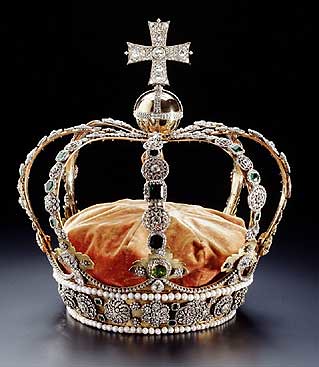
Zamorin of Calicut, P.K.S.Raja

Dr. E.K. Govinda Varma Raja wrote a biography of the Zamorin, titled The King Without A Crown, who as an officer of the Post and Telegraph Department, travelled widely, and had extended postings in the eastern parts of India, Pakistan and Bangladesh, when it was still the British Raj. After retirement as a Deputy General Manager with BSNL (Bharat Sanchar Nigam Limited, an Indian state-owned telecommunications company), he spent his years travelling the world till he ascended the throne in 2003.

As Zamorin he had few powers, but he was trustee to 40 temples from Chemanchery to Palakkad. He had a permanent seat on the Guruvayur Sree Krishna Temple’s managing committee. His family managed the Zamorin’s Guruvayurappan College, where the P.K.S Raja Centenary Research Centre, built at a cost of Rs. 1.5 crore (AU$ 265,000), was scheduled to be inaugurated this month.

Kerala's royal families have a very special succession law: The new rulers are always the sons of the deceased ruler's sister, never his own sons. This matrilinear line of succession is still in use to determine the Maharaja's of Travancore and Kochi. Were this succession law in place in Britain (and therefore in Australia) it would mean that Prince Charles' successor would be Princess Anne's son, Peter Philips.

Saturday, 23 March 2013

The Prince of Wales in the Sultanate of Oman


The British Government has asked Their Royal Highnesses Prince Charles, The Prince of Wales, and Camilla, The Duchess of Cornwall, to undertake a 9-day official visit to The Hashemite Kingdom of Jordan, The Emirate of Qatar, The Kingdom of Saudi Arabia and The Sultanate of Oman between 11th to 19th March 2013.

The Prince of Wales and The Duchess of Cornwall arrived in Oman on 17th March for the final leg of their overseas tour to the Middle East, having spent the morning in Jeddah.

His Majesty The Sultan of Oman Qaboos bin Said Al Saidat welcomed the royal couple at the Bayt al Baraka palace in Muscat.


The Prince of Wales and The Duchess of Cornwall witnessed a horse show and toured Nizwa Fort, which is located in the heart of Oman and dates back to the 12th Century. It is the country's most visited national monument.        


The Royal couple also paid a visit to the historic fort of Nizwa in the Governorate of  Dakhiliyah.
     
Prince Charles viewed the traditional irrigation system of the Sultanate, 'Aflaj', at the Niyabat of Birkat Al Mouz.

Wednesday, 20 March 2013

Greek King still on a mission for Greece


HM King Constantine II of the Hellenes has no official function in Greece anymore, however, he is still actively working for his home country.

This became obvious in a new documentary Our Queen that was broadcast last Sunday on ITV. The excellent two-hour documentary about the Queen in her Jubilee year received praise from the critics and can be watched on YouTube or in the embedded video below.


Twelve minutes ten seconds into the programme Prime Minister David Cameron appears for his weekly meeting with the Queen. The comment goes on like this:

Every Wednesday at 6 pm the sovereign receives her prime minister.

Prime Minister : There’s a lot going on this week. There’s the Euro zone crisis, the Greek elections, French elections ...

Queen Elizabeth: We were talking about the Euro zone problem. The King did ring me. He is very worried about it.
Greek republicans may not like it, but via the British Monarch the Greek King raised the issue with one of the important leaders in the EU.

On The Greek Royal Familiy's website is another indicator for the King's concern:

His Majesty King Constantine’s message on the occasion of the centennial anniversary of the Liberation of the city of Ioannina 4 March 2013

Asked by journalists about Greece's social and economic crisis, HM King Constantine, stressed, that the politicians and our society can lead our country to better days, only when they act in accord, in unity.

We cannot afford further friction amongst politicians nor our society to be divided.

Citizens and the State must be in concord.

"When the people suffer, we all suffer", HM King Constantine concluded.

Tuesday, 19 March 2013

100 years ago: Greek King George I assassinated


King George I (Γεώργιος Αʹ, Βασιλεύς των Ελλήνων, Geórgios Αʹ, Vasiléfs ton Ellínon; *24th December 1845) was elected King of the Hellenes by the Greek National Assembly on 30th March 1863.


Just as he did in Athens, the King went about Thessaloniki without any protection. While out on an afternoon walk near the White Tower on 18th March 1913, he was shot at close range in the back by Alexandros Schinas, who was said to belong to a Socialist organization and declared when arrested that he had killed the King because he refused to give him money. The King died instantly, the bullet having penetrated his heart.


The King's body was taken to Athens on the Amphitrite, escorted by a flotilla of naval vessels. The first King of the Schleswig-Holstein-Sonderburg-Glücksburg dynasty was buried at Tatoi, a royal resort at the foot of Mount Parnitha outside Athens, which King George had bought with his own private money.

The tombs of the Greek Royal Family, lying in a pine wood by a disused chapel, have been vandalised. They include the graves of the Duke of Edinburgh's parents. In 1994 a decree by the viciously anti-royal Socialist Government of the time stripped King Constantine II of Tatoi, its contents, and his Greek citizenship. In November 2002 the European Court of Human Rights at Strasbourg ruled that the confiscation of the Greek Royal Family's property in their homecountry was an illegal act.

Monday, 18 March 2013

30th Anniversary of King Umberto's passing away


After the Italians elected their 630 deputies and 315 senators for the 17th Parliament of the Italian Republic on 24th/25th February 2013, Euronews commented: 
"The results of the Italian general election are threefold, political gridlock, market jitters and a slap in the face for European austerity.
"The numbers mean that the country faces stalemate in the coming weeks as former foes try to put hostilities to bed in order to govern a country in difficulty."
In a couple of weeks the term of president Napolitano will come to an end and the deputies and senators have to find a replacement of the 87-year-old former Communist deputy.

It is rather ironic that at a time, when Italy does not have a functioning government and is looking for a head of state, Italian Monarchists commemorate the late King Umberto II who died 30 years ago on 18th March 1983 in Switzerland.

Proclamation of King Umberto II on 10th May 1946 under the thundering joy of tenths of thousands of Romans at a balcony of the Quirinale Palace.

After the rigged referendum of 2nd June 1946 the Monarch left Italy to avoid a civil war and bloodshed and went into a life-long exile in Portugal, never to be allowed back to Italy, not to die there and not to be buried in his own country. His body was put to rest in the monastery Hautecombe, France. The Radical Royalist commemorated King Umberto’s accession to the Italian throne on 9th May 1946 and called it La grande tragedia d'Italia - Umberto II.

But King Umberto is not forgotten in Italy, as this graffito shows.

The politicial and economic mess Italy is in at the moment is the right time to reflect how Italy could flourish under a Constitutional Monarchy with an impartial King above the parties, above the politicians and overlook an impartial judicial system.

Never did Italy need a King more urgently than now. Viva King Umberto! Viva Italia!

Sunday, 17 March 2013

Princess Lilian laid to rest in Sweden


Sweden bid fair well to Princess Lilian who died in her 98th year at her Stockholm home on Sunday, 10th March, surrounded by the royal family with a state funeral. In 2010, the Royal Court announced she was suffering from Alzheimer's and that she would not be participating in Crown Princess Victoria's wedding in June that year. Her late husband Prince Bertil, an uncle of King Carl XVI Gustaf, died in 1997.

She was born Lillian May Davies in Swansea, Wales, on 30th August 1915, the daughter of William Davies and his wife, Gladys Mary Curran. She originally spelt her name with two “l”s, but changed to Lilian when she adopted a career variously described as fashion model, ballerina and singer. In September 1940 she married the Scottish actor Ivan Craig (1912 - 1995), whose career never flourished beyond bit parts such as 2nd policeman in Murder at the Windmill in 1949 and Lord Blackheath in four episodes of Ivanhoe in 1958. He served in Africa during the WWII.

In the early 40s Lilian Davies worked at a factory in London making wirelesses for the Royal Navy, and at a hospital for wounded soldiers. In 1943, she met Prince Bertil of Sweden at the Les Ambassadeurs nightclub in London, some say at a cocktail party to mark her 28th birthday, others at a nightclub called Nuthouse; yet another version placed their meeting on the London Underground. She divorced Ivan Craig in 1945 on amicable terms, her husband having also met someone new while abroad.

During World War II Prince Bertil was stationed at the Royal Swedish embassy as a naval attaché. He was the third son of the then Crown Prince Gustaf Adolf, later King Gustaf VI Adolf (1882 – 1973) and a great-grandson of Queen Victoria through his late mother, Princess Margaret of Connaught (1882 – 1920).

On 26th January 1947, Prince Bertil's eldest brother and heir presumptive Prince Gustaf Adolf (*22nd April 1906), died in a plane crash in Denmark, leaving behind a nine-month old son who was second in line to the throne and would one day inherit the throne as King Carl Gustaf (*30th April 1946).

Prince Bertil's two other brothers had already renounced their succession rights. Their father ascended the throne as King Gustaf VI Adolf in 1950 and Prince Bertil became heir presumptive and no 2 in the line to the throne. As long as his nephew, Crown Prince Carl Gustaf, was a child, Prince Bertil would have to serve as Regent of the Kingdom until his nephew coming to age.

A big responsibility was put on Prince Bertil’s shoulders and for the future of the Monarchy he followed his father’s advice and did not marry Lilian Craig. Prince Bertil and Lilian Craig had moved to Sweden in 1957, living in Villa Solbacken on Djurgården in Stockholm. She stayed in the shadows, but the couple lived together openly, if discreetly at their homes in southern France and Stockholm. They remained together until Prince Bertil’s death in January 1997.

When Prince Bertil's father died in 1973, his nephew Carl XVI Gustaf ascended the throne. King Carl Gustaf allowed Bertil and Lilian to marry, which they did on 7th December 1976, 33 years after their first meeting.

She was 61, he was 64.

Prince Bertil once said that one of his biggest regrets was that the couple had to sacrifice having children in order to protect the throne.

Hugely popular in Sweden for his romance with Lilian and known as "the prince of cars" for his love of fast vehicles, Bertil died in 1997 aged 84.

"In this life choice of hers, there must have been a lot of pain," he said, referring to how long Lilian had to wait until she was able to marry Bertil.

Princess Lilian was laid to rest next to her husband in the Haga Park royal cemetery on the outskirts of Stockholm.