Showing posts with label Queen Anne-Marie. Show all posts

Sunday, 27 May 2018

Crown Prince Frederik of Denmark celebrates his 50th Birthday

His Royal Highness Crown Prince Frederik of Denmark was born on 26th May 1968. On bis 50th birthday his mother Her Majesty Queen Margrethe II gave the following speech at a gala banquet at Christiansborg Palace, Copenhagen:

It is a great pleasure for me to welcome you all here tonight to celebrate Crown Prince Frederik’s 50th birthday.
A warm welcome to all our guests from near and far who have come here to celebrate Crown Prince Frederik on his 50th birthday.
Frederik, I have looked forward to celebrating you on your 50th birthday where you are surrounded by family and friends from near and far, and where the official Denmark and the Danish Realm are represented, which is natural when Denmark’s Crown Prince is to be celebrated.
You are, as they say, in the middle of your life. You have achieved much and you have experienced much, and during these days you have experienced how all of Denmark supports you and takes pleasure in your work. You bring energy and enthusiasm to all that you do and it makes an impact wherever you go.
To be a crown prince is not at all easy for a very young and searching person. But you found your own way, and every time you started a new chapter of your life, you showed the strength within you.
You learnt to grit your teeth and you finished the race. Last Monday you made all of Denmark join in the run. Your Grandmother would have been so proud of you, and how I wish that Papa could have lived to experience your 50th birthday, for he was just as proud of you as I am. He too saw how you developed your talents year by year.
When you found Mary, a new period of life began. Now you were two, then three, then four – indeed, six! A whole family that everybody can take pleasure in, and a family that many are pleased to follow and see themselves reflected in. You and Mary have succeeded in creating a safe and warm family life while both of you together and individually assume tasks that take you to faraway places.
The two of you make Denmark bigger, and you are a credit to Denmark. You make me so happy!
Dear Frederik! Congratulations!
Please raise your glasses and join me in nine cheers for Crown Prince Frederik!

"On our wedding day, you invited me to come and to see what awaited us in love and I have loved every step and every view." - HRH Crown Princess Mary 

HM King Constantine II and HM Queen Anne Marie of the Hellenes were also at the 50th birthday banquet of their nephew, HRH Crown Prince Frederik of Denmark.

Wednesday, 13 December 2017

50 years ago: King Constantine fails to restore democracy in Greece


King Constantine II and Queen Anne-Marie arrived in Rome early in the morning of 14th December 1967
From the outset, the relationship between King Constantine and the colonels, who seized power in Greece with a coup d'état was an uneasy one. Constantine II was at the Tatoi Palace outside Athens when the coup occurred in the early hours of the 21st of April. The king was cut off from his advisers and was at an initial loss as to how to re-act. His Majesty made his way to the Defence Ministry where the assembled generals stood at attention and pledged allegiance to their king.

However Constantine II’s visit to the Defence Ministry demonstrated to His Majesty that operational power was with the colonels, not the generals. Constantine II had to accept that actual power lay with the coup leader Colonel George Papadopoulos and not the army chief of staff General Grigorios Spantidakis (who was ignorant of the April coup).

The King on returning to Tatoi from the Defence Ministry was faced with the agonizing choice of departing for exile or initially acquiescencing to the coup. Cut off from his political advisers Constantine II opted to stay in Greece. Following his mothers’ suggestion the Supreme Court Prosecutor Constantine Kollias was appointed the new prime minister whom the colonels grudgingly accepted.

The King decided to launch his counter-coup on 13th December 1967. Since Athens was militarily in the hands of the colonels, Constantine decided to fly to the small northern city of Kavala, where he hoped to be among troops loyal only to him. The vague plan that Constantine and his advisors had conceived was to form a unit that would invade and take control over Thessaloniki, where an alternative administration would be installed. The King hoped that international recognition and internal pressure between the two governments would force the junta to resign, leaving the field clear for him to return triumphant to Athens.

In the early morning hours of 13th December, the King boarded the royal plane, together with Queen Anna Maria, their two baby children Princess Alexia and Crown Prince Pavlos, his mother Queen Frederika, his sister, Princess Irene and Prime Minister Constantine Kollias. At first, things seemed to be going according to plan. Constantine was well received in Kavala, which was under the command of a general loyal to him. The Hellenic Air Force and Navy, both strongly royalist and not involved in the junta, immediately declared for him and mobilised. Another of Constantine's generals effectively cut all communication between Athens and northern Greece.

However, Constantine's plans were overly bureaucratic, naïvely supposing that orders from a commanding general would automatically be obeyed. Further, Constantine was obsessive about avoiding "bloodshed", even where the junta would most likely respond with violence. Instead of attempting to drum up the widest popular support, hoping for spontaneous pro-democracy risings in most towns, Constantine preferred to let his generals put together the necessary force for advancing on Thessaloniki in strict compliance with military bureaucracy. The King made no attempt to contact politicians, even local ones.

In the circumstances, middle-ranking pro-junta officers neutralised and arrested Constantine's royalist generals and took command of their units, and subsequently put together a force to advance on Kavala to arrest the King. Realising that the counter-coup had failed, Constantine fled Greece on board the royal plane, taking his family with him. They landed in Rome early in the morning of 14th December. The royal family took refuge in the Greek embassy, but Queen Anna Maria, who was pregnant again, lost her baby.

Sunday, 18 December 2016

Greek King and Queen cheered in Athens streets

Doing their Christmas shopping in Athens: King Constantine II of the Hellenes and his wife Queen Anna Maria in a shop.

The monarchist news agency Royal Central published this report from Greece on 14th December:

"Now, King Constantine have appeared publicly on the streets of Athens with his wife. The two were seen when they were out, looking to buy Christmas gifts for their family. According to witnesses, they visited one of Athens finest jewellery stores and some other shops. The news that the Greek King was out in the streets spread quickly both in the media and among Athens residents. Not long after the King was first observed a small herd of Greeks had gathered outside the store the King was in and cheered when the King came out.

"The King seemed in good health, he took the time to be photographed with some of those who waited for him and he spoke to some of them. He was still pretty shaky and had difficulty keeping his balance. He leaned on a walking stick with his right hand and his wife held him steady with his other arm."

Sunday, 9 March 2014

Honouring King Pavlos I of the Hellenes

In the centre: H.M. King Constantine II of the Hellenes and his wife, H.M. Queen Anna-Maria of the Hellenes. On the extreme right, H.R.H. Princess Irene of Greece and Denmark and next to her, H.M. Queen Sofía of Spain.

Their Royal Highnesses Crown Prince Alexander and Crown Princess Katherine attended the two day commemoration for the 50 years of the passing of His Majesty King Paul I of the Hellenes and published the following short report on the website of The Royal Family of Serbia.
A documentary “Pavlos No Ordinary King” about the life of His Majesty King Paul of the Hellenes was shown last night at the Gennadius Library, Kolonaki in Athens. HM Queen Sophia of Spain hosted a dinner for relatives after the documentary.

This morning a memorial service took place at the graveside located at Tatoi for His Majesty King Paul.

The Greek Royal Family was represented by Their Majesties King Constantine and Queen Anne Marie, Their Royal Highnesses The Crown Prince and Crown Princess Marie Chantal and their children and Her Royal Highness Princess Irene. Also present were Her Majesty Queen Sophia of Spain, Their Royal Highnesses the Prince and Princess of Asturias, Infanta Elena and Infanta Cristina, as well as His Majesty King Simeon of the Bulgarians.

King Paul was born in Athens 14 December 1901 and was the third son of King Constantine I of Greece and his wife, Princess Sophia of Prussia. King Paul married Princess Frederica of Hanover. King Paul’s brother was His Majesty King Alexander of the Hellenes grandfather of Crown Prince Alexander of Serbia. King Paul died in Athens 6 March 1964.

His Majesty King Alexander of the Hellenes and Her Royal Highness Princess Aspasia (grandparents of Crown Prince Alexander) are buried in the Royal Cemetery at Tatoi. Her Majesty Queen Alexandra of Yugoslavia was buried in the cemetery and was transferred last year to the Royal Family Crypt in the Mausoleum at Oplenac, Serbia.
HRH Crown Prince Alexander II lays wreath on the tomb of HM King Paul of the Hellenes, commemorating the 50 years of his passing, Tatoi cemetery, Athens, March 6, 2014.

Monday, 10 June 2013

Swedish Wedding


On Saturday 8th June, Princess Madeleine of Sweden and Mr Christopher O'Neill were married in the Royal Chapel at the Royal Palace of Stockholm.

The Princess Couple with the bridal attendants.

The wedding began at 16.00, and the service was conducted by Chaplain to The King and Bishop Emeritus Lars-Göran Lönnermark. Princess Madeleine's wedding dress was created by the Italian designer Valentino Garavani. The Princess's tiara is privately owned, and was decorated with sprigs of orange blossom.

Representing the British royal family: Prince Edward, the Earl of Wessex and Sophie, the Countess of Wessex, leaving the Royal Chapel.

Crown Prince Frederik and Crown Princess Mary of Denmark.

The Greek Royal Family was represented by four children of Their Majesties King Constantine II and Queen Anne-Marie of the Hellenes.

Crown Prince Pavlos of Greece and his wife Marie-Chantal.

Prince Nikolaos of Greece and his wife Tatiana.

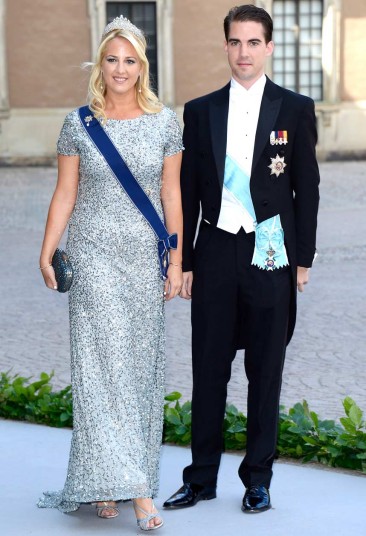
Princess Theodora and her brother Prince Philippos of Greece.


Saturday, 18 February 2012

Good news from Greece

There was a time, not so long ago, when news from Greece were joyful:


Arrival of HRHPrincess Anne-Marie of Denmark in her new homecountry.


Their Majesties' wedding on 18th September 1964 was the first televised royal wedding in Greece. This wedding was watched by millions of people around the world and was international headline news. All of Athens seemed to celebrate the wedding. Prime Minister Georgios Papandreou attended the wedding in good spirits. King Constantine II publicly heralded the prime minister as a replacement father figure in the wake of his father’s death. King Pavlos I had died on 6th March 1964.

The US magazine Time knew this about the Royal Wedding:
"Weddings are, so to speak, expensive propositions. In Athens, Finance Minister Constantine Mitsotakis announced that the marriage of Greece's King Constantine, 24, to Denmark's Princess Anne-Marie, 18, cost the treasury $303,000, including $183,300 spent on wedding gifts.

However, an issue of 2,000,000 commemorative 30-drachma pieces will net a profit of $1,063,000, leaving the wily Greeks with $760,000 to play around with, or possibly use as a dowry for
Crown Princess Irene."

A very apt comment by a French Royalist
Ces vues nous rappellent que la dynastie et le peuple grec faisaient qu'un à l'époque et que la Grèce pouvait montrer au monde sa puissance et sa prospérité. Quel dommage que le jeune couple royal n'est pas pu gouverner plus longtemps leur royaume. Peut-être aujourd'hui il n'y aurait pas la crise et le chaos qui se passe actuellement en Grèce. Si les Grecs voient ces photos, ils doivent se rappeler du bon vieux temps. Espérons que dans quelques années, le roi Constantin ou un de ses descendants pourra remonter sur le trône grec.

And of course this is still true: The Hellenic Republic is losing its sovereignty

Wednesday, 2 June 2010

Happy Birthday, Your Majesty!

This is how Italian Monarchists congratulated the King of the Hellenes.


Tuesday, 8 December 2009

35th Anniversary of another Greek Referendum
It seems, nothing has changed in Greece. DW published this news item on 7th December 2009:

Greece has seen another day of violent clashes that erupted over last year's police shooting of the 15-year-old teenager Alexis Grigoropoulos.

Greek riot police clashed with hundreds of stone-throwing youths in Athens on Monday as protesters took to the streets for a second day.


Security forces made 21 arrests after scores of stone-throwing youths separated from the throng of 5,000 demonstrators marching towards parliament.

Two youths were arrested earlier on Monday for throwing stones at a police station in Athens. Two other police stations in the suburbs of Agia Paraskevi and Kallithea were also attacked, police said.

In the northern city of Thessaloniki police fired teargas at dozens of violent youths, who broke away from a march of 2,500 people.

"The clashes are not significant overall, the protests went as expected," said a police official who declined to be named.


Today’s news from Greece is as disturbing as it was 35 years ago, when just another Greek referendum on the country’s Monarchy took place. Barely 18 months after the military dictators had forced the Greek people to sanction their decision to proclaim a republic, the Greeks were asked to go to the polls again.

The weekly magazine “To the Point International” covered the referendum:
In spite of the low turn-out, the monarchy referendum brought all the Greek passions back into the political arena. The campaign was more lively than the general election. A few days before the vote, six policemen were slightly hurt, when a group of Maoists attacked a royalist headquarters …”
On 9th December 1974 German TV correspondent Günter Eder gave this report from Athens:
When the first result came in and were displayed in the press centre the international and Greek journalists were hit by a shock: A village on the Peloponnese had voted with a two thirds majority for the King. But all following results demonstrated quickly that there would be a hefty defeat for the King.

In the end 1,443,804 Greeks backed the Monarchy, while 3,236,345 rejected the idea of a “Crowned Democracy” as the King had called his concept of a renewed Greek Monarchy. 1,328,665 Greeks did not cast their vote in the polls.

Naturally Monarchists were disappointed by the result. In a declaration King Constantine said: “I have lost. I wish that the result of the referendum may be good for our country.” Even while in exile he served his country. For example, he was to play a leading and perhaps crucial role on the International Olympic Committee in the award of the 2004 Olympics to Athens.

He had been in exile since December 1967 and unlike other Greeks who had been forced by the dictatorship to live abroad, the Greek Royal Family was not allowed to return, when the regime collapsed. The referendum campaign took place without the main person, although it is unlikely that the King would have been like a political campaigner attending meetings and shouted slogans.
Instead, on 26th November 1974 he sent his people a message expressing his admiration for their fight and their sacrifices during the time of the dictatorship. “As you all know, I was forced to leave the country after my effort to liberate Greece from the dictatorship.”

In the British television programme, "Constantine: A King's Story", a Greek Orthodox priest explained that Constantine will always be King. Unlike many modern Monarchs, but as with Queen Elizabeth II, the King was anointed at his coronation, as were the Kings of the Old Testament. Although he accepts the referendum, The King has not abdicated.
The acclaimed six part TV series “A Royal Family” finished with this remarkable sentence: “Some countries have lost their Monarchy, yet, they still have a Royal Family.” That is certainly true for Greece.Queen Anne-Marie in a costume that was designed by the first Queen of modern Greece, Queen Amalia.

Friday, 18 September 2009

Royal Wedding in Athens

"This week the happiness of two young royal children attracted more the attention of many Greeks than the unsolved conflict of Cyprus. Accompanied by the enthusiastic joy of his compatriots young King Constantine II led his 18 year old bride, Princess Anne-Marie of Denmark, to their wedding in Athens." This is how the German weekly DIE ZEIT began its report on the colourful celebrations in the Greek capital on 18th September 1964, to this day 45 years ago.


More still photos on this joyous day can be see on the website Greek Wedding.

The US magazine Time knew this about the Royal Wedding:
"Weddings are, so to speak, expensive propositions. In Athens, Finance Minister Constantine Mitsotakis announced that the marriage of Greece's King Constantine, 24, to Denmark's Princess Anne-Marie, 18, cost the treasury $303,000, including $183,300 spent on wedding gifts. However, an issue of 2,000,000 commemorative 30-drachma pieces will net a profit of $1,063,000, leaving the wily Greeks with $760,000 to play around with, or possibly use as a dowry for Crown Princess Irene."

Tuesday, 12 August 2008


Chinese Communist TV gave Greek King and Queen the preference

The politicians in Greece who try to wipe out and re-write the country’s history of the past 100 years must have received a shock, when they watched the opening ceremony of the Olympic circus last week. The Chinese television showed the entry of the world teams, with the Greek athletes traditionally the first to enter the stadium. The Greeks received a roaring applause from the audience – and from King Constantine and Queen Anne-Marie of the Hellenes, who were present in the stadium, cheering towards the Greek athletes. King Constantine II who won a gold medal for Greece in 1960, was visibly very proud to see his countrymen entering the arena.

The Greek royal couple were treated in the same way the Chinese showed pictures of head of states, royalty or prime ministers for other participating countries. Not a single moment was spared for any Greek politician – should they have been in the stadium. Who would recognize them anyway? Can you name the person who today calls himself president of Greece?

Strangely enough the tightly controlled Chinese television gave King Constantine and Queen Anne-Marie the honours some European countries deny them.

Did you miss the stadium scene? Send me an e-mail and I can help you out.

Tuesday, 29 July 2008

1973: Greek Referendum on the Country's Monarchy
Hardly any country has had so many referenda on their form of state than Greece. Some resulted in favouring the Monarchy, some gave the politicians’ republic the preference. On this day 35 years ago, the then ruling military junta ordered the country to accept the colonels' republic. What's hardly a surprise in a dictatorship, they got what they had asked for: A republic.

According to the official results, in the referendum of 29th July 1973 3,870,124 (78.4%) agreed with the military rulers to abolish the Monarchy, 1,064,300 (21.6%) courageously expressed their disapproval with the republic and remained loyal to King Constantine II, who has been living in exile since 1967. Greece had a population of 10 million, the junta registered less than 6 million voters. According to the official figures 4,934,424 took part in the referendum. Considering these figures the achieved majority is put in a different spot light.

King Constantine II and Queen Anne-Marie on 14th December 1967 on their way into exile after the King's attempted coup to restore democracy in Greece had failed.


The Mutiny of the Velos
1973 was a crucial year in Greek history. In May 1973 a wide-ranging anti-junta movement among the ranks of the mostly Royalist Navy was discovered and suppressed, just before its outbreak. On 25 May 1973, the destroyer Velos, under the command of Nikolaos Pappas, while participating in a NATO exercise and in order to protest against the dictatorship in Greece, anchored at Fiumicino, Italy, refusing to return to Greece. The captain and the officers had learned by radio that royalist naval officers had been arrested and tortured in Greece. Commander Pappas was a member of a group of democratic officers, loyal to their oath to the King and planning to act against the junta. Pappas knew the arrested officers and realised there was no further hope for a coup at that point.
Headline in a German newspaper on 29th May 1973: "Mutiny for the King was a strike against the King."

Nikolaos Pappas and 31 officers and crew disembarked and asked for political asylum, creating a world-wide interest for the situation in Greece. The failed Navy revolt demonstrated that even after six years of junta "normality", the opposition had not died off, and that it existed even amongst large parts of the armed forces, which were the regime's main internal supporter.

The US magazine Time wrote in its edition of 11th June 1973: "In the wake of the coup, there were reports that the regime had rounded up hundreds of civilians and military men who were suspected of being royalist partisans. Last week, Papadopoulos sacked his chief of the navy after sitting down to dinner with him the night before. The air force was also grounded for fear that dissident pilots would fly their planes to Italy, in a show of support for the coup.

"'He
[the King] cooperated with all kinds of reactionaries, turned against the armed forces and behaved like a party leader of adventurists, fellow travelers, saboteurs and even murderers.' With those sharp words, Premier George Papadopoulos, in a ten-minute, nationwide broadcast, last week abolished the monarchy and appointed himself head of the new Greek Republic. He accused Constantine of supporting an abortive coup planned by royalist naval officers, which gave Papadopoulos an ideal excuse to extend the junta's heavyhanded rule and depose the King. Under the constitution that Papadopoulos promulgated in 1968, which provides that the King is titular head of state, last week's announcement that Greece had become a republic was patently illegal. But it did not come as much of a surprise. Originally, the colonels had used the throne as a way of giving their rule some illusion of legitimacy. King Constantine's refusal to return to Greece from exile in Rome until democracy was restored had long since made a mockery of that claim."
In June 1973 King Constantine declared in a press conference, that he would not accept Papadopoulos' act and would fight instead for the restoration of democracy in his home country.

A Decreed republic
The Navy’s royalist sympathies gave Georgios Papadopoulos the pretext he was looking for to assume total power in Greece. The Daily Telegraph wrote (1st June 1973): “Last week's abortive mutiny has apparently convinced Mr. Papadopoulos that the time was ripe to put paid to future plots in which the King is used as a rallying cry.”

On 1st June, Papadopoulos issued a decree declaring Greece a presidential republic, with himself as president. The act was widley criticised as illegal. To give his new putsch the air of legality, Papadopoulos ordered a referendum to be held on 29 July 1973. The defunct political parties and their leaders urged for a "No" as a sign of opposition to the regime, but the vote was tightly controlled by the junta, and the results were predictably favourable to the regime. (See results above).

Once again Time magazine: "Last month [it was actually April 1973], exiled former Premier Constantine Caramanlis, 66, issued a bitter broadside from Paris against the regime, calling for its resignation and the return of the King to oversee the restoration of democracy. … Many Greeks have mixed feelings about King Constantine, but the monarchy has traditionally been viewed as a symbolic support of democracy."

The referendum did not quieten the opposition, among which the royalists formed a large part: “The press [in Greece] has published anti-regime appeals, but has not been allowed to do so when these have come from influential sources. … The same applies to the appeals of the deposed King Constantine and retired military officers. One retired officer was recently jailed for sending a letter to a provincial paper in which he suggested that the monarchy should be restored.” (Weekly "To the Point", 8th September 1973).

Papadopoulos couldn’t enjoy his presidency for very a long time. In November 1973, the Athens Polytechnic uprising broke out. The student uprising is generally believed to have been spontaneous, started with purely student demands at first, and not orchestrated by any political groups in Greece. On 24th November 1973 he was toppled by Brigadier General Dimitrios Ioannides and arrested. Lieutnant General Phaedon Gizikis was declared president.

The Legacy of the 1973 Referendum

Observers from the very diversified Greek political spectrum may argue on many issues, but they agree on one point: The results of the 29th July 1973 referendum “were achieved by fraud and intimidation”(Panayotis Kanellopoulos, last royal Prime Minister in 1967), however, the legacy of dictator Georgios Papadopulos’ is still effecting Greek politics.

King Constantine II ascended to the Greek throne after the death of his father, King Pavlos I, on 6th March 1964.

"A king is a king unless he says he is no longer a king. Titles don't disappear but power and privelege can be taken away from them. Found in Wikipedia, posted by Charles, 4 October 2006