Showing posts with label King of Greece. Show all posts

Sunday, 18 December 2016

Greek King and Queen cheered in Athens streets

Doing their Christmas shopping in Athens: King Constantine II of the Hellenes and his wife Queen Anna Maria in a shop.

The monarchist news agency Royal Central published this report from Greece on 14th December:

"Now, King Constantine have appeared publicly on the streets of Athens with his wife. The two were seen when they were out, looking to buy Christmas gifts for their family. According to witnesses, they visited one of Athens finest jewellery stores and some other shops. The news that the Greek King was out in the streets spread quickly both in the media and among Athens residents. Not long after the King was first observed a small herd of Greeks had gathered outside the store the King was in and cheered when the King came out.

"The King seemed in good health, he took the time to be photographed with some of those who waited for him and he spoke to some of them. He was still pretty shaky and had difficulty keeping his balance. He leaned on a walking stick with his right hand and his wife held him steady with his other arm."

Sunday, 9 March 2014

Honouring King Pavlos I of the Hellenes

In the centre: H.M. King Constantine II of the Hellenes and his wife, H.M. Queen Anna-Maria of the Hellenes. On the extreme right, H.R.H. Princess Irene of Greece and Denmark and next to her, H.M. Queen Sofía of Spain.

Their Royal Highnesses Crown Prince Alexander and Crown Princess Katherine attended the two day commemoration for the 50 years of the passing of His Majesty King Paul I of the Hellenes and published the following short report on the website of The Royal Family of Serbia.
A documentary “Pavlos No Ordinary King” about the life of His Majesty King Paul of the Hellenes was shown last night at the Gennadius Library, Kolonaki in Athens. HM Queen Sophia of Spain hosted a dinner for relatives after the documentary.

This morning a memorial service took place at the graveside located at Tatoi for His Majesty King Paul.

The Greek Royal Family was represented by Their Majesties King Constantine and Queen Anne Marie, Their Royal Highnesses The Crown Prince and Crown Princess Marie Chantal and their children and Her Royal Highness Princess Irene. Also present were Her Majesty Queen Sophia of Spain, Their Royal Highnesses the Prince and Princess of Asturias, Infanta Elena and Infanta Cristina, as well as His Majesty King Simeon of the Bulgarians.

King Paul was born in Athens 14 December 1901 and was the third son of King Constantine I of Greece and his wife, Princess Sophia of Prussia. King Paul married Princess Frederica of Hanover. King Paul’s brother was His Majesty King Alexander of the Hellenes grandfather of Crown Prince Alexander of Serbia. King Paul died in Athens 6 March 1964.

His Majesty King Alexander of the Hellenes and Her Royal Highness Princess Aspasia (grandparents of Crown Prince Alexander) are buried in the Royal Cemetery at Tatoi. Her Majesty Queen Alexandra of Yugoslavia was buried in the cemetery and was transferred last year to the Royal Family Crypt in the Mausoleum at Oplenac, Serbia.
HRH Crown Prince Alexander II lays wreath on the tomb of HM King Paul of the Hellenes, commemorating the 50 years of his passing, Tatoi cemetery, Athens, March 6, 2014.

Sunday, 25 August 2013

"King Constantine was the first to move against the colonels, but was shown the door"


Good old Taki Theodoracopulos sums the Greek problem up in a few words What History Does to Heroes:
"We Greeks are down and out right now, but there are still a few seconds left before the referee counts to ten. When in trouble, think and dream about the past. Back then we were number one in everything. There were no gruesome, soulless, untalented hustlers like Jay-Z, no punk rockers, no TV vulgarians like Jonathan Ross. Sure, we were a bit tough on people who were born on the wrong side of the tracks, but no one’s perfect, as Socrates should have told us. My great hero was a real person, not a mythological one—Kimon, son of Miltiades, victor of the battle of Marathon. Kimon had his cake and also ate it. He was a real stud who serviced everyone and was madly loved by his wife. He, too, ended up in exile like his old man.
Official photo of H.M. King Constantine II of the Hellenes.
"Greeks have a tendency to do that sort of thing—get rid of what’s good and keep what’s rotten and corrupt. Themistocles won the battle of Salamis and was shown the door.
"Since 1974 the same two parties have shared power and have stolen the country blind. The king, who was the first to move against the colonels, was also shown the door and his property stolen from him by the state. Go figure, as Homer never said."

Monday, 10 June 2013

Swedish Wedding


On Saturday 8th June, Princess Madeleine of Sweden and Mr Christopher O'Neill were married in the Royal Chapel at the Royal Palace of Stockholm.

The Princess Couple with the bridal attendants.

The wedding began at 16.00, and the service was conducted by Chaplain to The King and Bishop Emeritus Lars-Göran Lönnermark. Princess Madeleine's wedding dress was created by the Italian designer Valentino Garavani. The Princess's tiara is privately owned, and was decorated with sprigs of orange blossom.

Representing the British royal family: Prince Edward, the Earl of Wessex and Sophie, the Countess of Wessex, leaving the Royal Chapel.

Crown Prince Frederik and Crown Princess Mary of Denmark.

The Greek Royal Family was represented by four children of Their Majesties King Constantine II and Queen Anne-Marie of the Hellenes.

Crown Prince Pavlos of Greece and his wife Marie-Chantal.

Prince Nikolaos of Greece and his wife Tatiana.

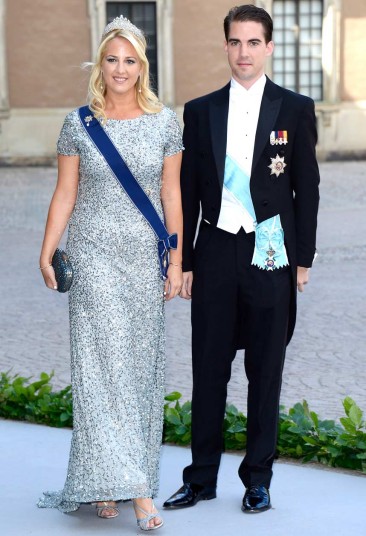
Princess Theodora and her brother Prince Philippos of Greece.


Wednesday, 20 March 2013

Greek King still on a mission for Greece


HM King Constantine II of the Hellenes has no official function in Greece anymore, however, he is still actively working for his home country.

This became obvious in a new documentary Our Queen that was broadcast last Sunday on ITV. The excellent two-hour documentary about the Queen in her Jubilee year received praise from the critics and can be watched on YouTube or in the embedded video below.


Twelve minutes ten seconds into the programme Prime Minister David Cameron appears for his weekly meeting with the Queen. The comment goes on like this:

Every Wednesday at 6 pm the sovereign receives her prime minister.

Prime Minister : There’s a lot going on this week. There’s the Euro zone crisis, the Greek elections, French elections ...

Queen Elizabeth: We were talking about the Euro zone problem. The King did ring me. He is very worried about it.
Greek republicans may not like it, but via the British Monarch the Greek King raised the issue with one of the important leaders in the EU.

On The Greek Royal Familiy's website is another indicator for the King's concern:

His Majesty King Constantine’s message on the occasion of the centennial anniversary of the Liberation of the city of Ioannina 4 March 2013

Asked by journalists about Greece's social and economic crisis, HM King Constantine, stressed, that the politicians and our society can lead our country to better days, only when they act in accord, in unity.

We cannot afford further friction amongst politicians nor our society to be divided.

Citizens and the State must be in concord.

"When the people suffer, we all suffer", HM King Constantine concluded.

Tuesday, 19 March 2013

100 years ago: Greek King George I assassinated


King George I (Γεώργιος Αʹ, Βασιλεύς των Ελλήνων, Geórgios Αʹ, Vasiléfs ton Ellínon; *24th December 1845) was elected King of the Hellenes by the Greek National Assembly on 30th March 1863.


Just as he did in Athens, the King went about Thessaloniki without any protection. While out on an afternoon walk near the White Tower on 18th March 1913, he was shot at close range in the back by Alexandros Schinas, who was said to belong to a Socialist organization and declared when arrested that he had killed the King because he refused to give him money. The King died instantly, the bullet having penetrated his heart.


The King's body was taken to Athens on the Amphitrite, escorted by a flotilla of naval vessels. The first King of the Schleswig-Holstein-Sonderburg-Glücksburg dynasty was buried at Tatoi, a royal resort at the foot of Mount Parnitha outside Athens, which King George had bought with his own private money.

The tombs of the Greek Royal Family, lying in a pine wood by a disused chapel, have been vandalised. They include the graves of the Duke of Edinburgh's parents. In 1994 a decree by the viciously anti-royal Socialist Government of the time stripped King Constantine II of Tatoi, its contents, and his Greek citizenship. In November 2002 the European Court of Human Rights at Strasbourg ruled that the confiscation of the Greek Royal Family's property in their homecountry was an illegal act.

Saturday, 30 June 2012

The Belgian-Greek Royal Connection


In his latest posting The Exiled Belgian Royalist published a most interesting article on the Belgian-Greek Connection in the 1830s:
"The Greeks had claimed independence to break away from the Ottoman Empire of Turkey in 1830 and were in need of a monarch. A prince from a powerful royal family or with, at least, family ties to powerful countries, was preferred to help secure Greek independence as a policy of insurance against efforts by the Turks to retake Greece. Prince Leopold of Saxe-Coburg-Gotha was considered and was asked to come reign over the new Kingdom of Greece. The cause of the Greeks had been a popular one in Europe, seen by many as a great romantic adventure and there was much sympathy for the Greeks against the Turks. Prince Leopold was not unaffected by this and he considered seriously accepting the offer to become the first King of Greece or King of the Greeks.

"After reviewing the Greek situation, he did not have much confidence in their chances of success. The population seemed too divided, the situation was too unstable and there were not the resources to ensure to a reasonable degree the long-term success. Finally he decided to decline the offer ..."

Instead of Prince Leopold of Saxe-Coburg and Gotha, in August 1832 the Greek National Assembly elected 17 year old Prince Otto, the second son of King Ludwig I of Bavaria as King of Greece. He arrived in his new Kingdom on 6th February 1833.